How many calories are in a tangerine: weight of one fruit, peeled and unpeeled
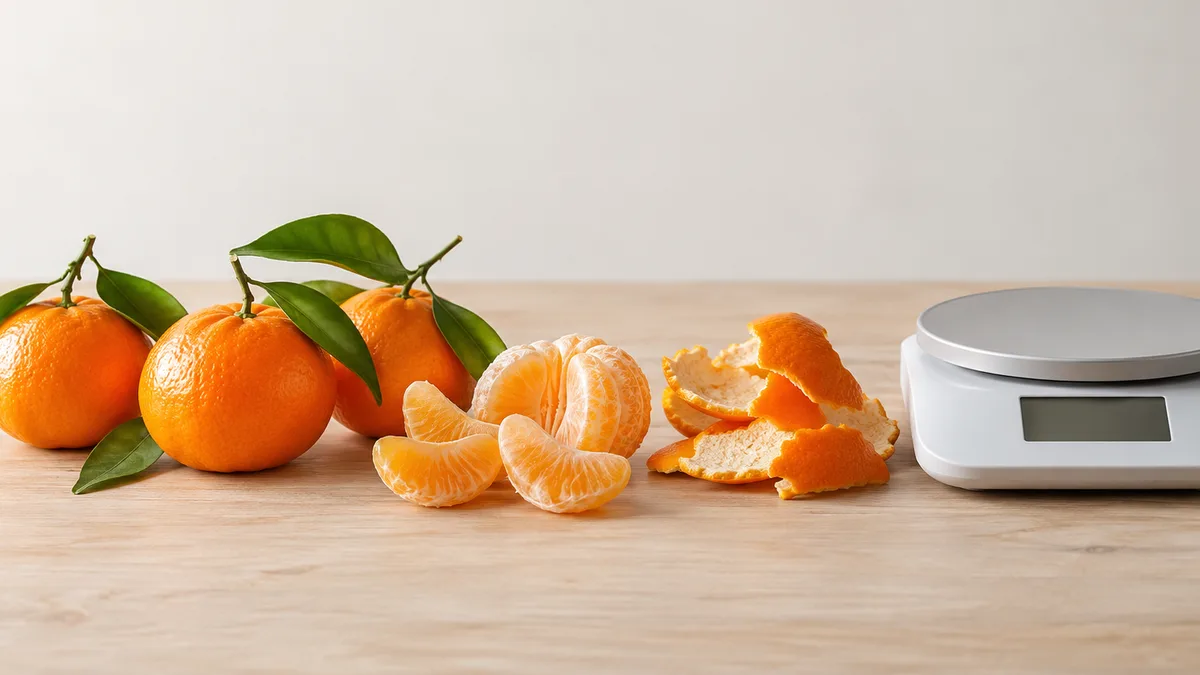
A medium peeled tangerine weighs 88 g and has about 47 kcal, a small one 76 g and 40 kcal, a large one 120 g and 64 kcal. These are USDA figures for the peeled fruit: the peel is not eaten, so it is not counted. Below are a table by size, clementines, and a way to count tangerines eaten by the handful.
Tangerine calories by size
The values come from USDA FoodData Central, SR Legacy: raw tangerine (mandarin orange) FDC 169105, raw clementine 168195. Per 100 g of tangerine flesh there are 53 kcal, 0.8 g protein, 0.3 g fat and 13.3 g carbohydrate, of which 10.6 g is sugars, plus 1.8 g fibre. The fruit weights in the table are also from USDA and also peeled.
| Fruit | Peeled weight | kcal | Sugars, g | Vitamin C, mg |
|---|---|---|---|---|
| Tangerine, small | 76 g | 40 | 8.0 | 20 |
| Tangerine, medium | 88 g | 47 | 9.3 | 23 |
| Tangerine, large | 120 g | 64 | 12.7 | 32 |
| Clementine | 74 g | 35 | 6.8 | 36 |
| Cup of segments | 195 g | 103 | 20.6 | 52 |
USDA sizes are defined by diameter: small about 5.7 cm (2¼ in), medium 6.4 cm (2½ in), large 7 cm (2¾ in). Fruit in the shop can be smaller, and then it is more accurate to weigh your own. The formula is the same: flesh weight × 53 ÷ 100. A 65 g peeled tangerine: 65 × 53 ÷ 100 = 34 kcal.
Peeled or unpeeled: what to weigh
Calories in food tables and on labels refer to the edible part. If you put a whole tangerine on the scale, the peel is included and you get more calories than you ate. The simplest option is to weigh the tangerine after peeling. If it is easier to weigh it whole, weigh the peel afterwards and subtract it.
The share of peel depends on the variety and the thickness of the rind, so one extra weighing works better than a general coefficient. How this recalculation works for other foods with an inedible part — stones, peel, bones — is covered in the article on counting the edible portion.
Clementine or tangerine: does it matter for counting
USDA lists the clementine separately: 47 kcal per 100 g against 53 for the tangerine, and an average fruit of 74 g. In practice the difference between them is smaller than between two tangerines of different sizes: 35 kcal for a clementine and 40–64 for tangerines. If the label does not say clementines, count them as tangerines.
A handful of tangerines: how to count it
Tangerines are rarely eaten one at a time. Three medium fruit are 264 g of flesh, 140 kcal and 28 g of sugars. Five are 440 g, 233 kcal and 47 g of sugars.
The most reliable way is to log weight, not pieces. Weigh the bowl of tangerines before and after, and the difference shows how much was eaten with the peel. Then weigh the peels and subtract. Without scales, log the number and size: "three medium". An error of a few dozen calories on fruit is smaller than the error of not logging the tangerines at all.
The sugar in a whole tangerine counts as the fruit's natural sugar. WHO does not include it in the free sugars it advises limiting — details in the article on free sugars. How fruit affects blood sugar is covered separately.
Vitamin C in a tangerine
100 g of tangerine flesh has 26.7 mg of vitamin C, a medium fruit about 23 mg. The clementine has more per 100 g — 48.8 mg — so one clementine gives about 36 mg. An orange in the same database is richer: 53.2 mg per 100 g.
Whether vitamin C helps with a cold is covered in the article on what to eat with a cold.
If your palms turn yellow
After weeks of eating a lot of tangerines, some people notice their palms, soles and the skin by the nose turning yellow. This is carotenaemia: tangerines are rich in beta-cryptoxanthin, one of the carotenoids, and it is deposited in the skin. The StatPearls review of carotenemia (NCBI Bookshelf) describes the condition as benign. The colour fades once there are fewer carotenoids in the diet, though it can last several months.
The whites of the eyes help tell carotenaemia from jaundice: with carotenaemia they stay white. If the whites of your eyes turn yellow, your urine darkens or you have other symptoms, see a doctor — tangerines are not the cause.
How to log tangerines
Log the weight of the flesh or the number of fruit with their size. If you photograph peeled tangerines on a plate, their number and size are visible in the picture.
Frequently asked questions
- How many calories are in one tangerine?
- A medium tangerine weighs 88 g peeled and has about 47 kcal. A small one, 76 g, has about 40 kcal, and a large one, 120 g, about 64 kcal. Figures from USDA FoodData Central.
- How much does a peeled tangerine weigh?
- According to USDA a small tangerine weighs 76 g, a medium one 88 g and a large one 120 g — this is the weight of the flesh without peel. Shop fruit can be smaller, so weighing your own is more accurate.
- Should tangerine calories be counted with or without the peel?
- Without. Calories are given for the edible part. Weigh the peeled tangerine, or weigh it whole and subtract the weight of the peel.
- How much sugar is in a tangerine?
- 100 g of flesh has 10.6 g of sugars, a medium tangerine about 9 g. These are natural sugars of whole fruit, which WHO does not count as free sugars.
- Why do tangerines turn your palms yellow?
- This is carotenaemia: carotenoids from tangerines are deposited in the skin. It is benign and fades once there are fewer carotenoids in the diet. If the whites of your eyes turn yellow, see a doctor.
Read next
- Calories in one apple, banana or orange: weight with and without the peel — A medium banana without the peel (118 g) has about 105 calories, a medium apple (182 g) about 95, and an orange without the peel (131 g) about 62.
- Bone-in chicken, watermelon with rind, nuts in the shell: log only what you ate — Log the weight of what you ate, not what was on the plate.
- Fruit and blood sugar: how an apple differs from juice — Fruit is the only food that is simultaneously called a source of sugar and recommended for daily consumption.
This article is for general information. It is not medical advice, a diagnosis, or a prescription for treatment or a diet, and it does not replace a consultation with your doctor. If you have a health condition, are pregnant, take medication, or follow a diet prescribed to you, decisions about food belong with your doctor.
Figures from regulations, guidelines and studies are given as they stood when this article was prepared and may since have changed; check them against the primary sources. This article is not advertising, an offer, or individual advice, and neither the author nor the site owner is responsible for decisions taken on the basis of it.