Calories in one apple, banana or orange: weight with and without the peel
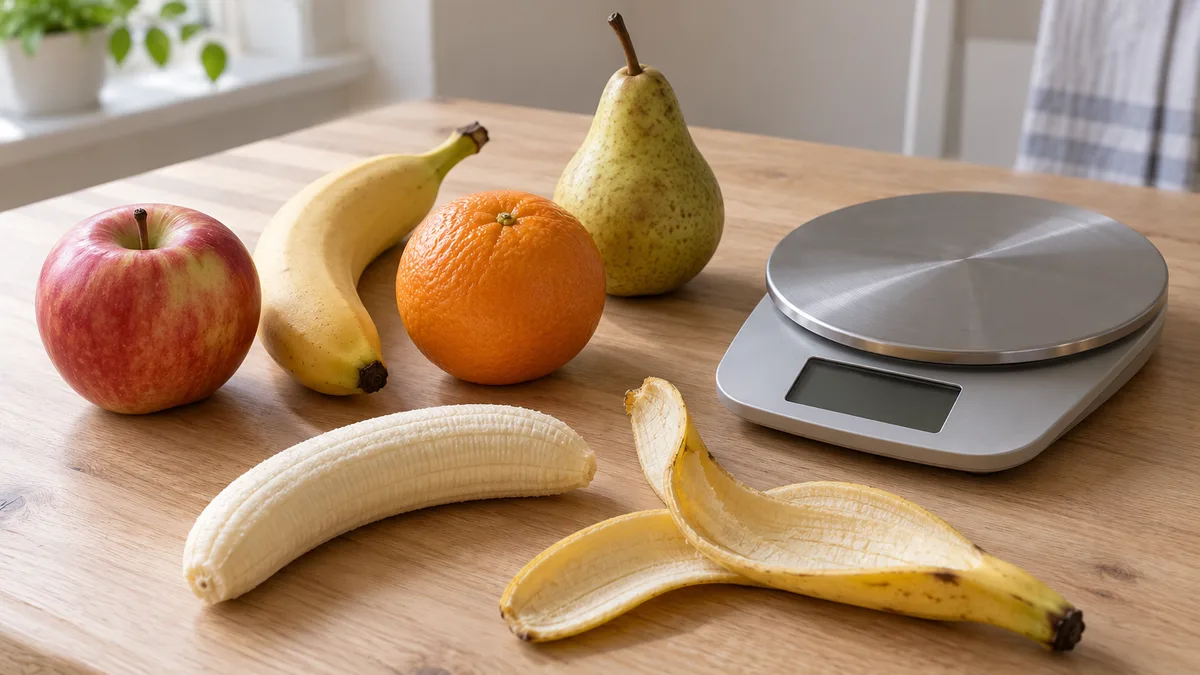
A medium banana without the peel (118 g) has about 105 calories, a medium apple (182 g) about 95, and an orange without the peel (131 g) about 62. These USDA figures describe the edible part: a fruit with its peel weighs noticeably more but contains the same calories.
Calories in one fruit, per the USDA reference
The table lists a medium fruit from USDA FoodData Central (SR Legacy database, checked on 5 October 2026). Calories per fruit are the value per 100 g multiplied by the edible weight.
| Fruit | Edible part of a medium fruit, g | Calories per 100 g | Calories per fruit |
|---|---|---|---|
| Apple with skin | 182 | 52 | 95 |
| Banana | 118 | 89 | 105 |
| Orange | 131 | 47 | 62 |
| Pear | 178 | 57 | 101 |
| Kiwi | 69 | 61 | 42 |
| Avocado | 201 | 160 | 322 |
USDA does not say which avocado variety the entry covers. “Medium” here is an American size: an apple 3 inches across, a banana 7 to 7⅞ inches long, an orange 2⅝ inches across. Your fruit may differ, and the section after next shows by how much.
Two numbers circulate for a banana, 89 and 105, and both are right. 89 calories is for 100 g of flesh; 105 is a whole medium banana with 118 g of flesh. Food composition tables usually give the first number, while a food diary needs the second.
A fruit in its peel: what it weighs and what it contains
The USDA reference gives the weight of edible material without waste: its documentation says the weight of an apple is given without the core or stem. USDA records waste separately as a share of inedible parts. With that share you can go from a whole fruit to the flesh.
| Fruit | Inedible share (USDA) | What it includes | Whole medium fruit, g | Calories per 100 g of whole fruit |
|---|---|---|---|---|
| Apple | 10% | core, stem | ≈ 202 | ≈ 47 |
| Banana | 36% | peel | ≈ 184 | ≈ 57 |
| Orange | 27% | peel, seeds | ≈ 179 | ≈ 34 |
| Pear | 10% | stem, core, seeds | ≈ 198 | ≈ 51 |
| Kiwi | 24% | skin | ≈ 91 | ≈ 46 |
| Avocado | 26% | seed, skin | ≈ 272 | ≈ 118 |
The whole-fruit weight is calculated from these shares: the edible weight is divided by the edible fraction (118 ÷ 0.64 ≈ 184 g for a banana). Calories per 100 g of whole fruit are the value per 100 g multiplied by the same fraction (89 × 0.64 ≈ 57). The shares come from the SR28 table (the Refuse_Pct field, documentation) and describe average American fruit. Your banana may have a thicker peel, your pear smaller seeds.
If you eat kiwi with the skin on, USDA does not account for that: count by the weight of the whole fruit and remember the figure is approximate.
Small, medium, large: how much fruit varies
USDA lists several sizes for the apple, banana, orange and pear. Calories per fruit are the edible weight multiplied by the calories per 100 g.
| Fruit | Small | Medium | Large |
|---|---|---|---|
| Apple | 149 g, 77 kcal | 182 g, 95 kcal | 223 g, 116 kcal |
| Banana | 101 g, 90 kcal | 118 g, 105 kcal | 136 g, 121 kcal |
| Orange | 96 g, 45 kcal | 131 g, 62 kcal | 184 g, 86 kcal |
| Pear | 148 g, 84 kcal | 178 g, 101 kcal | 230 g, 131 kcal |
Between a small and a large fruit of one kind there are 30 to 50 calories. An entry that just says “banana” with no size or weight is therefore an estimate with that margin, and it may be enough. If you do not weigh the rest of your food, there is no point weighing the banana.
How to log a fruit in your food diary
The most precise way is to peel the fruit, put the flesh on the scale and multiply the weight by the calories per 100 g. For a banana with 118 g of flesh that is 118 × 0.89 ≈ 105 calories.
If you would rather not peel, or you eat on the go, weigh the fruit whole and use the calories per 100 g of whole fruit from the second table. For a banana in its peel at 184 g that is 184 × 0.57 ≈ 105 calories, the same result without peeling on the scale.
Without a scale, pick the “small”, “medium” or “large” row that matches the fruit in your hand and log it. Half a banana is half a row. The principles resemble those in our guide to estimating portion size and the mango example, where the seed and skin also take up weight. How fruit sugar behaves is covered in a separate article.
Frequently asked questions
- How many calories are in one banana?
- A medium banana with 118 g of flesh has about 105 calories per USDA. The figure of 89 calories is for 100 g of flesh. In its peel such a banana weighs about 184 g.
- How many calories are in one apple?
- A medium apple with skin (182 g without core and stem) has about 95 calories, a small one (149 g) about 77 and a large one (223 g) about 116.
- How many calories are in an orange?
- An orange with 131 g of flesh has about 62 calories; a small one (96 g) about 45 and a large one (184 g) about 86.
- Should I weigh a fruit with or without the peel?
- Without is better: you multiply the weight of the flesh by the calories per 100 g of flesh. If you weighed the whole fruit, use the calories per 100 g of whole fruit or subtract the share of waste.
- Why do tables say 89 calories for a banana and you say 105?
- 89 calories is the value per 100 g of flesh. 105 calories is a whole medium banana with 118 g of flesh.
Read next
- How to determine portion size without a scale — Portion weight is the most inaccurate variable in any calculation, including analysis by photo.
- How much does a mango weigh: flesh, pit, and serving — USDA lists one mango without refuse as 336 g and a cup of pieces as 165 g.
- Raw or cooked weight: how to count grains, pasta, and meat — "100 g of buckwheat" can mean 346 kcal or 92, depending on the state of the grain.
- Fruit and blood sugar: how an apple differs from juice — Fruit is the only food that is simultaneously called a source of sugar and recommended for daily consumption.
This article is for general information. It is not medical advice, a diagnosis, or a prescription for treatment or a diet, and it does not replace a consultation with your doctor. If you have a health condition, are pregnant, take medication, or follow a diet prescribed to you, decisions about food belong with your doctor.
Figures from regulations, guidelines and studies are given as they stood when this article was prepared and may since have changed; check them against the primary sources. This article is not advertising, an offer, or individual advice, and neither the author nor the site owner is responsible for decisions taken on the basis of it.