Bone-in chicken, watermelon with rind, nuts in the shell: log only what you ate
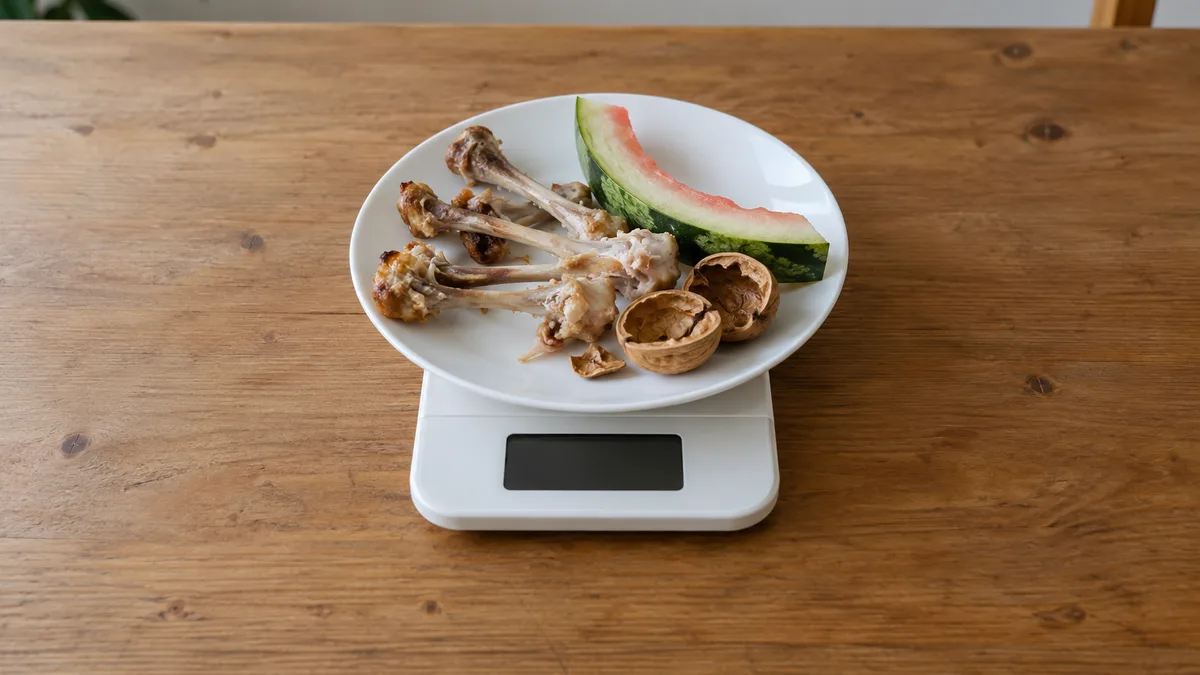
Log the weight of what you ate, not what was on the plate. The easiest way is to weigh the leftovers (bones, rind, shells) and subtract them. If they are already in the bin, take the inedible share from a reference table: a third of a roasted chicken thigh, nearly half of a watermelon.
Weigh the leftovers and subtract
Zero the scale with an empty plate on it, add the dish and note the weight. After eating, put the bones, rind or shells on the same empty plate and weigh them the same way. The difference is what you ate.
Say a roasted thigh weighed 180 g with the bone and the bones weighed 59 g afterwards. You ate 121 g of meat and skin. Multiply the calories per 100 g for roasted thigh by 1.21 and you get about 280 kcal. Log 180 g of meat instead and the diary shows 418 kcal.
Bones keep a little meat on them, which adds to the leftover weight, so your record comes out slightly low. For a diary that error is tolerable; there is no need to correct it.
If the bones are already gone, use a reference share
USDA gives calories per 100 g of the edible portion. The inedible part is recorded separately as a percentage of the weight of the item as purchased. The edible weight is simple to work out: weight on the plate × (100 − share) ÷ 100.
| Food (USDA entry) | Inedible | What it is |
|---|---|---|
| Chicken breast with skin, roasted | 19% | bone |
| Chicken thigh with skin, roasted | 33% | bone and cartilage |
| Chicken wing with skin, raw | 38% | bone and connective tissue |
| Pork spareribs, roasted | 32% | bone |
| Hen's egg | 12% | shell |
| Watermelon | 48% | rind, seeds, cutting loss |
| Pineapple | 49% | peel, core, crown |
| Banana | 36% | peel |
| Avocado | 26% | skin and seed |
| Walnuts | 55% | shell |
| Pistachios, raw | 47% | shell |
| Sunflower seeds | 46% | hull |
The shares come from the Refuse field of the USDA SR28 reference (the FOOD_DES file in the data archive) and are USDA averages from American samples. Your chicken, your watermelon and your avocado variety will differ: for California avocados USDA gives 33%, not 26%. That is enough for an estimate. For an exact record, weigh the leftovers.
Five examples: what changes in the record
Calories per 100 g come from the same USDA entries: roasted thigh 232 kcal, watermelon 30, walnuts 654, avocado 160, egg 143.
| On the scale | Edible part | If you log the full weight | By edible part |
|---|---|---|---|
| Thigh with bone, 180 g | 120.6 g | 418 kcal | 280 kcal |
| Watermelon with rind, 600 g | 312 g | 180 kcal | 94 kcal |
| Walnuts in shell, 100 g | 45 g | 654 kcal | 294 kcal |
| Whole avocado, 250 g | 185 g | 400 kcal | 296 kcal |
| Egg in shell, 60 g | 52.8 g | 86 kcal | 76 kcal |
The error always runs one way: skip the subtraction and the record is too high. For the chicken the gap is 138 kcal, for the walnuts 360. For the egg it is barely visible. Subtract waste where it weighs a lot: bones, shells, rind. The egg is the exception, with a difference of only 10 kcal.
Mango has its own article: flesh, stone and serving.
Take the share and the calories from the same entry
The inedible share depends on the state of the food. For chicken wing USDA gives 38% raw and 40% roasted; for breast, 20% and 19%. There is no rule: after roasting the share can rise or fall.
So pick the entry that matches what you weighed. A roasted thigh gets the "roasted" entry, and both the share and the calories per 100 g come from it. The difference between raw and cooked weight is covered in dry versus cooked weight.
If you left part of the portion
Leftovers on the plate work like bones: weigh the plate afterwards and subtract the plate itself. If the dish is mixed, like a stew or a salad, count the share you ate of the whole portion: two thirds eaten, two thirds logged.
If the components are separate, count leftovers by component. Uneaten rice and uneaten chicken are different lines. Without scales, judge the share from a photo before and after: a quarter, a half, three quarters. The record will be approximate, and an approximate record is a normal one. For cafés, where nobody tells you the portion weight, see the article on restaurants and delivery.
Where to get calories for raw meat and fruit
The pack of raw meat, fish, vegetables or fruit may have no nutrition table at all: the Eurasian technical regulation TR CU 022/2011 allows raw products to leave it out. That leaves a reference database. Check what weight its figure refers to: the edible portion, or the whole cut with the bone. In USDA it is the edible portion. Other databases and apps follow their own rules; where their numbers come from is covered in where apps get their macros.
How exact does this need to be
A diary is an estimate, not accounting. You do not have to weigh every bone. It is enough not to log bone-in chicken as boneless chicken.
If checking grams starts to spoil eating rather than help it, that is a reason to stop and read about when counting becomes a problem.
Frequently asked questions
- How do I count calories in bone-in chicken?
- Weigh the dish, weigh the bones afterwards and subtract. If the bones are gone, take the inedible share from a reference: for roasted thigh with skin USDA gives 33%, for breast 19%.
- Does the weight of a watermelon on the scale include the rind?
- Yes. USDA puts the inedible part of watermelon at 48% of its weight: rind, seeds and cutting loss. It is an average for American samples, and yours may differ.
- How do I log nuts in the shell?
- Weigh the shells separately or subtract a reference share: USDA gives 55% for walnuts and 47% for pistachios. The calories per 100 g in the reference refer to the kernel.
- Should I log a whole avocado or the flesh only?
- The flesh only, without skin and seed. By USDA these make up about a quarter of the weight of the whole fruit: 26% overall and 33% for California avocados.
Read next
- Raw or cooked weight: how to count grains, pasta, and meat — "100 g of buckwheat" can mean 346 kcal or 92, depending on the state of the grain.
- How much does a mango weigh: flesh, pit, and serving — USDA lists one mango without refuse as 336 g and a cup of pieces as 165 g.
- How to determine portion size without a scale — Portion weight is the most inaccurate variable in any calculation, including analysis by photo.
- Where do apps get calorie and macronutrient data and why do the numbers differ — The same cottage cheese gets different calorie counts in two apps, and people usually assume one of them is wrong.
This article is for general information. It is not medical advice, a diagnosis, or a prescription for treatment or a diet, and it does not replace a consultation with your doctor. If you have a health condition, are pregnant, take medication, or follow a diet prescribed to you, decisions about food belong with your doctor.
Figures from regulations, guidelines and studies are given as they stood when this article was prepared and may since have changed; check them against the primary sources. This article is not advertising, an offer, or individual advice, and neither the author nor the site owner is responsible for decisions taken on the basis of it.