Pie calories: how to count the dough, the filling and your slice
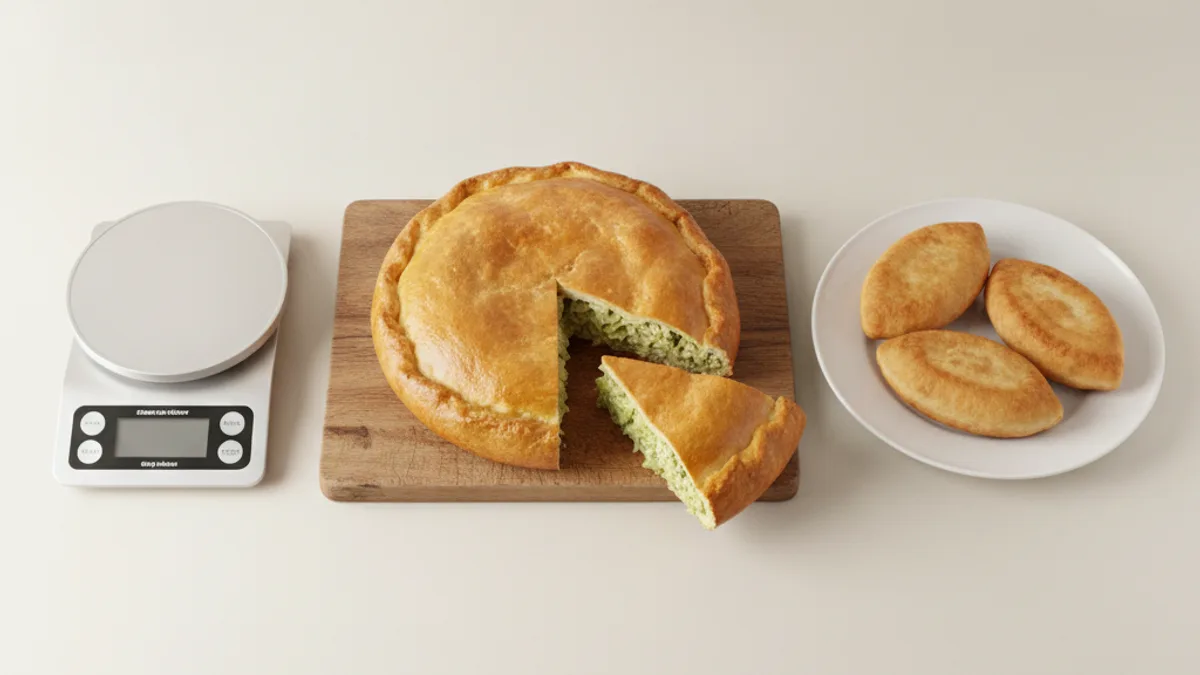
The FoodGPT reference puts a 100 g fried pirozhok (a Russian hand pie) at about 260 kcal, and a baked one at roughly a third less. For a pie you baked yourself, the recipe gives a closer figure: add up the calories in the dough and the filling, divide by the weight of the pie after baking, and multiply by the weight of your slice. In the example below, a slice of yeast-dough cabbage pie has 254 kcal, and five-sixths of them come from the dough.
What the reference says about pirozhki
The fried pirozhki entry in the calorie table lists 260 kcal per 100 g, and a typical hand pie weighs about 100 g. Baked ones are roughly a third lighter. This is an estimate for a pie when all you know is whether it was fried or baked: from a canteen, a bakery or someone else's table.
A pie you baked yourself can be counted more precisely. Everything that went into it can be weighed, and a recipe calculation gives a number for your dough, your filling and your slice. The general method is in the guide to counting calories in homemade food. Baking adds three questions to it: how many calories the dough has, which weight to use, and what to do with the oil from the frying pan.
Dough: the calories come from flour, butter and sugar
Values per 100 g are from USDA FoodData Central, SR Legacy: wheat flour, 364 kcal (FDC 169761); sugar, 387 (FDC 169655); butter, 717 (FDC 173430); sunflower oil, 884 (FDC 171025); raw whole egg, 143 (FDC 171287); whole milk, 3.25%, 61 (FDC 171265); compressed baker's yeast, 105 (FDC 175042). For kefir, the example uses a label showing 50 kcal per 100 g. If your flour, butter or kefir has a label, use its figures.
The recipes in the table are there for the arithmetic; your proportions will differ.
| Dough | Example recipe | Calories in the whole dough | Calories per 100 g of raw dough |
|---|---|---|---|
| Kefir dough | 450 g flour, 250 g kefir, 50 g egg, 30 g sunflower oil | 2,100 | 269 |
| Enriched yeast dough | 500 g flour, 250 g milk, 50 g butter, 50 g egg, 30 g sugar, 20 g yeast | 2,540 | 282 |
| Sponge batter, as for Russian apple charlotte | 200 g eggs, 150 g sugar, 150 g flour | 1,413 | 283 |
| Puff pastry | 250 g flour, 200 g butter, 125 g water | 2,344 | 408 |
| Shortcrust pastry | 200 g flour, 100 g butter, 60 g sugar, 50 g egg | 1,749 | 427 |
The rows differ because of butter. Puff and shortcrust pastry contain 50–80 g of it for every 100 g of flour, which makes the raw dough about one and a half times as calorie-dense as yeast dough. Sponge batter has no butter at all, and its only fat comes from the eggs, so it sits next to yeast dough.
Filling: in a cabbage filling, the oil adds more than the cabbage
| Filling | Example ingredients | Calories in the whole filling |
|---|---|---|
| Cabbage | 800 g fresh cabbage, 100 g onion, 30 g sunflower oil for braising | 505 |
| Apple | 600 g apples, 60 g sugar | 544 |
| Fish | 500 g cod, 150 g onion, 20 g butter | 613 |
| Cottage cheese | 500 g cottage cheese (tvorog) 5%, 50 g egg, 60 g sugar | 909 |
| Meat | 500 g ground beef 80/20, 150 g onion, 15 g sunflower oil | 1,463 |
Values per 100 g from the same database: raw cabbage, 25 kcal (FDC 169975); raw onion, 40 (FDC 170000); apples with skin, 52 (FDC 171688); raw Atlantic cod, 82 (FDC 171955); raw ground beef, 80% lean and 20% fat, 254 (FDC 174036). For 5% cottage cheese, the example uses 121 kcal from the cottage cheese entry.
In the cabbage filling, 30 g of oil adds 265 kcal and 800 g of cabbage adds 200. Getting the cabbage wrong by 50 g changes the total by 12 kcal; getting the oil wrong by 10 g changes it by 88. So weigh the oil you braise the cabbage in. In the meat filling, the beef supplies 1,270 kcal of the 1,463, and how many calories the beef has depends on its fat content (see the guide to homemade cutlets).
Example: a cabbage pie from ingredients to slice
Take the yeast dough and the cabbage filling from the tables above. This is a worked calculation, not a recipe.
- Dough: 2,540 kcal. Filling: 505 kcal. Whole pie: 3,045 kcal.
- The baked pie weighs 1,350 g without the tin.
- Per 100 g: 3,045 ÷ 1,350 × 100 = 226 kcal.
- The pie is cut into 12 equal slices. One slice: 3,045 ÷ 12 = 254 kcal, with an average weight of 112.5 g.
The dough supplied 2,540 of the 3,045 kcal, or five-sixths. For a cabbage pie this means that the thinner the dough and the thicker the filling, the fewer calories a slice of the same weight contains. With the meat filling, the dough's share in the same pie drops to 63%: 2,540 of 4,003.
Why you weigh the pie after baking
In the oven, the dough and the filling lose water but keep their calories. Suppose the pie in the example weighed 1,500 g before baking. Dividing 3,045 kcal by that weight gives 203 kcal per 100 g instead of 226, so every 100 g of pie would go into your log 23 kcal lighter than it is.
The easiest way is to weigh the pie in its tin: note the weight of the empty tin before baking and subtract it from the weight of the tin with the finished pie. How cooking changes food weight is covered in the guide to raw and cooked food weights.
Fried pirozhki: the oil from the pan is part of the recipe
Fried pirozhki are counted the same way, but the oil they absorbed while frying is added to the dough and filling. You measure it with scales: how much went into the pan and how much was left afterwards. More on this measurement is in the guide to calories from cooking oil.
Example: 16 pirozhki made with kefir dough (2,100 kcal) and cabbage filling (505 kcal). The pan got 120 g of sunflower oil, and 40 g was left after frying. The pies took up 80 g, or 707 kcal.
- Total: 2,100 + 505 + 707 = 3,312 kcal.
- One pirozhok: 3,312 ÷ 16 = 207 kcal.
- The fried pies weigh 1,300 g together, which gives 255 kcal per 100 g.
Oil from the pan supplied a fifth of the calories. With this method, oil left on paper towels is counted too, so the estimate comes out slightly high. You cannot know in advance how much your pies will absorb, so do not copy the 80 g from the example: weigh the pan before and after once.
The same pirozhki baked in the oven skip those 707 kcal: 2,605 kcal for 16 pies, or 163 kcal each.
How to count your slice
If the pie is cut into equal pieces, divide the calories in the whole pie by the number of pieces. If it was cut by eye, this does not work: a slice one and a half times the size of the next one has one and a half times the calories.
In that case, weigh your slice, multiply its weight by the calories per 100 g and divide by 100. A 150 g slice of the cabbage pie from the example has 150 × 226 ÷ 100 = 339 kcal. If you have no scales at hand, use the methods in the guide to estimating portion size without scales.
If someone else baked the pie
Without a recipe and a weight, you are left with an estimate. For fried pirozhki that is 260 kcal per 100 g from the reference; for baked ones, roughly a third less. For a slice of pie, it helps to at least identify the dough: in the examples above, raw puff and shortcrust pastry are one and a half times as calorie-dense as yeast dough. How to log food from someone else's table is covered in the guide to counting calories at someone's home.
Frequently asked questions
- How many calories are in one pirozhok?
- The FoodGPT reference gives a fried pirozhok about 260 kcal per 100 g; a baked one is roughly a third lighter. For a pie of a different weight, scale the figure: a fried pirozhok weighing 80 g has about 208 kcal.
- How many calories are in a slice of pie?
- It depends on the dough, the filling and the size of the slice. In the article's example, a 112.5 g slice of yeast-dough cabbage pie has 254 kcal. For your own pie, add up the calories in the ingredients, divide by the weight of the baked pie and multiply by the weight of the slice.
- Which pie dough has the most calories?
- In the article's examples, shortcrust and puff pastry: about 410–430 kcal per 100 g of raw dough, against 270–285 for yeast dough, sponge batter and kefir dough. The difference comes from butter.
- Why weigh a pie after baking rather than before?
- A pie loses water in the oven but keeps its calories. If you divide the total calories by the raw weight, the value per 100 g comes out too low: 203 kcal instead of 226 in the article's example.
- How many calories does frying add to pirozhki?
- As many as the oil they absorbed: every 10 g of sunflower oil is 88 kcal. To find the amount, weigh the oil before frying and what is left in the pan afterwards.
Read next
- How to count calories in homemade food — Processed foods are counted by the label, and restaurant meals by a reference guide.
- Raw or cooked weight: how to count grains, pasta, and meat — "100 g of buckwheat" can mean 346 kcal or 92, depending on the state of the grain.
- How many calories does frying add — The cooking method adds more calories to a dish than any choice between "healthy" and "unhealthy" foods.
- How to determine portion size without a scale — Portion weight is the most inaccurate variable in any calculation, including analysis by photo.
- How to count calories at someone else’s home when you do not know the recipe or weight — When you are visiting, you do not need to ask your hosts how many grams of oil they used or weigh every meatball.
This article is for general information. It is not medical advice, a diagnosis, or a prescription for treatment or a diet, and it does not replace a consultation with your doctor. If you have a health condition, are pregnant, take medication, or follow a diet prescribed to you, decisions about food belong with your doctor.
Figures from regulations, guidelines and studies are given as they stood when this article was prepared and may since have changed; check them against the primary sources. This article is not advertising, an offer, or individual advice, and neither the author nor the site owner is responsible for decisions taken on the basis of it.