Homemade cutlet calories: count meat, breading, and oil
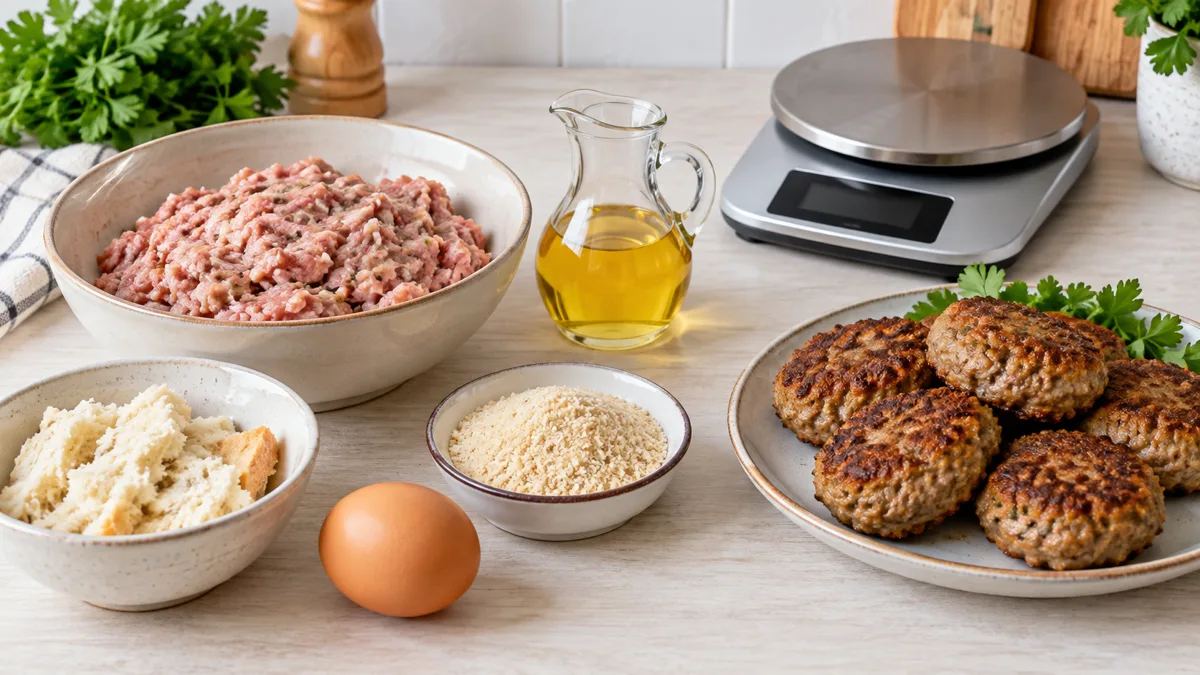
There is no single calorie value for a homemade cutlet. The result depends on the fat in the mince, the bread and coating, and the oil in the pan. For a useful household calculation, count the entire batch first, weigh the cooked yield, and only then calculate a value per 100 g or per patty.
Start with the whole batch
A calorie-table entry for a cutlet can estimate a dish when its recipe is unknown. Your own batch can be calculated more closely: two patties that look alike may use mince with different fat percentages, contain more or less bread, or have no coating at all.
- Weigh the edible portion of every raw ingredient: mince, bread, milk, egg without its shell, and everything else mixed in.
- Measure the breading that actually stayed on the cutlets and the oil added to the pan.
- Add the calories in all ingredients. This is the batch total before adjusting for material left in the bowl or pan.
- After cooking, weigh all the cutlets together and subtract the plate or container.
Calories per 100 g = batch calories ÷ cooked batch weight × 100.
Calories per cutlet = batch calories ÷ number of cutlets when they are roughly equal. For uneven cutlets, multiply the weight of each one by the per-100-g value.
Raw mince fat matters more than the meat's name
Use the fat percentage on the package or supplied by the butcher. In USDA FoodData Central, raw ground beef that is 80% lean and 20% fat provides 254 kcal per 100 g. The 90/10 entry provides 176 kcal per 100 g.
For 500 g, that is 1,270 versus 880 kcal—a 390 kcal difference before bread, egg, or oil. Logging “ground beef” without its fat percentage can therefore create a substantial error. For pork, chicken, or mixed mince, use the package value or a database entry matching both the meat and fat content.
Cooking evaporates water and may render some fat. A lower weight does not itself mean lost calories because water contains no calories. If rendered fat remains in the pan and is discarded, however, a calculation from all raw ingredients will slightly overstate the batch. Do not treat all liquid in the pan as fat; it also contains water and meat juices.
Count the bread, milk, and egg that enter the mixture
Soaked bread does not lose calories. Water changes its weight without adding energy; milk adds the calories in the amount retained. If you pour away some milk after soaking, the recipe contains only what remained in the bread and mince.
Set the bread bowl on a scale, tare it, and add milk. The simplest measurement is to add small amounts until all the milk is absorbed. Weigh egg without the shell.
FoodData Central lists commercial white bread at 266 kcal per 100 g, raw whole egg at 143 kcal, and whole milk with 3.25% fat at about 61 kcal. These are specific database entries, not fixed values for every loaf, egg, or milk. Prefer the label when one is available.
Measure breading before and after coating
The breadcrumbs poured into a bowl are not the amount on the cutlets. Weigh the separate bowl before coating and again afterward. The difference is the amount used by the batch; discarded crumbs do not belong in the calculation.
The FoodData Central entry for plain dry breadcrumbs provides 395 kcal per 100 g, so 40 g adds 158 kcal in the worked example below. Homemade crumbs and commercial coatings can differ; use their label or the bread from which you made them.
Use the same before-and-after method for flour or semolina. Once leftover crumbs become mixed with raw egg, their separate weights cannot be recovered. Pouring small amounts into the coating bowl avoids that problem.
Weigh oil instead of estimating a spoonful
Weigh the oil bottle before and after frying. The difference is the oil added across all batches. Fat supplies 9 kcal per gram under Annex XIV of Regulation (EU) No 1169/2011: 12 g of oil supplies 108 kcal and 20 g supplies 180 kcal.
For a reproducible household calculation, include all the oil you added. This is an upper estimate when some remains in the pan. Only subtract residue if you measured it separately; cutlet drippings are unsuitable because they mix added oil, rendered fat, water, and food particles.
If you cook in several rounds, weigh the bottle once before the first and once after the last. This captures oil added between rounds. The guide to calories from frying oil explains the measurement in more detail.
Worked example: 1,881 kcal per batch and 269 kcal per 100 g
This demonstrates the arithmetic; it is not a universal cutlet recipe. It uses the FoodData Central entries above and the regulated energy factor for oil:
| Ingredient | Weight | Reference value | Batch calories |
|---|---|---|---|
| 80/20 ground beef | 500 g | 254 kcal / 100 g | 1,270 kcal |
| White bread | 80 g | 266 kcal / 100 g | 213 kcal |
| Whole milk | 100 g | 61 kcal / 100 g | 61 kcal |
| Raw egg without shell | 50 g | 143 kcal / 100 g | 72 kcal |
| Plain dry breadcrumbs | 40 g | 395 kcal / 100 g | 158 kcal |
| Added oil | 12 g | 9 kcal / g | 108 kcal |
The unrounded sum is 1,881.3 kcal. After frying, ten cutlets weigh 700 g together: 1,881.3 ÷ 700 × 100 = 268.8 kcal per 100 g, rounded to 269 kcal.
If the cutlets are equal, each of ten averages 188 kcal. If one weighs 82 g, use the cooked-weight figure: 268.8 × 82 ÷ 100 = 220 kcal. This number belongs only to this batch. Changing 80/20 beef to 90/10, or using different amounts of breading or oil, changes the result.
Handle rendered fat and leftovers consistently
- Juices and fat remain in the pan. Do not subtract them as pure fat. Keep the result as an upper estimate and use the same method next time.
- Mince remains on the mixing bowl. For a noticeable amount, weigh the bowl before washing and subtract the empty bowl. A thin film usually makes little practical difference.
- Breading and egg remain in separate bowls. Subtract them by weight while the components are still separate.
- The cutlets finish cooking in a sauce. Add the sauce ingredients to the total and weigh the complete cooked dish. It is now a cutlet-and-sauce recipe, not the same fried batch.
Do not mix raw and cooked weights in one calculation. Count ingredients using values for their raw state, then divide that total by the cooked weight of the entire batch. The guide to raw and cooked food weights explains why the denominator changes.
Save the result without recalculating every patty
Save the recipe as “homemade cutlets” with the date and its per-100-g value. You can then weigh differently sized patties on the plate. If you repeat the same recipe, occasionally check its cooked yield: greater water loss raises the value per 100 g even when ingredient calories are unchanged.
Create a separate entry when you change the mince fat, coating, or cooking oil. Averaging several recipes under one name eventually recreates the generic reference value that the batch calculation was meant to replace.
The general method for soups, casseroles, and other recipes is in the guide to counting calories in homemade food. Cutlets follow the same method, with separate measurements for coating and oil.
Frequently asked questions
- How do I calculate calories in one homemade cutlet?
- Add the calories in every batch ingredient, including the breading actually used and all added oil. Divide by the number of cutlets if they are equal. If their sizes differ, calculate calories per 100 g from the cooked batch weight and multiply by the weight of the individual cutlet.
- Should I weigh bread before or after soaking it?
- Count bread by its weight before soaking and milk by the amount retained in the bread and mince. Water adds no calories. If you pour away some soaking milk, leave that discarded amount out of the recipe.
- Do I count all the breadcrumbs in the bowl?
- No. Weigh the breadcrumb bowl before and after coating. The difference is the amount used on the batch; discarded crumbs do not belong in the finished food.
- Can I subtract the fat left after frying?
- Not from the weight of all liquid in the pan because it contains water and meat juices as well as fat. Without a separate measurement, count the raw ingredients and all added oil as a reproducible upper estimate.
Read next
- How to count calories in homemade food — Processed foods are counted by the label, and restaurant meals by a reference guide.
- How many calories does frying add — The cooking method adds more calories to a dish than any choice between "healthy" and "unhealthy" foods.
- Raw or cooked weight: how to count grains, pasta, and meat — "100 g of buckwheat" can mean 346 kcal or 92, depending on the state of the grain.
- Air fryer calories: how much oil does it save? — An air fryer saves exactly the calories in the oil you did not add.
This article is for general information. It is not medical advice, a diagnosis, or a prescription for treatment or a diet, and it does not replace a consultation with your doctor. If you have a health condition, are pregnant, take medication, or follow a diet prescribed to you, decisions about food belong with your doctor.
Figures from regulations, guidelines and studies are given as they stood when this article was prepared and may since have changed; check them against the primary sources. This article is not advertising, an offer, or individual advice, and neither the author nor the site owner is responsible for decisions taken on the basis of it.