Air fryer calories: how much oil does it save?
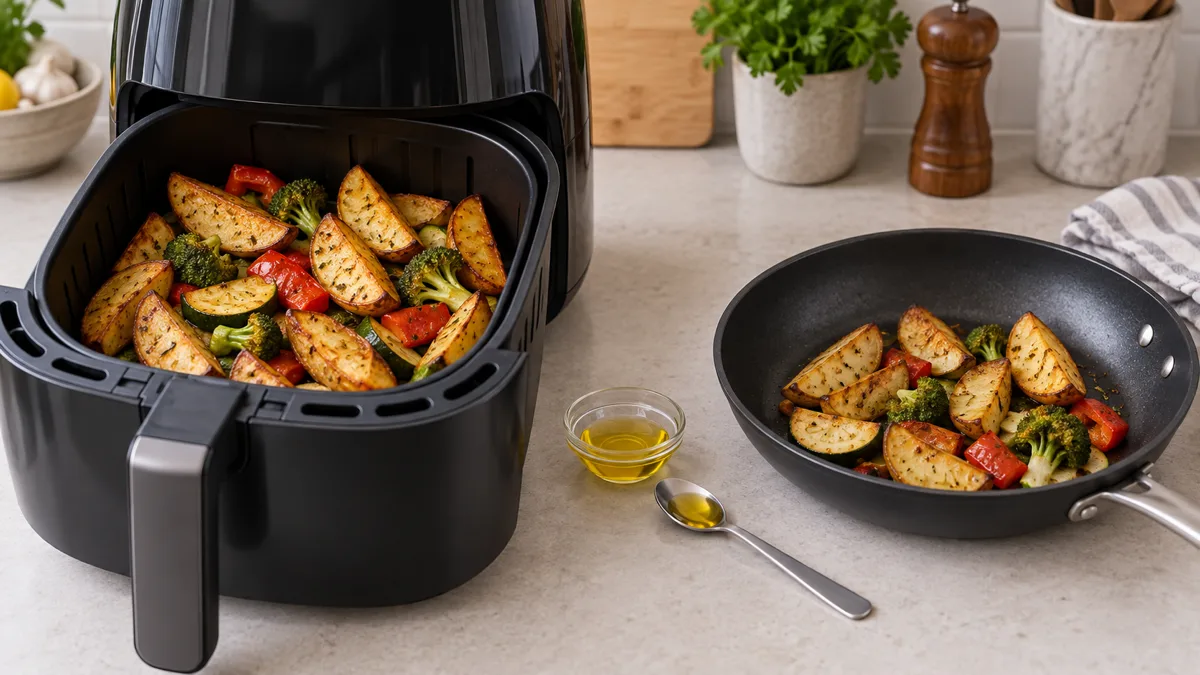
An air fryer saves exactly the calories in the oil you did not add. If the same batch uses 15 g of oil in a pan and 5 g in an air fryer, the difference is 90 kcal for the whole dish. There is no universal percentage: it depends on the food, recipe, and amount of oil used in each method.
The oil changes the calories, not the appliance
An air fryer cooks with circulating hot air. Some foods can brown in their own fat; others need a thin coating of oil. The appliance itself does not remove calories from potatoes, chicken, or vegetables.
To compare methods, start with the same weight of the same food and calculate the difference in added oil:
Calories saved = (oil used in the pan, g − oil used in the air fryer, g) × 9.
Fat supplies 9 kcal per gram under the conversion factors in Annex XIV of the EU food information regulation. A 5 g difference therefore equals 45 kcal for the batch, 10 g equals 90 kcal, and 20 g equals 180 kcal.
| Oil in the pan | Oil in the air fryer | Difference per batch |
|---|---|---|
| 10 g | 5 g | 45 kcal |
| 15 g | 5 g | 90 kcal |
| 25 g | 5 g | 180 kcal |
These rows illustrate the calculation; they are not recommended amounts. A good nonstick pan may cook vegetables with the same 5 g of oil, leaving no calorie advantage for the air fryer. If both methods use the same amount, the ingredients contain the same calories.
What a direct potato comparison found
A 2015 University of Reading study compared equally sized potato strips. The researchers cooked 100 g batches at 180°C in each appliance, adding 0.45 g of sunflower oil to the air fryer while immersing the other batch in 2 litres of oil. They compared the finished samples at similar moisture and colour.
Under those conditions, oil content was 1.12 g versus 5.63 g per 100 g of defatted dry matter—about five times lower with air frying. The air fryer took 21 minutes and deep-frying took 9 minutes; texture and sensory characteristics differed.
Those figures belong to those potato strips, temperatures, and appliances. They show that hot air can reduce oil uptake relative to immersion in oil. They do not provide a savings percentage for a pan-fried patty, frozen chicken nuggets, or vegetables. For a pan comparison, the measured grams of oil in your two versions are more useful.
How to compare an air fryer with your pan
- Weigh the oil bottle before and after cooking. The difference is more reliable than counting spoonfuls or sprays because spray bottles dispense different amounts.
- Use the same starting amount of the same food. Comparing 300 g raw potato with 300 g cooked potato is distorted by water loss.
- Count all added oil. This gives a reproducible upper estimate for everyday tracking. Do not subtract residue on the cookware unless you measured it separately.
- Divide the whole batch by servings. If the batch differs by 90 kcal and makes four equal servings, the difference is about 23 kcal per serving.
Our guide to calories added by frying oil covers pan measurements in more detail. For a recipe with several ingredients, calculate the whole homemade dish first, then divide by its cooked weight.
When the calories barely change
- The prepared food already contains oil. Frozen fries, nuggets, and breaded products may be pre-fried. An air fryer does not remove the fat listed in the nutrition information.
- The recipe already uses no added oil. Reheating a pastry or cooking a food in its own fat does not create a separate calorie saving merely because the appliance changed.
- You add the same amount to both versions. Five grams of oil provides the same 45 kcal in an air-fryer basket, baking tray, or frying pan.
You cannot accurately subtract fat that collects below the basket by looking at it: the drippings also contain water and juices. For consistent tracking, use the nutrition data for the starting food and count added oil. For a more exact recipe calculation, weigh every ingredient and the cooked batch; see the guide to raw and cooked weights.
An air fryer does not eliminate acrylamide
Calories and heat-formed compounds are separate questions. According to the UK Food Standards Agency, acrylamide can form in starchy foods during frying, roasting, baking, and other cooking above 120°C. Circulating hot air does not prevent that process.
The agency advises cooking starchy foods to a golden-yellow or lighter colour and following the instructions on packaged foods. There is no need to chase the darkest possible crust to imitate deep-frying. Read more in the guide to acrylamide in cooked food.
What to enter in a food log
Log the starting food from its label or a food database, all added oil, and the other ingredients. You can save the cooking method in the dish name, but “air-fried” has no calorie value of its own.
To compare it with your pan, cook the same starting portion both ways once and weigh the oil used. That difference belongs to your recipe and cookware, making it more useful than an advertising percentage that cannot be transferred to another food.
Frequently asked questions
- How many calories does an air fryer save?
- It saves the calories in the oil you leave out. Subtract the grams of oil used in the air fryer from those used in the pan and multiply by 9. A 10 g difference equals 90 kcal for the whole batch.
- Should I count oil used in an air fryer?
- Yes. Each gram of added oil provides about 9 kcal regardless of cooking method. Weigh the bottle before and after cooking for a reproducible measurement.
- Can I subtract fat that drips into the basket?
- You cannot identify the amount by sight because the drippings contain fat, water, and food juices. For consistent everyday tracking, count the starting food and added oil unless you make a separate measurement.
- Does air frying prevent acrylamide?
- No. Acrylamide can form in starchy foods during high-temperature cooking. The UK Food Standards Agency advises cooking them to a golden-yellow or lighter colour.
Read next
- How many calories does frying add — The cooking method adds more calories to a dish than any choice between "healthy" and "unhealthy" foods.
- How to count calories in homemade food — Processed foods are counted by the label, and restaurant meals by a reference guide.
- Raw or cooked weight: how to count grains, pasta, and meat — "100 g of buckwheat" can mean 346 kcal or 92, depending on the state of the grain.
- Acrylamide: what forms during frying and baking — Acrylamide is not present in raw foods — it forms during the cooking process, in the same place where a golden-brown crust and its aroma appear.
This article is for general information. It is not medical advice, a diagnosis, or a prescription for treatment or a diet, and it does not replace a consultation with your doctor. If you have a health condition, are pregnant, take medication, or follow a diet prescribed to you, decisions about food belong with your doctor.
Figures from regulations, guidelines and studies are given as they stood when this article was prepared and may since have changed; check them against the primary sources. This article is not advertising, an offer, or individual advice, and neither the author nor the site owner is responsible for decisions taken on the basis of it.