How many calories are in a slice of bread: white loaf, Borodinsky and sandwich bread
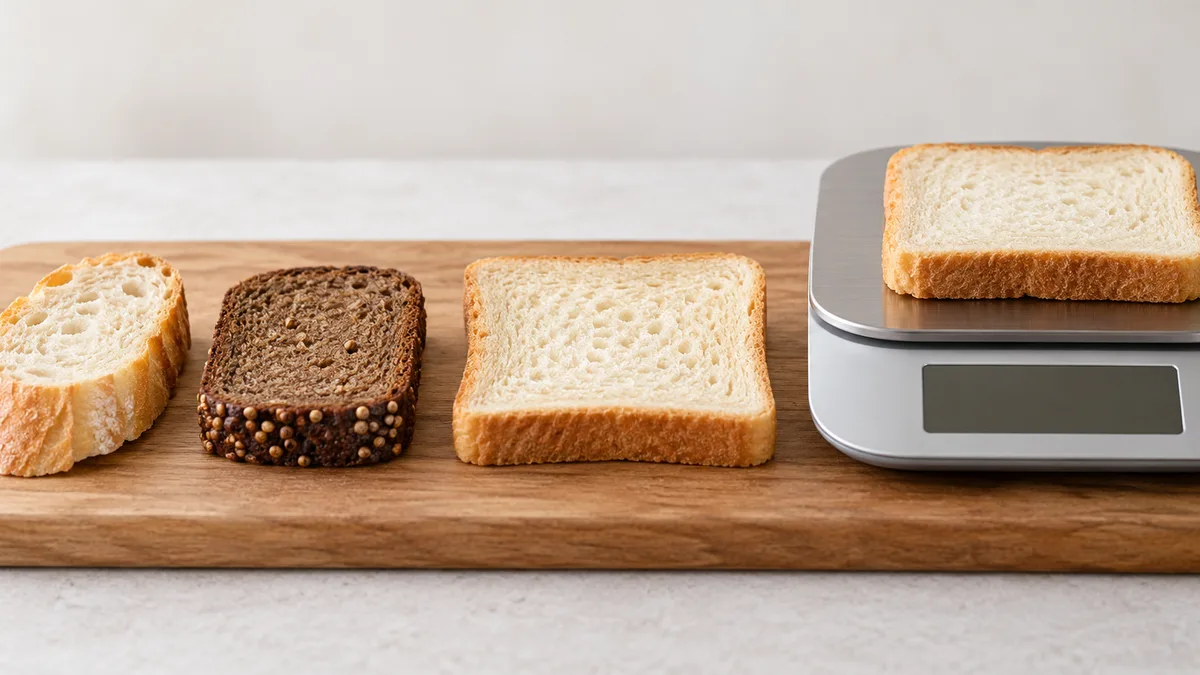
A slice of bread weighs 20 to 40 g depending on the loaf and how thick it is cut. A 25 g slice of white loaf has about 60 kcal, a 30 g slice of Borodinsky about 63 kcal, a 30 g slice of sandwich bread about 83 kcal. The most accurate approach is to weigh one slice of your bread once and then multiply the weight by the calories on the label.
How much a slice weighs
USDA FoodData Central gives slice weights for several breads:
| Bread and USDA entry | Slice | Weight |
|---|---|---|
| White wheat, FNDDS "Bread, white" | thin | 24 g |
| regular | 28 g | |
| thick | 43 g | |
| White, commercially prepared, Foundation 325871 | regular | 27.3 g |
| Rye, SR Legacy 172684 | thin | 25 g |
| regular | 32 g |
A thick home-cut slice weighs almost twice as much as a thin factory-cut one. So "one slice of bread" in a diary without a weight means a spread of dozens of calories.
How many calories are in a slice
Calories per 100 g vary even within one type of bread. The table uses three product entries:
- white loaf: "Batony gorodskie", Sdobryanka, 300 g in Open Food Facts — 240 kcal per 100 g;
- Borodinsky: "Khleb borodinsky", Smak in Open Food Facts — 210 kcal per 100 g;
- sandwich bread: Harry's American Sandwich wheat, 470 g on the Lenta product page — 278 kcal, 8 g protein, 6 g fat and 48 g carbohydrate per 100 g, as of 18 October 2026.
| Bread | 25 g slice | 30 g slice | 35 g slice |
|---|---|---|---|
| White loaf | 60 kcal | 72 kcal | 84 kcal |
| Borodinsky | 53 kcal | 63 kcal | 74 kcal |
| Sandwich bread | 70 kcal | 83 kcal | 97 kcal |
The formula for your bread: slice weight × kcal per 100 g from the label ÷ 100. Borodinsky is not much lighter than white loaf: the difference per 100 g in these entries is 30 kcal, and per slice about 10. Sandwich bread has more calories: its entry lists 6 g of fat per 100 g against 2 g for the white loaf. How bread compares with crispbread is covered in the article on bread and crispbread.
How to find your slice weight without scales
If the bread is factory-sliced, you can work out the slice weight from the pack. Divide the net weight by the number of slices. For example, if a 300 g pack has 12 slices, each weighs about 25 g.
If you slice it yourself, weigh one slice of your usual thickness once. You can then use that weight every day until you change bread or knife. Reference weights for white, rye and wholegrain bread are on our weights and measures cards for white, rye and wholegrain bread.
Toast: no fewer calories
When bread is toasted, water leaves it and the calories stay. That is why toasted bread has more calories per 100 g: USDA lists rye bread at 259 kcal per 100 g fresh and 284 kcal per 100 g toasted. The slice becomes lighter, but it holds as many calories as before the toaster. Log bread by its weight before toasting, or use the toasted-bread value if you weigh the toast.
The same logic applies to raw and cooked weights of other foods, covered in the article on raw and cooked weight.
What goes on the bread
Butter, cheese and sausage are logged as separate lines. A thin layer of butter on a slice is about 5 g and 36 kcal — more than half the calories of the white loaf slice itself. A full sandwich is worked through in the article on the caviar sandwich.
How to log bread
Log weight, not pieces: "Borodinsky, 30 g". If the bread is in the frame with the plate, it shows in the photo, but a picture conveys slice thickness less precisely than scales.
Frequently asked questions
- How much does a slice of bread weigh?
- According to USDA a thin slice of white bread weighs 24 g, a regular one 28 g and a thick one 43 g; a regular slice of rye 32 g. The most accurate way is to weigh one slice of your bread once.
- How many calories are in a slice of white loaf?
- At 240 kcal per 100 g, a 25 g slice of white loaf has about 60 kcal and a 30 g slice about 72 kcal. For your loaf, use the calories on the label.
- How many calories are in a slice of Borodinsky bread?
- At 210 kcal per 100 g, a 30 g slice has about 63 kcal and a 25 g slice about 53 kcal.
- How many calories are in a slice of sandwich bread?
- Harry's American Sandwich bread on the Lenta product page lists 278 kcal per 100 g, so a 30 g slice has about 83 kcal.
- Does toasting reduce calories?
- No. Toasting removes water, while the calories stay: the slice gets lighter but holds as many calories.
Read next
- Bread or crispbread: which is actually lighter — People buy crispbread instead of bread, thinking it is lighter.
- Wholegrain bread: how to tell it apart from bran bread — Look for wholegrain flour or whole grain in the ingredients and check its position.
- How to determine portion size without a scale — Portion weight is the most inaccurate variable in any calculation, including analysis by photo.
This article is for general information. It is not medical advice, a diagnosis, or a prescription for treatment or a diet, and it does not replace a consultation with your doctor. If you have a health condition, are pregnant, take medication, or follow a diet prescribed to you, decisions about food belong with your doctor.
Figures from regulations, guidelines and studies are given as they stood when this article was prepared and may since have changed; check them against the primary sources. This article is not advertising, an offer, or individual advice, and neither the author nor the site owner is responsible for decisions taken on the basis of it.