Bread or crispbread: which is actually lighter
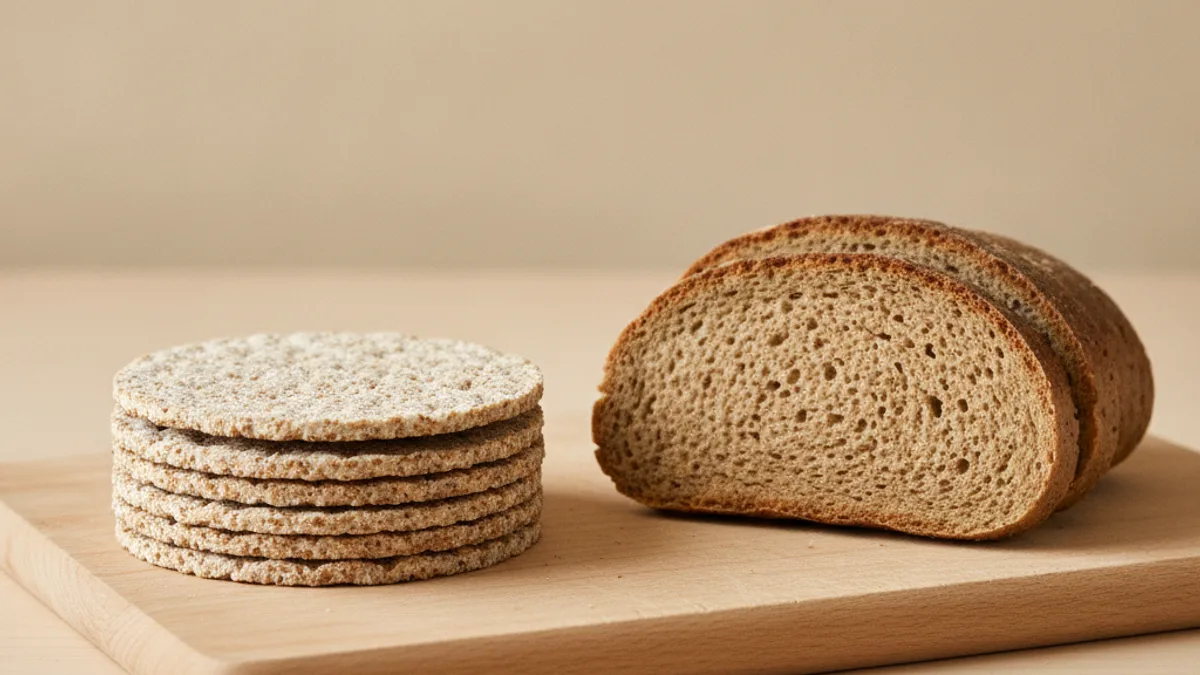
People buy crispbread instead of bread, thinking it is lighter. According to the labels, it is one and a half times more caloric than bread. Both statements are true, and this is explained by a simple division.
Numbers per 100 grams
| Product | kcal / 100 g |
|---|---|
| Rye bread | 210 |
| Whole grain bread | 247 |
| White wheat bread | 265 |
| Crispbread (based on various manufacturers' labels) | 300–380 |
The difference is explained by one word: water. Bread crumb contains about 40% water, while crispbread contains only a few percent. By removing the water, you get the same product with the same energy, packed twice as densely. The mechanism is analyzed separately — energy density.
Numbers per piece
Here the picture flips because a single piece of crispbread weighs very little.
| Item | Weight per piece | Approx. kcal |
|---|---|---|
| Slice of rye bread | 30 g | 63 |
| Slice of white bread | 25–30 g | 66–80 |
| Round rice crispbread | 8–9 g | 30–34 |
| Rectangular rye crispbread | 12–13 g | 40–48 |
The practical conclusion: two pieces of crispbread and one slice of bread are roughly the same in terms of calories. Not "one and a half times more" and not "half as much."
The weight per piece is not always printed on the packaging, but the quantity per pack almost always is. Dividing the net weight by the number of pieces takes five seconds and is more accurate than any estimate.
Where crispbread actually wins
Fixed portion. You cannot cut a piece of crispbread thicker. You can cut a slice of bread thicker, and the difference between a thin and a thick slice can be twofold.
Shorter ingredients. Whole grain extruded crispbread sometimes consists of a single line: grain. No yeast, salt, oil, or sugar — because the technology is different: the grain is heated under pressure and bakes itself.
More fiber. Whole grain versions have significantly more than white bread due to bran and husks.
Longer shelf life. Without water, there is nothing to mold.
Where it loses
Not all crispbread is extruded. There are baked versions — essentially thin, dry crackers made from dough — and they often contain oil, sugar, leavening agents, and salt. You can distinguish them by an ingredient list of five to eight lines instead of one or two.
Salt content can be just as high. The label "dietary" has nothing to do with sodium content. How much is in ready-made food in general — a separate breakdown.
Lower satiety for the same calories. Crispbread is dry and small, and three pieces are eaten more easily than one sandwich.
Price per kilogram is significantly higher. Bread is one of the cheapest products by this metric; crispbread is not. Comparison method — price per kilogram.
What to look for on the package
- Net weight and number of pieces. This gives you the weight of one crispbread and the portion calories.
- The first line of ingredients. Whole grain versus flour is a fundamental difference. Flour implies baked technology and, most likely, additives.
- Presence of oil and sugar. They should not be in extruded crispbread.
- Salt. Indicated in the nutritional table; more than 1.5 g per 100 g is high.
- Fiber. Not everyone lists it, but good whole grain products will have it in the table.
General rules for reading ingredient lists are in the article what to look for in ingredients in ten seconds. It is also worth knowing that private label brands in this category are often made by the same factory as well-known brands.
What to choose
If the goal is fewer calories, there is almost no difference: it arises not from the choice between bread and crispbread, but from how much you eat. If the goal is a controlled portion and a short ingredient list, crispbread is more convenient. If the goal is satiety for the same calories, bread with its moisture content wins.
And one case where the answer is clear: rye bread is a quarter lighter than white bread, all else being equal — 210 kcal versus 265. This substitution provides more benefit than the entire debate about crispbread.
Frequently asked questions
- Is crispbread more caloric than bread?
- Per 100 grams, yes: 300–380 kcal versus 210–265 kcal. Per piece, no: a crispbread weighs 8–13 g compared to 25–30 g for a slice of bread, so two crispbreads are roughly equal to one slice of bread.
- Why do crispbreads have such a high calorie content?
- Because of the lack of water. Bread crumb contains about 40% water, while crispbread contains only a few percent, so the same amount of energy is packed twice as densely.
- How to identify a good crispbread by its ingredients?
- Look at the first line and the length of the ingredient list. Extruded products contain whole grains and only one or two lines. Flour, oil, sugar, and leavening agents indicate a baking process—essentially, it is thin, dry bread.
Read next
- Price per kilogram: the only comparable figure on a price tag — There are two numbers on a price tag.
- Energy density: why the same calorie count can mean different amounts of food — Energy density is calories per gram, and it is already printed on every package: that very line "per 100 g" that people usually overlook while searching for the per-serving figure.
- What to look for in an ingredient list in ten seconds — Reading an entire ingredient list at the shelf is impossible: the print is small, and there is no time.
This article is for general information. It is not medical advice, a diagnosis, or a prescription for treatment or a diet, and it does not replace a consultation with your doctor. If you have a health condition, are pregnant, take medication, or follow a diet prescribed to you, decisions about food belong with your doctor.
Figures from regulations, guidelines and studies are given as they stood when this article was prepared and may since have changed; check them against the primary sources. This article is not advertising, an offer, or individual advice, and neither the author nor the site owner is responsible for decisions taken on the basis of it.