Wholegrain bread: how to tell it apart from bran bread
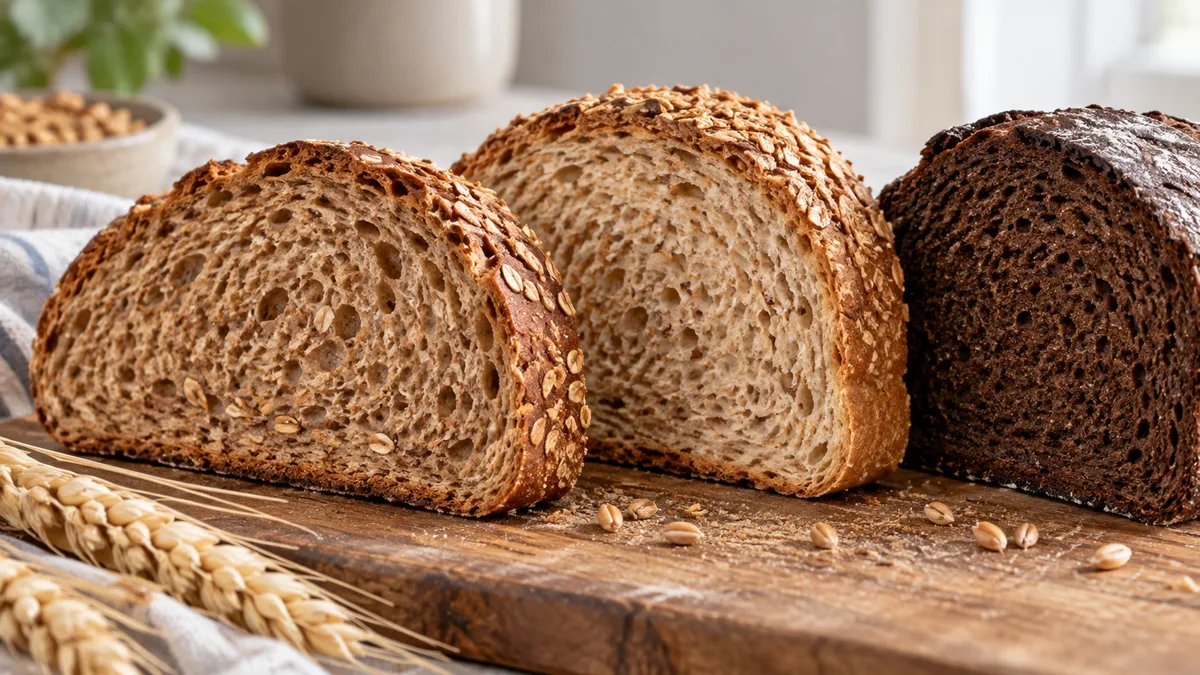
Look for wholegrain flour or whole grain in the ingredients and check its position. Bran, seeds and the word “multigrain” alone do not tell you which flour the bread was made from.
Whole grain can be milled
Wholegrain bread does not have to contain visible kernels. The Whole Grains Council's definition allows grain to be cracked, crushed or rolled. It should retain the endosperm, germ and bran in their original proportions. This is the organisation's definition, not a Russian bread labelling threshold.
Flour can therefore be wholegrain, while large seeds on the crust do not establish that the main flour was wholegrain. To choose bread with a wholegrain base, turn over the pack and read the ingredients. Use the appearance of the crumb to choose the texture you enjoy.
Bran and several grains describe different things
| Label wording | What to check in the ingredients |
|---|---|
| Wholegrain | Whether wholegrain flour or whole grain is listed, and which other flours appear |
| With bran | Which flour appears before the bran |
| Multigrain | Which grains were added and whether they are described as wholegrain |
| With seeds | What the dough is made from besides the seeds |
Bran is one part of the grain. Listing it separately from flour does not establish that all parts remain in their original proportions. Bread can contain both wholegrain flour and added bran. These terms can appear together, but neither removes the need to check the base.
Decide what you are looking for before buying: bread with wholegrain flour first among its grain ingredients, or a comparison of fibre in familiar loaves. The first task needs the ingredients; the second also needs nutrition information. The word “grain” in the name does not supply both answers.
Two actual examples: names and the start of the list
The manufacturers' pages were checked on 9 October 2026. The table shows the beginning of each ingredient list, not the complete list. The products have different uses: one is ready to eat and the other is a baking mix.
| Product | Start of the ingredients | What it tells you |
|---|---|---|
| “Wholegrain” bread, 300 g, Chelny-Hleb | First-grade wheat bread flour, water, wholegrain wheat flour | The recipe contains different flours; wholegrain flour is not first |
| “Wholegrain Bread” flour mix, KhlebBurg | Wholegrain wheat flour, wholegrain rye flour, rolled oats | Both flours at the beginning are described as wholegrain |
Do not apply a dry mix's calories to baked bread. For a diary entry, use nutrition information for the finished loaf or calculate the recipe using its baked yield. When buying ready-made bread, check the label on that particular loaf: the exact name and pack size help distinguish it from another product.
What the order of flours tells you
Under EAEU food labelling regulation TR TS 022/2011, part 4.4, ingredients generally appear in descending order of weight at manufacture. If ordinary flour appears before wholegrain flour, the order alone does not support calling the loaf bread made exclusively with wholegrain flour. It does not give an exact percentage either.
Read every type of flour rather than stopping at the first word. Water can appear between them. A compound ingredient such as a baking mix can have its own list in brackets; read that separately. If your choice depends on a specific proportion of wholegrain flour, look for a declared percentage or ask the manufacturer about the recipe.
If you have a food allergy, also read the notes after the ingredients. For example, the Chelny-Hleb bread page lists possible traces of soy, nuts, milk and egg protein. Check this against your pack and your doctor's advice.
Compare nutrition and calculate your slice
Put two packs side by side and write down calories, protein and fibre for the same weight, where fibre is stated. Do not record a missing fibre entry as zero. Reading ingredients and comparing calories answer different questions: one describes what went into the bread, while a serving calculation describes how much you ate.
Weigh your slice, multiply the value per 100 g by its weight, then divide by 100. As a worked example, bread with 240 kcal per 100 g gives 84 kcal in a 35 g slice, or 168 kcal in two such slices. These figures demonstrate the calculation; they do not describe the products in the table above. Record spreads and other sandwich ingredients separately.
Keep a photo of the ingredients of bread you like for your next shopping trip. When replacing it, check the feature you chose it for: flour type, declared fibre or a convenient serving. The comparison of bread and crispbread by serving weight is in a separate article.
Frequently asked questions
- Does wholegrain bread have to contain visible kernels?
- No. Whole grain can be milled. Look for wholegrain flour or whole grain in the ingredients rather than relying on visible pieces in the crumb.
- Are bran bread and wholegrain bread the same?
- No. Bran is one part of the grain; adding it separately does not establish a wholegrain base. Bread can contain both wholegrain flour and extra bran.
- Is multigrain bread always wholegrain?
- The name alone does not establish that. Read the flours and grains in the ingredients and check which are described as wholegrain.
- Can I calculate the wholegrain flour percentage from the list?
- The ingredient order alone does not give an exact percentage. You need a declared proportion or recipe information from the manufacturer.
- How do I calculate the calories in a slice?
- Multiply the calories per 100 g on the pack by the slice weight in grams and divide by 100. Count sandwich fillings separately.
Read next
- Bread or crispbread: which is actually lighter — People buy crispbread instead of bread, thinking it is lighter.
- How to read the ingredients list on a label: the rules governing its writing — A label looks like a list of words from which everyone reads something different: one person considers a long list of ingredients a red flag, another looks for E numbers.
- How to compare two products by their labels: six steps with a worked example — Two nutrition tables are comparable only when they describe the same weight, the same state of the product and the same units.
- What to look for in an ingredient list in ten seconds — Reading an entire ingredient list at the shelf is impossible: the print is small, and there is no time.
This article is for general information. It is not medical advice, a diagnosis, or a prescription for treatment or a diet, and it does not replace a consultation with your doctor. If you have a health condition, are pregnant, take medication, or follow a diet prescribed to you, decisions about food belong with your doctor.
Figures from regulations, guidelines and studies are given as they stood when this article was prepared and may since have changed; check them against the primary sources. This article is not advertising, an offer, or individual advice, and neither the author nor the site owner is responsible for decisions taken on the basis of it.