What to swap your usual foods with to cut calories: 15 substitutions with numbers
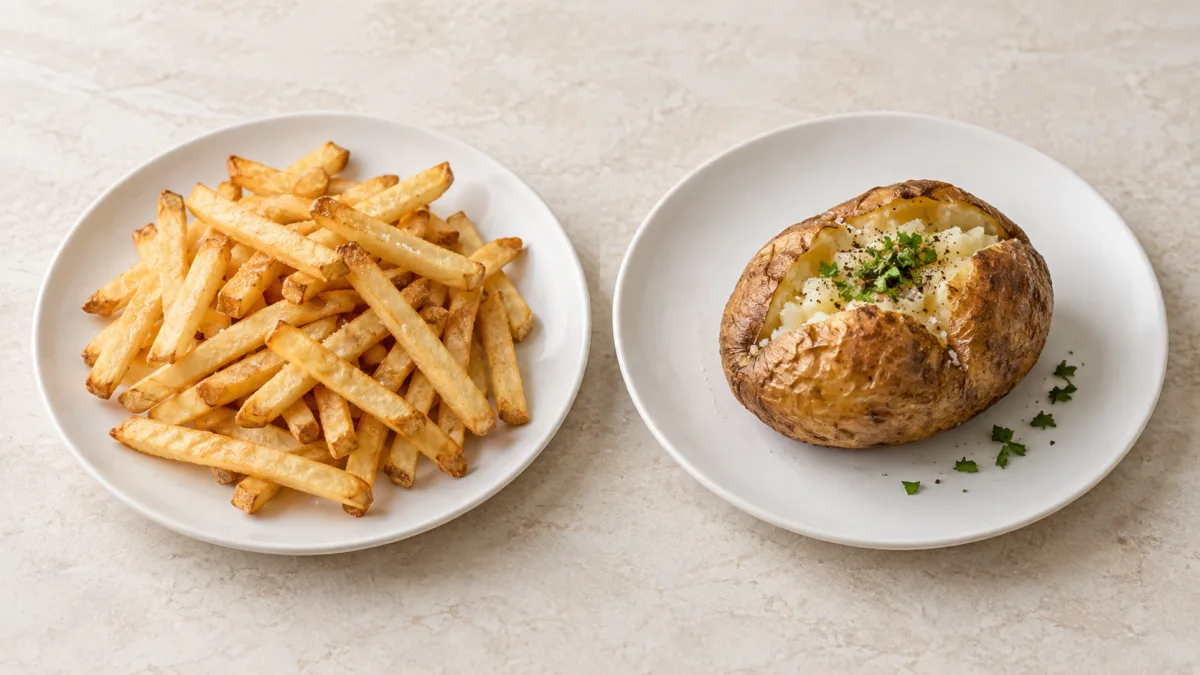
Swapping sauces, sides, and drinks cuts the most calories: mayonnaise for Greek yogurt saves about 180 kcal per 30 g, pasta for zucchini about 280 kcal per serving. Swapping juice for a whole orange barely reduces calories at all. Below are 15 pairs with numbers and notes on where the swap loses out on taste or satiety.
15 swaps in one table
Values per 100 g are taken from the USDA database; portions are conventional, and their weights are indicated in the table. The difference is calculated between portions: a minus sign means fewer calories.
| Original → swap | kcal per 100 g | Portion | kcal per portion | Difference |
|---|---|---|---|---|
| Fried french fries → baked potato | 312 → 93 | 150 g | 468 → 140 | −328 |
| Cooked pasta → raw zucchini, sliced into ribbons | 158 → 17 | 200 g | 316 → 34 | −282 |
| Mayonnaise → 2% Greek yogurt (in dressing) | 680 → 73 | 30 g | 204 → 22 | −182 |
| Cooked white rice → cooked cauliflower | 130 → 23 | 150 g | 195 → 34 | −161 |
| Cola → water | 42 → 0 | 330 g | 139 → 0 | −139 |
| 80/20 ground beef → 95/5 ground beef (raw) | 254 → 137 | 100 g | 254 → 137 | −117 |
| Cream cheese → 1% cottage cheese | 350 → 72 | 30 g | 105 → 22 | −83 |
| Chicken thigh with skin → skinless chicken breast (baked) | 232 → 165 | 100 g | 232 → 165 | −67 |
| Whole milk 3.25% → skim milk | 61 → 34 | 200 g | 122 → 68 | −54 |
| Chips → air-popped popcorn without oil | 532 → 387 | 30 g | 160 → 116 | −44 |
| Fried egg → hard-boiled egg | 196 → 155 | 100 g | 196 → 155 | −41 |
| Butter on bread → avocado | 717 → 160 | 10 g butter, 30 g avocado | 72 → 48 | −24 |
| Peanut butter → reduced-fat peanut butter | 598 → 520 | 30 g | 179 → 156 | −23 |
| 20% sour cream → 10% sour cream | 198 → 136 | 30 g | 59 → 41 | −18 |
| Orange juice → whole orange | 45 → 47 | 200 g | 90 → 94 | +4 |
Source: USDA FoodData Central, SR Legacy release, April 2018 (fdc.nal.usda.gov), energy values per 100 g; accessed 10/01/2026. The 20% and 10% sour creams in the table refer to American “cultured” (19.35% fat) and “light” (10.6%) varieties. Values on specific store-bought products may differ from those listed.
Where calories drop significantly
Four swaps remove more than 150 kcal at once: fries, pasta, mayonnaise, and rice. In all four cases, the most calorie-dense component of the dish is replaced by a food high in water content. Baked potato contains 93 kcal per 100 g, while fried french fries contain 312 kcal because frying adds fat. This principle is explained in the article on energy density: the more water and fiber a food contains, the fewer calories it has per unit volume.
If you replace deep-fried potatoes not with baked ones but with oven-baked fries, the benefit is smaller. Frozen french fries prepared at home in the oven contain 158 kcal per 100 g according to the same database. How much frying in oil adds is detailed in the article on calories from frying.
Beverages are a special case. A 330 g can of cola contains about 139 kcal. Sugar-free cola has 1 kcal per 100 g (USDA), and water has zero. Alcohol follows the same logic, only with higher numbers: calories in alcohol.
Where the difference is small or negligible
Hard-boiled eggs instead of fried save 41 kcal per 100 g. The entire difference comes from the fat used for frying. Switching from 20% to 10% sour cream reduces calories by 18 kcal per 30 g—almost insignificant for daily intake.
“Reduced-fat” products aren’t always low-calorie. Reduced-fat peanut butter has 520 kcal versus 598 kcal—a 13% reduction. It contains one-third less fat (34 g vs. 51 g per 100 g) but more carbohydrates (36 g vs. 22 g)—according to USDA data, some fat is replaced with carbs. For someone counting calories, it’s nearly the same product.
Orange juice and whole oranges are nearly equal in calories: 45 vs. 47 kcal per 100 g. The real difference lies elsewhere: an orange provides 2.4 g of fiber per 100 g, while juice offers only 0.2 g. Eating a whole orange takes longer and promotes greater satiety. If you enjoy juice, it can stay in your diet—just remember that a glass counts as a glass.
Air-popped popcorn without oil instead of chips reduces calories by 27% per 100 g. This is noticeable but not dramatic: by weight, popcorn remains relatively calorie-dense, though it appears lighter due to its volume.
Where swaps compromise taste and satiety
Using cauliflower instead of rice or zucchini instead of pasta mimics appearance but not nutritional value. Rice and pasta provide energy and bulk. Vegetable substitutes reduce calories—and potentially satiety—leading to earlier hunger. The taste also differs: zucchini “pasta” doesn’t replicate real pasta; it’s simply a different dish.
Greek yogurt instead of mayonnaise adds tanginess and lacks the rich aftertaste of fat. If you specifically crave mayonnaise flavor, this won’t satisfy it. Mayonnaise-free dressings are explored in the article on salads without mayonnaise.
Skim milk often tastes blander and feels “thinner” in coffee. Avocado instead of butter on bread tastes different, and people typically spread it thicker—hence the table shows 30 g versus 10 g. Chicken breast is drier than thigh meat.
Any swap you don’t enjoy eating will last only a few days. It’s better to choose substitutions where calorie savings exist but flavor loss is minimal: baked potatoes, cottage cheese instead of cream cheese on sandwiches, or 95/5 ground beef in sauces.
Swapping isn’t banning
The original product stays in your diet if you enjoy it. Swaps are useful when you want the same volume with fewer calories—and none of these 15 pairs is mandatory. Enjoying chips with friends in the evening or using mayonnaise in a holiday salad requires no justification.
It’s more practical to pick two or three swaps for your most frequently consumed items. Replacing sugary soda you drink daily yields greater benefits than swapping fries eaten once a week: the impact depends not only on the swap’s effectiveness but also on how often you consume the item. How a calorie deficit is created is covered in the article on calorie deficit, and a list of low-calorie foods appears in the piece on low-calorie foods.
If you have diabetes, kidney or liver disease, an eating disorder, or a doctor-prescribed diet, consult a physician or dietitian before making substitutions: changing protein and carbohydrate sources affects more than just calories.
Frequently asked questions
- Which food swaps cut the most calories?
- Swapping sauces, side dishes, and drinks. According to the USDA database, replacing deep-fried French fries with baked potatoes reduces intake by about 330 kcal per 150 g serving; pasta with zucchini noodles cuts roughly 280 kcal per 200 g; and mayonnaise with Greek yogurt saves around 180 kcal per 30 g portion.
- How many calories are in mayonnaise, and what can replace it?
- Mayonnaise contains about 680 kcal per 100 g (USDA), or roughly 204 kcal per 30 g serving. Plain 2% Greek yogurt has 73 kcal per 100 g, so a dressing made with it provides only about 22 kcal for the same 30 g portion. The taste will be different—more tangy.
- Which is better for weight loss: juice or whole fruit?
- Calorie-wise, they’re nearly identical: orange juice has 45 kcal per 100 g versus 47 kcal in whole oranges. The difference lies in fiber (0.2 g vs. 2.4 g per 100 g) and satiety: eating a whole fruit takes longer and feels more filling.
- Do reduced-fat products help?
- Not always. Reduced-fat peanut butter has 520 kcal compared to 598 in the regular version—that’s a 13% reduction—but it contains more carbohydrates. Always compare calories per 100 g listed on the package, not just the label claim.
- Can you replace rice with cauliflower and pasta with zucchini?
- Yes, if you enjoy the taste: calories will drop significantly—23 kcal per 100 g in cauliflower versus 130 in rice. However, this substitution matches the dish visually, not in satiety, and hunger may return sooner afterward.
Read next
- Energy density: why the same calorie count can mean different amounts of food — Energy density is calories per gram, and it is already printed on every package: that very line "per 100 g" that people usually overlook while searching for the per-serving figure.
- How many calories does frying add — The cooking method adds more calories to a dish than any choice between "healthy" and "unhealthy" foods.
- Salads without mayonnaise: four dressings and what they pair with — In a salad, calories are almost always found not in the vegetables, but in the dressing: two tablespoons of mayonnaise contain about as many calories as everything else on the plate combined.
- Low-calorie foods: calories and macros per 100 g — Cucumbers, tomatoes, zucchini, berries and plain yogurt add variety without many calories per serving.
This article is for general information. It is not medical advice, a diagnosis, or a prescription for treatment or a diet, and it does not replace a consultation with your doctor. If you have a health condition, are pregnant, take medication, or follow a diet prescribed to you, decisions about food belong with your doctor.
Figures from regulations, guidelines and studies are given as they stood when this article was prepared and may since have changed; check them against the primary sources. This article is not advertising, an offer, or individual advice, and neither the author nor the site owner is responsible for decisions taken on the basis of it.