Salads without mayonnaise: four dressings and what they pair with
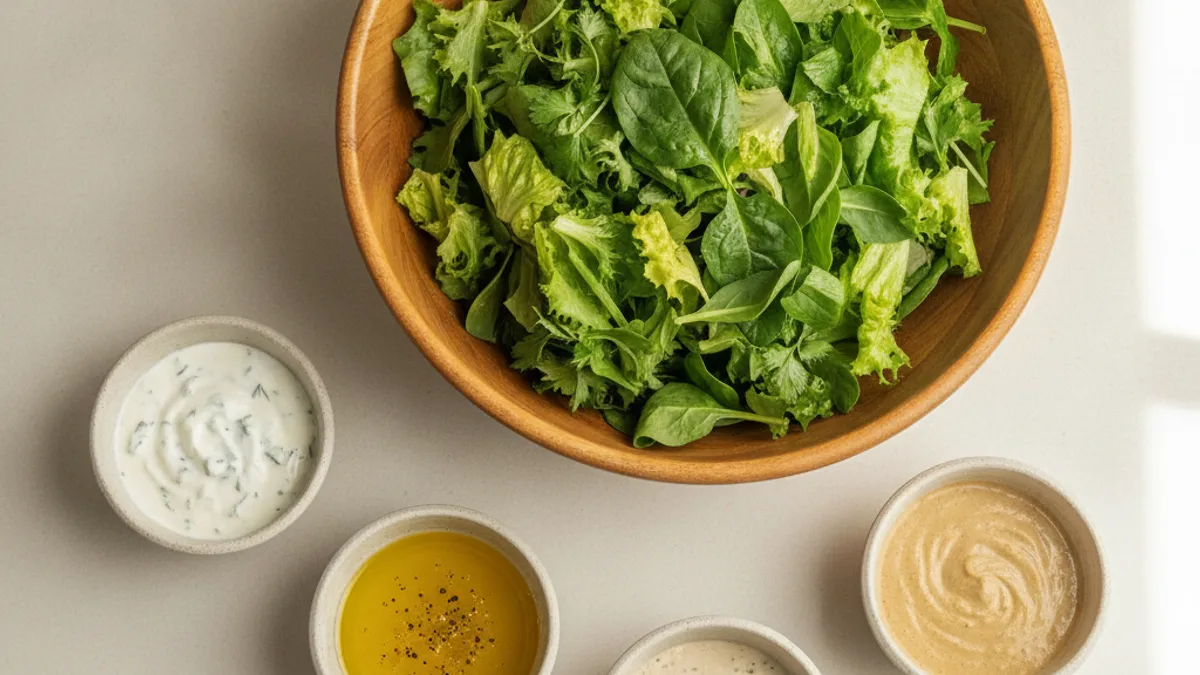
In a salad, calories are almost always found not in the vegetables, but in the dressing: two tablespoons of mayonnaise contain about as many calories as everything else on the plate combined. This is not an argument against mayonnaise, but an argument for knowing what is going on. Below are four dressings that can be made in a minute from what you have at home.
How much a dressing costs
| Dressing, 2 tbsp | Approximate calories |
|---|---|
| Mayonnaise 67% | about 180 kcal |
| Olive oil | about 220 kcal |
| Sour cream 20% | about 60 kcal |
| Greek yogurt | about 20 kcal |
| Lemon juice with mustard | about 15 kcal |
Pay attention to the second row: olive oil is higher in calories than mayonnaise because mayonnaise is partially made of water. This doesn't make it worse — their fatty acid composition is different, and this is analyzed in the article about healthy and unhealthy fats — but the idea that "I replaced mayonnaise with oil and it became lighter" is arithmetically incorrect.
Yogurt dressing
Base: 3 tbsp of thick unsweetened yogurt, a teaspoon of mustard, juice of a quarter of a lemon, salt, pepper.
Variations: add crushed garlic, chopped dill, a drop of honey, grated cucumber.
Best for: Olivier and similar salads with potatoes and eggs, chicken salads, cabbage salads.
This is the closest substitute for mayonnaise in terms of texture. The key requirement is that the yogurt must be thick and sugar-free; liquid drinkable yogurt will drain to the bottom.
Lemon-mustard dressing
Base: juice of half a lemon, a teaspoon of mustard, a tablespoon of olive oil, salt, pepper.
Variations: replace lemon with apple cider vinegar, add a drop of honey to balance the acidity.
Best for: leafy salads, tomatoes, cucumbers, anything fresh.
Mustard works here not just for flavor: it is an emulsifier and holds the oil and juice together — the mechanism is the same as the one analyzed in the article about emulsifiers.
Sour cream with herbs
Base: 2 tbsp of sour cream 15–20%, a bunch of herbs, salt, black pepper, a little water to reach the desired consistency.
Best for: radishes, cucumbers, young cabbage, beets.
A compromise option: higher in calories than the yogurt dressing, but more familiar in taste for those who don't like yogurt in savory dishes.
Tahini dressing
Base: a tablespoon of sesame paste, juice of half a lemon, water to reach a cream-like consistency, salt, garlic.
Best for: roasted vegetables, chickpeas, carrots, green salads.
The only one of the four that is significantly high in calories — about 90 kcal per tablespoon of paste — but you need less of it. Sesame is on the list of mandatory allergens, which is covered in the article about mandatory allergens.
What else changes the calorie content of a salad
- Croutons and fried bacon. They cost more in calories than the dressing, and they are usually not counted.
- Cheese. Fifty grams of hard cheese is about 170 kcal.
- Nuts and seeds. A tablespoon is about 60 kcal; they are added "for health" and are not accounted for.
- Canned corn and peas. More about sugar and salt than calories.
How to estimate portion weight without a scale is analyzed in the article about portion weight.
Three recurring combinations
- Chicken, cucumber, greens, lemon-mustard dressing. About 350 kcal per large plate, about 30 g of protein.
- Tuna, beans, red onion, tomato, lemon-mustard dressing. About 400 kcal, about 30 g of protein.
- Cabbage, carrots, apple, yogurt dressing. About 200 kcal, a side dish for any meat.
The scheme for building a plate is in the article about weekly menu.
Frequently asked questions
- What can I use to replace mayonnaise in a salad?
- Thick unsweetened yogurt with mustard and lemon — this is the closest substitute in terms of texture. For fresh salads, a lemon-mustard dressing works well; for vegetables, sour cream with herbs; and for roasted vegetables and chickpeas, a tahini dressing.
- Is it true that olive oil is lighter than mayonnaise?
- In terms of calories, no: two tablespoons of oil contain about 220 kcal compared to approximately 180 kcal for mayonnaise, because mayonnaise is partially made of water. They differ in their fatty acid composition, not in caloric content.
- Why does homemade dressing separate?
- Oil and juice do not mix on their own. A spoonful of mustard acts as an emulsifier and holds them together—this is the same mechanism that keeps industrial mayonnaise stable.
- What else in a salad contributes the most calories?
- After the dressing, it is croutons, fried bacon, cheese, and nuts. Fifty grams of hard cheese provide about 170 kcal, a tablespoon of nuts provides about 60 kcal, and these are usually overlooked.
- Which yogurt should I use for dressing?
- Thick and unsweetened, preferably Greek-style. Thin drinkable yogurt will drain to the bottom of the bowl, and sweetened yogurt will give a savory salad a sweet taste.
Read next
- Three protein-rich breakfasts that take ten minutes to prepare — The usual breakfast has one problem, and it's not the calories: porridge made with water, toast with jam, and coffee contain almost no protein.
- Weekly menu: how to build your own instead of looking for a ready-made one — People look for a ready-made weekly menu to avoid thinking.
- Which fats are healthy and which are not — Dividing fats into "healthy" and "unhealthy" is convenient for a headline but almost useless at the grocery shelf: a single product usually contains all types at once, and the difference between them is not about general health benefits, but about specific effects.
- Holiday table: where do the calories in Olivier and herring under a fur coat come from — Olivier salad does not have one correct number: one cook's version may have twice as many calories as another's, despite using the same ingredients.
This article is for general information. It is not medical advice, a diagnosis, or a prescription for treatment or a diet, and it does not replace a consultation with your doctor. If you have a health condition, are pregnant, take medication, or follow a diet prescribed to you, decisions about food belong with your doctor.
Figures from regulations, guidelines and studies are given as they stood when this article was prepared and may since have changed; check them against the primary sources. This article is not advertising, an offer, or individual advice, and neither the author nor the site owner is responsible for decisions taken on the basis of it.