Holiday table: where do the calories in Olivier and herring under a fur coat come from
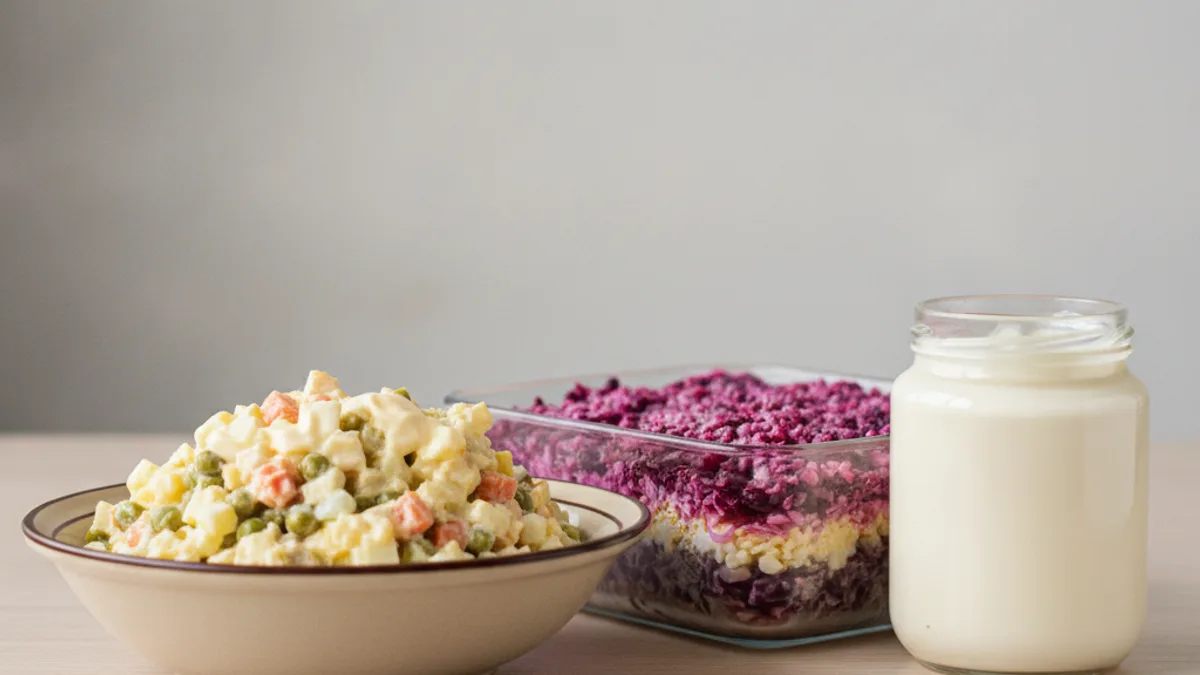
Olivier salad does not have one correct number: one cook's version may have twice as many calories as another's, despite using the same ingredients. The dressing makes the difference, and its share can be read on the jar — the fat content is declared there as a percentage.
Why one name does not have one number
Holiday salads are assembled from ingredients that provide little on their own: boiled potatoes, eggs, peas, pickles, beets, and carrots. They all have one thing in common: the bulk of their mass is water, which provides no calories at all — read more about this in our article on energy density.
The dressing works the opposite way. It adds a little mass to the salad but a lot of calories, so the final number is determined primarily by it. This explains the variation between two bowls with the same name: the recipe is the same, but the proportion and fat content of the mayonnaise are not.
Dressing arithmetic
You don't need to estimate it by eye: the fat content is stated on the jar as a percentage, and the number of calories provided by a gram of fat is established by regulation — 9 kcal/g (Appendix 4 to TR TS 022/2011). Then it's just multiplication:
| Dressing | Provides only fat, kcal per 100 g |
|---|---|
| Mayonnaise 67% | about 600 |
| Mayonnaise 50% | about 450 |
| Mayonnaise 30% | about 270 |
| Sour cream 20% | about 180 |
| Sour cream 10% | about 90 |
Proteins and carbohydrates add a little more to these numbers, so the label will show slightly higher values. But the order of magnitude is set by the fat content line, which is visible without turning the jar to the fine-print table.
What this adds to the salad
Let's make an assumption: the dressing makes up about one-fifth of the salad's mass. This is an assumption, not a measurement — another cook might use less or significantly more, and the total number will shift accordingly.
With this proportion, for every 100 g of salad, the dressing provides:
- mayonnaise 67% — about 120 kcal;
- mayonnaise 30% — about 55 kcal.
The difference between these options is more than double, and it arises from a single decision made at the store a week before the feast. Everything else in the salad remains the same.
For those preparing the food themselves, changing the dressing is easier than changing the ingredients. Options without mayonnaise are discussed in our article on salads without mayonnaise.
Meat and hot dishes
The same rule applies here, although the fat content is not always declared. Baked meat without sauce is closer to its original fat content; anything served under a mayonnaise or cheese crust gets the same addition as the salad.
Aspic is a special case: gelatin and broth provide little, and the number is determined by how much meat it contains and how fatty it is. You cannot estimate it by name, and this is exactly the case where it is easier to look at a cross-section than to guess.
Aspic, vegetable platters, pickles, and roasted vegetables are low in calories for the same reason as the salad base: they contain a lot of water.
How to find the number for your plate
Breaking down the feast into components at the table is pointless: you don't know the exact composition, and asking the host about grams of oil is not the kind of conversation that improves the evening. Something else works: take a photo of your plate before you start eating. The image shows both the composition and the ratio of parts, and then the number calculates itself.
If there are several courses on the table, each photo is a separate entry. How to calculate when the table is set for everyone without individual portions and the serving size is unlimited is discussed in our article on the buffet.
These numbers are not meant to be used for restrictions at the table. One well-known day is easier to manage than a week of guessing afterward.
Frequently asked questions
- Why does the calorie content of Olivier salad vary so much between different cooks?
- Because of the dressing. The vegetable base consists mostly of water and provides few calories, while mayonnaise adds a little mass and many calories. Mayonnaise with 67% fat provides about 600 kcal per 100 g, while 30% fat mayonnaise provides about 270 kcal.
- How to calculate the calorie content of a dressing without looking at a table?
- Multiply the stated fat content by 9. According to Annex 4 to TR TS 022/2011, one gram of fat provides 9 kcal, so 67% mayonnaise contains about 600 kcal per 100 g from fat alone. Proteins and carbohydrates will add a little more on top.
- How much does the dressing add to the salad itself?
- If it makes up about a fifth of the total weight, then every 100 g of salad contains about 120 kcal with 67% mayonnaise and about 55 kcal with 30% mayonnaise. The proportion of dressing varies by recipe, and the number changes accordingly.
- What is low in calories on a holiday table?
- Vegetable platters, pickles, aspic, and roasted vegetables: they contain a lot of water, and water provides no calories. The same applies to the salad base before it is dressed.
- How to calculate if the ingredients of a dish are unknown?
- Take a picture of the plate before eating: the frame will show the composition and the ratio of the parts. There is no need to ask the host about the grams or break the dish down into components at the table.
Read next
- Energy density: why the same calorie count can mean different amounts of food — Energy density is calories per gram, and it is already printed on every package: that very line "per 100 g" that people usually overlook while searching for the per-serving figure.
- Buffet and all-inclusive: how to count when there are no portions — At a buffet, calorie counting can only be approximate, and that is normal.
- Salads without mayonnaise: four dressings and what they pair with — In a salad, calories are almost always found not in the vegetables, but in the dressing: two tablespoons of mayonnaise contain about as many calories as everything else on the plate combined.
This article is for general information. It is not medical advice, a diagnosis, or a prescription for treatment or a diet, and it does not replace a consultation with your doctor. If you have a health condition, are pregnant, take medication, or follow a diet prescribed to you, decisions about food belong with your doctor.
Figures from regulations, guidelines and studies are given as they stood when this article was prepared and may since have changed; check them against the primary sources. This article is not advertising, an offer, or individual advice, and neither the author nor the site owner is responsible for decisions taken on the basis of it.