Buffet and all-inclusive: how to count when there are no portions
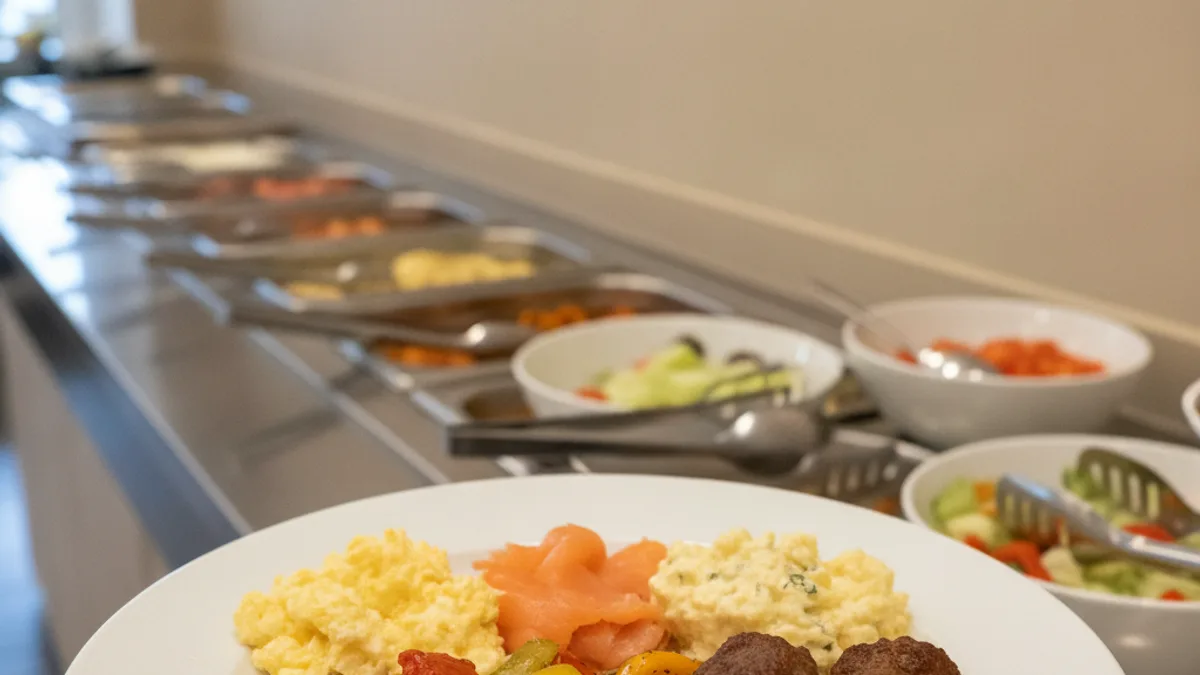
At a buffet, calorie counting can only be approximate, and that is normal. The error here does not arise because you are bad at counting, but because the portion size is not defined, the plate is assembled from various pieces, and there may be more than one trip to the food station.
Why the count is most inaccurate here
In a standard menu, a dish at least has boundaries: one plate, one name, one kitchen portion. At a buffet, these boundaries do not exist. You decide how much to take, you can go back for more, and identical-looking spoons in two different salads may hide completely different ingredients.
Because of this, the usual way of tracking breaks down: a person tries to recall dinner in one phrase—"something with rice, chicken, and salad"—and loses everything that happened between those words. Not because their memory is poor, but because the plate was not a single dish from the start.
Count the parts, not the plate
The working unit at a buffet is not a "trip" or a "whole plate," but individual blocks of food.
- Protein. Meat, fish, eggs, legumes, cheese.
- Side dish. Rice, potatoes, pasta, couscous.
- Vegetables and fruits. Separate from dressing and oil.
- Sauces and oils. As a separate entry, even if there was only a little.
- Bread, dessert, drinks. These are not additions to the plate, but independent items.
This makes the record longer, but more honest. "Chicken, rice, vegetables, a spoonful of sauce, a piece of bread, juice" is almost always more accurate than "dinner at the hotel."
How to estimate weight by eye
You won't get precision without a scale here, and you don't need to strive for it. You need an order of magnitude. Constant reference points work best for this: cutlery, half a plate, a standard palm-sized portion. Detailed guidelines can be found in the article on portion weight without a scale.
The error begins where a person tries to estimate the entire plate at once. It is more reliable to mentally break it down into sectors: here is the fish, here is the side dish, here is the salad, here is a spoonful of creamy sauce. The smaller the element, the easier it is not to lie to yourself about it.
What is missed most often
| What is missed | Why |
|---|---|
| Oil and dressings | They are already on the food or in the salad and are not perceived as a separate part |
| Second plate | The first is still remembered, the second is considered a "refill" rather than a new meal |
| Small pieces of dessert | It feels like a sample rather than a portion |
| Bread and pastries | They are taken on the way, not as a conscious decision |
| Juices, sodas, and alcohol | The drink is not felt as part of the dinner |
This is why the buffet is almost always undercounted not in the main dish, but in the details around it. For the same reason, restaurant tracking often breaks down on fat and sauces rather than the meat or fish itself—this is analyzed in the article on calories in a restaurant.
Multiple trips should be recorded as multiple decisions
The most common mistake here is not arithmetic, but narrative: a person thinks that everything happened as one dinner, which means everything can be recalled later as a single number. In reality, every return to the line is a new set of food and a new record.
Practically, it looks simple:
- take a photo of the plate before you start eating;
- if you go back for a refill, count it separately rather than adding it to the first in your head;
- record dessert and drinks immediately, without leaving them "for later."
A photo here is not for beauty, but as insurance against forgotten details. Skipping is almost always worse than a rough estimate: a zero in the diary is knowingly incorrect, while an approximate record at least preserves the order of magnitude.
What helps before you put food on your plate
At a buffet, it is useful to first walk the line with your eyes rather than grabbing a plate immediately. This is not about restriction or "willpower." It is easier to understand where the main food is, where the dessert is, and where the sauces are, and not to pile everything you see first onto one plate.
Another effective technique is to count sauces and sweet drinks as separate decisions. Then they stop being background noise and become what they are: part of the dinner with their own caloric value.
When there will be no accuracy at all
Complex casseroles, salads with mayonnaise, dishes in thick sauce, and unknown desserts at a buffet are almost impossible to estimate accurately. In such cases, it is better to record them as an approximate portion of a similar dish and note that it is an estimate.
This does not ruin your diary. Only a confident but false number ruins it. What other counting errors accumulate unnoticed is analyzed in a separate article.
In short
- At a buffet, there is no such thing as a standard portion, so an exact count is impossible by definition.
- You need to count not the whole plate, but individual parts: protein, side dish, vegetables, sauce, bread, dessert, drinks.
- Each new trip is a new record, not a "refill of the previous plate."
- A photo of the plate and an honest approximate estimate work better than trying to remember everything in the evening with one word.
Frequently asked questions
- Is it even possible to count calories at a buffet?
- Yes, but only approximately. There are no fixed portions here, so the goal is not precision down to the gram, but rather to honestly estimate the order of magnitude for the individual components on your plate and not overlook extras, sauces, and drinks.
- How should I log multiple trips to the buffet?
- As several separate entries. It is better to count each plate or addition individually rather than trying to remember everything as one single dinner at the end of the day.
- What is most often forgotten at a buffet?
- Sauces, oils, bread, small desserts, and drinks. These are the items most frequently forgotten because they are perceived as background elements around the main plate.
- What should I do with a dish in an unknown sauce or with a complex composition?
- Log it as an approximate portion of a similar dish and mark it as an estimate. Skipping it is worse than a rough but honest range.
Read next
- How to determine portion size without a scale — Portion weight is the most inaccurate variable in any calculation, including analysis by photo.
- How to count calories in a restaurant and with food delivery when there is no recipe — A home-cooked meal can be calculated by its ingredients, and packaged food can be checked on the label.
- Why the tracker shows a deficit but weight remains the same — The app has shown a deficit for four weeks, but the scale hasn't moved.
- Business trips: where calorie counting breaks down — It is not discipline that breaks down during a trip, but the very possibility of counting: there are no scales, no familiar dishes, and no control over where and when you eat.
This article is for general information. It is not medical advice, a diagnosis, or a prescription for treatment or a diet, and it does not replace a consultation with your doctor. If you have a health condition, are pregnant, take medication, or follow a diet prescribed to you, decisions about food belong with your doctor.
Figures from regulations, guidelines and studies are given as they stood when this article was prepared and may since have changed; check them against the primary sources. This article is not advertising, an offer, or individual advice, and neither the author nor the site owner is responsible for decisions taken on the basis of it.