How many calories are in syrniki: fried, baked, with different tvorog
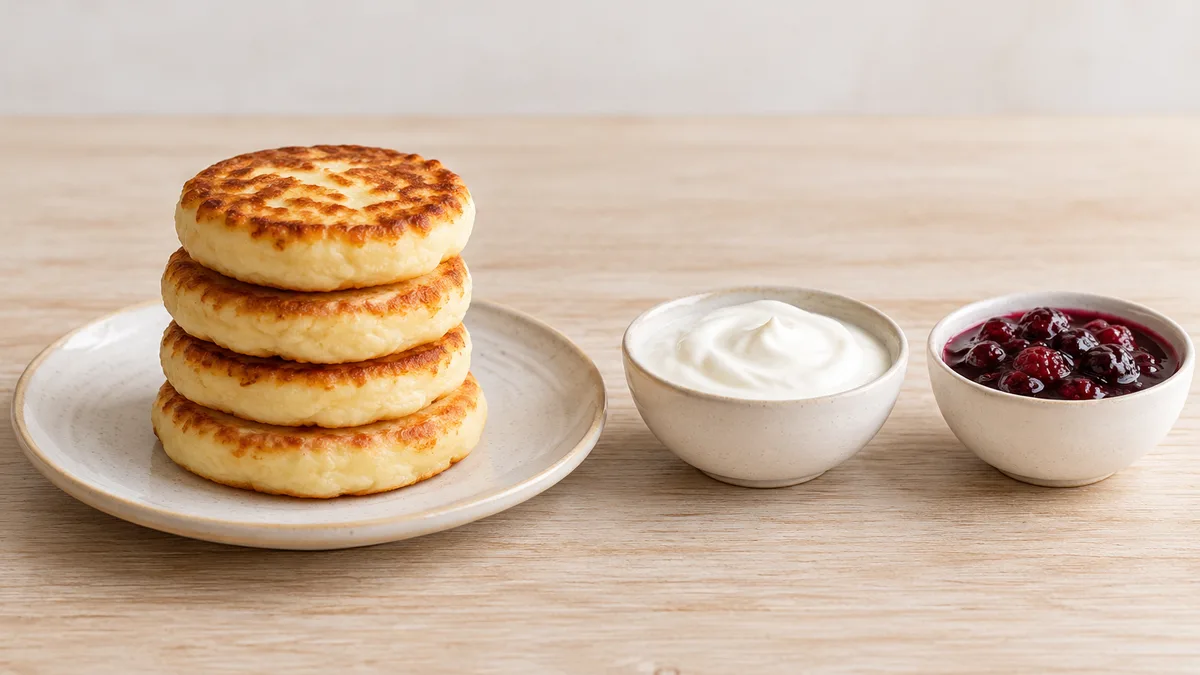
The FoodGPT reference card lists syrniki at 218 kcal per 100 g, so a 50 g syrnik is about 110 kcal. The homemade example below comes out lower, at 195 kcal per 100 g, and the two biggest variables are the oil in the pan and the fat content of the tvorog. Baking instead of frying takes about as many calories out of a batch as swapping 5% tvorog for fat-free.
When the reference figure is enough
The syrniki card in the calorie table lists 218 kcal per 100 g. That is a guide for syrniki in a café or from a deli counter, when the recipe is unknown.
Homemade syrniki are better counted from the recipe. The fat content of the tvorog, the amount of sugar and the oil in the pan are different in every kitchen, while the finished syrniki look almost the same.
How many calories each ingredient brings
For tvorog, the Russian fresh curd cheese, the FoodGPT reference cards are used: 5% tvorog has 121 kcal per 100 g and fat-free has 71. The other values come from USDA FoodData Central: wheat flour (FDC 168894), chicken egg (FDC 171287), sugar (FDC 169655) and sunflower oil (FDC 171025).
| Ingredient | Per 100 g | In the example recipe |
|---|---|---|
| Tvorog 5% | 121 kcal | 400 g = 484 kcal |
| Egg | 143 kcal | 1 egg, 50 g without shell = 72 kcal |
| Wheat flour | 364 kcal | 40 g = 146 kcal |
| Sugar | 387 kcal | 25 g = 97 kcal |
| Sunflower oil for the pan | 884 kcal | 20 g = 177 kcal |
Half of the calories in syrniki come from the tvorog. The oil comes second: 20 g in the pan bring more than the flour or the sugar on their own. Semolina instead of flour changes almost nothing: the FoodGPT reference cards list semolina at 333 kcal per 100 g and wheat flour at 342.
Example: 10 syrniki from the pan
The recipe from the table: 400 g of 5% tvorog, one egg, 40 g of flour, 25 g of sugar and 20 g of oil used in the pan.
- tvorog: 400 × 121 ÷ 100 = 484 kcal;
- egg: 50 × 143 ÷ 100 = 72 kcal;
- flour: 40 × 364 ÷ 100 = 146 kcal;
- sugar: 25 × 387 ÷ 100 = 97 kcal;
- oil: 20 × 884 ÷ 100 = 177 kcal.
The whole batch holds 975 kcal. The raw mixture weighed about 515 g, some water evaporated during frying, and in this example the finished syrniki weigh 500 g:
975 ÷ 500 × 100 = 195 kcal per 100 g.
That batch makes 10 syrniki of 50 g each, about 98 kcal apiece. A portion of three is about 290 kcal without sour cream.
Tvorog 0, 5 and 9%, the oven, sugar: what changes
Keep the recipe and change one thing. The finished weight is taken as 500 g throughout, so the figures can be compared with each other.
| Variant | Kcal per batch | Kcal per 100 g | Kcal per 50 g syrnik |
|---|---|---|---|
| Tvorog 9% | 1,103 | 221 | 110 |
| Example recipe, tvorog 5% | 975 | 195 | 98 |
| No sugar | 878 | 176 | 88 |
| Baked on paper, no oil | 798 | 160 | 80 |
| Fat-free tvorog | 775 | 155 | 77 |
For 9% tvorog the figure is calculated from the nutrition panel on the pack: 9 g of fat, 15 g of protein and 3 g of carbohydrate per 100 g give about 153 kcal. How that is calculated is explained in the article on the Atwater system.
If the pan took 40 g of oil instead of 20, the batch gains another 177 kcal and each syrnik rises to 115 kcal. The easiest way to find out how much oil was really used is to weigh the bottle before and after frying. The whole amount can be logged as eaten: that is a generous estimate, since some oil stays in the pan. More in the article on calories from frying.
Sour cream, jam, condensed milk: what the toppings add
The values come from the same FoodData Central records: sour cream (FDC 171257), jam (FDC 169641), honey (FDC 169640) and sweetened condensed milk (FDC 171275).
| Topping | Amount | Adds |
|---|---|---|
| Sour cream, about 20% | 20 g | 40 kcal |
| Jam | 20 g | 56 kcal |
| Honey | 20 g | 61 kcal |
| Condensed milk | 20 g | 64 kcal |
A level tablespoon of sour cream weighs 12 g in the USDA record, so 20 g is a heaped spoon. If the sour cream goes on generously, weigh it at least once.
How to count your own syrniki
- Add up the calories of the ingredients. Tvorog by the figure on the pack, oil by how much left the bottle.
- Weigh the finished syrniki. The whole batch at once, on a plate whose weight you know.
- Divide the calories by the weight and multiply by 100. That gives the calories per 100 g.
- Weigh your portion. Or divide the batch weight by the number of syrniki and count by the piece.
If you choose tvorog for more than its calories, the guide on how to choose tvorog by its ingredients and label will help.
Frequently asked questions
- How many calories are in one syrnik?
- A 50 g syrnik is about 110 kcal by the FoodGPT reference figure of 218 kcal per 100 g. In the article's homemade example with 5% tvorog and 20 g of oil per batch, it is about 98 kcal. The most accurate way is to weigh your own batch.
- How many calories are in 100 grams of syrniki?
- The FoodGPT reference card lists 218 kcal. Homemade syrniki come out at roughly 155 to 220 kcal per 100 g, depending on the tvorog, sugar and oil.
- How many calories are in baked syrniki?
- In the article's example, syrniki baked on paper without oil give 160 kcal per 100 g, against 195 for syrniki fried in 20 g of oil. The difference is all the oil that did not go into the pan.
- How much lighter are syrniki made with fat-free tvorog?
- In the article's example, 200 kcal lighter per batch made with 400 g of tvorog: 155 kcal per 100 g against 195 with 5% tvorog.
- How many calories does sour cream add to syrniki?
- 20 g of sour cream at about 20%, a heaped tablespoon, is about 40 kcal. The same amount of jam is 56 kcal, and of condensed milk 64 kcal.
Read next
- Tvorog: how to distinguish it from a tvorog product — On the tvorog shelf, there are four different products, and the difference between them is specified in the regulation.
- How many calories does frying add — The cooking method adds more calories to a dish than any choice between "healthy" and "unhealthy" foods.
- Why the body gets fewer calories than the label says — No one actually measured the number on the package: it was calculated by multiplying proteins, fats, and carbohydrates by factors over a century old.
- How many calories are in blini: made with milk, water or kefir — The FoodGPT reference card lists blini made with milk at 232 kcal per 100 g, so a 50 g blin has about 116 kcal.
This article is for general information. It is not medical advice, a diagnosis, or a prescription for treatment or a diet, and it does not replace a consultation with your doctor. If you have a health condition, are pregnant, take medication, or follow a diet prescribed to you, decisions about food belong with your doctor.
Figures from regulations, guidelines and studies are given as they stood when this article was prepared and may since have changed; check them against the primary sources. This article is not advertising, an offer, or individual advice, and neither the author nor the site owner is responsible for decisions taken on the basis of it.