How many calories are in blini: made with milk, water or kefir
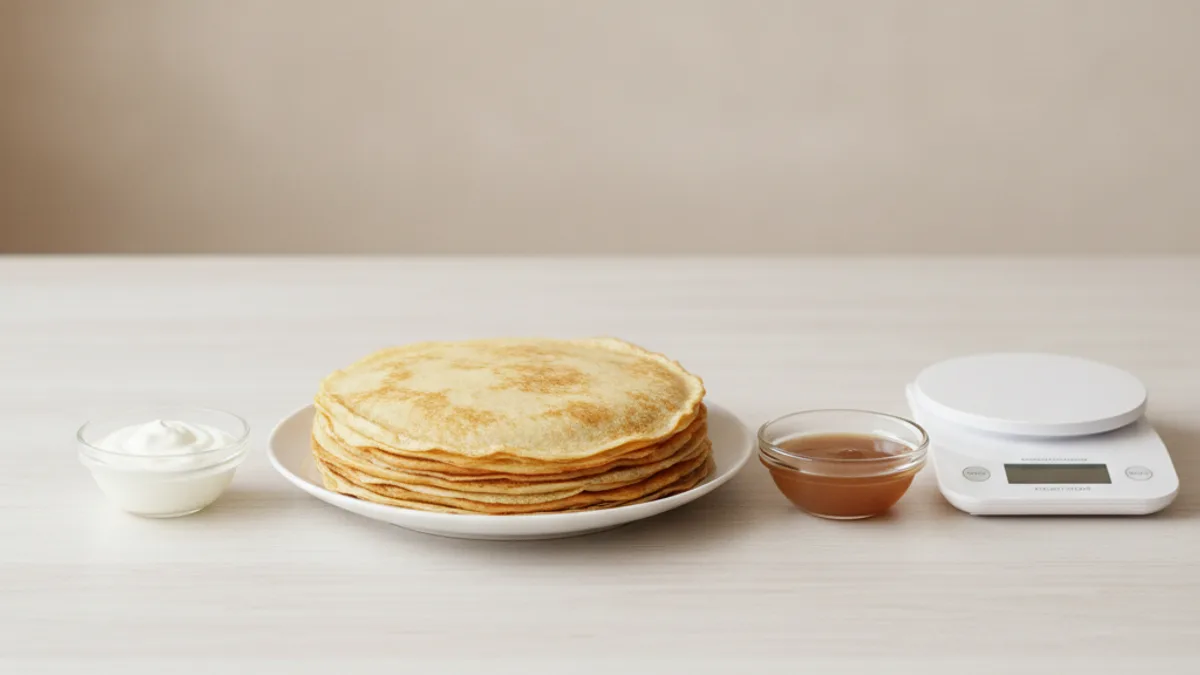
The FoodGPT reference card lists blini made with milk at 232 kcal per 100 g, so a 50 g blin has about 116 kcal. A home batch can differ noticeably: in the example below, swapping milk for water removes almost a fifth of the calories, and the oil in the batter supplies a sixth of all the energy. For your own stack, the exact answer comes from the grams of each ingredient and the weight of the finished blini.
When a reference value is enough
The FoodGPT blini card in the calorie table lists plain blini without filling at 232 kcal per 100 g. It is a guide for when the recipe is unknown: blini at a café, at a friend's place, or from a deli counter.
Blini you make yourself are better counted from the recipe. One batter is mixed with milk and three spoons of oil, another with water and no oil at all, and on the plate the two stacks look the same.
How many calories each ingredient brings
The values below come from USDA FoodData Central: wheat flour (FDC 168894), 3.25% whole milk (FDC 171265), whole egg (FDC 171287), granulated sugar (FDC 169655), sunflower oil (FDC 171025) and low-fat kefir of about 1% (FDC 170904). The numbers on your flour, milk or kefir packaging may differ, and for your own calculation the label matters more than the reference.
| Ingredient | Per 100 g | In the example recipe |
|---|---|---|
| Wheat flour | 364 kcal | 200 g = 728 kcal |
| Milk, 3.25% | 61 kcal | 500 g = 305 kcal |
| Eggs | 143 kcal | 2 eggs, 100 g without shell = 143 kcal |
| Sugar | 387 kcal | 25 g = 97 kcal |
| Sunflower oil in the batter | 884 kcal | 30 g = 265 kcal |
| Sunflower oil for the pan | 884 kcal | 10 g = 88 kcal |
| Water | 0 kcal | — |
| Kefir, about 1% | 43 kcal | — |
Flour supplies the most energy in the stack, milk comes second and the oil in the batter third. There is little sugar in a recipe like this: it adds less than the oil used on the pan.
200 g of flour is roughly one and a half 200 ml glasses, but kitchen scales are more reliable for counting than a glass.
Example: blini made with milk
Take the recipe from the table: 200 g flour, 500 g milk, two eggs, 25 g sugar, 30 g oil in the batter and 10 g oil used to grease the pan.
- flour: 200 × 364 ÷ 100 = 728 kcal;
- milk: 500 × 61 ÷ 100 = 305 kcal;
- eggs: 100 × 143 ÷ 100 = 143 kcal;
- sugar: 25 × 387 ÷ 100 = 97 kcal;
- oil in the batter and on the pan: 40 × 884 ÷ 100 = 354 kcal.
The whole stack contains 1,626 kcal. The batter weighed 855 g, but some water evaporates during cooking, and the finished blini in this example weigh 700 g. Calories per 100 g:
1,626 ÷ 700 × 100 = 232 kcal.
If the stack gave 14 blini, each weighs 50 g on average and has about 116 kcal. Your stack may not weigh 700 g, so use the number from your own scales in the formula.
Milk, water or kefir: what changes
Keep the same recipe and change only the liquid, or leave out the extras. For comparison, the finished weight is taken as the same 700 g every time. This is an arithmetic example: kefir batter is usually made thicker, and it yields fewer blini.
| Version | Kcal in the whole stack | Kcal per 100 g | Kcal in a 50 g blin |
|---|---|---|---|
| 500 g milk, oil and sugar in the batter | 1,626 | 232 | 116 |
| 500 g kefir, about 1% | 1,536 | 219 | 110 |
| 250 g milk and 250 g water | 1,474 | 211 | 105 |
| 500 g water | 1,321 | 189 | 94 |
| 500 g milk, no oil or sugar in the batter | 1,264 | 181 | 90 |
Swapping milk for water removes 305 kcal from the stack; leaving out the oil and sugar in the batter removes 362. The flour stays in every version, so blini made with water are not half as caloric: of their 1,321 kcal, 728 still come from flour.
Kefir falls between milk and water here only because a low-fat one was used. Kefir at 2.5 or 3.2% is closer to whole milk in calories, so check the label on your bottle.
Oil on the pan counts too
If the pan is greased before every blin, a batch uses a noticeable amount of oil. In the example it is 10 g and 88 kcal, more than the sugar added.
The simplest way to find your own number is to weigh the oil bottle before and after cooking. You can log all of it as eaten: some oil stays on the pan, so this estimate errs on the high side. For more precision, weigh the pan as well; the article on cooking oil calories explains how.
How much one blin weighs
A single blin has no standard weight. It depends on how much batter fits in the ladle, the diameter of the pan and how thick the batter is. Thin and thick blini from the same batter have the same calories per 100 g but different calories per piece.
So count grams, not pieces: weigh the whole stack and divide by the number of blini, or put your own serving on the scales. How to estimate a portion without scales is covered in the article on portion size.
Sour cream, condensed milk, honey: what the toppings add
The values come from the same FoodData Central entries: butter (FDC 173430), sour cream (FDC 171257), sweetened condensed milk (FDC 171275), honey (FDC 169640) and jam (FDC 169641).
| Topping | Amount | Adds |
|---|---|---|
| Butter | 5 g | 36 kcal |
| Sour cream, about 20% | 20 g | 40 kcal |
| Jam | 20 g | 56 kcal |
| Honey | 20 g | 61 kcal |
| Condensed milk | 20 g | 64 kcal |
A 116 kcal blin with condensed milk becomes a 180 kcal blin. Spoons vary, so it is more reliable to weigh the jar before and after, or to put the topping on a plate that sits on the scales.
Filled blini, with meat, cottage cheese or cabbage, are counted as two dishes: the blin on its own and the filling on its own, from its recipe.
How to count your own blini
- Weigh the flour, milk or other liquid, eggs, sugar and oil for the batter. Grams are more convenient than millilitres for liquids: bowl on the scales, tare, pour.
- Weigh the oil bottle before and after cooking. The difference is the oil used on the pan.
- Add up the calories of all ingredients. Water and salt add no calories.
- Weigh the finished stack without the plate. Divide the total calories by this weight and multiply by 100 to get calories per 100 g.
- Weigh your serving and its toppings. The serving's calories equal the calories per 100 g multiplied by the weight and divided by 100, plus whatever you ate it with.
You only need to do this once: if you cook from the same recipe, keep the figure per 100 g and weigh only the serving after that. The general method for any dish is in the article on counting calories in home cooking, and why the cooked weight matters more than the batter weight is explained in the article on weighing food raw or cooked.
Frequently asked questions
- How many calories are in one blin?
- It depends on its weight. The FoodGPT reference card lists blini made with milk at 232 kcal per 100 g, so a 50 g blin has about 116 kcal and a thin 35 g blin about 81 kcal. Weighing the stack and dividing by the number of blini is more accurate.
- How much lower in calories are blini made with water?
- In the article's example, 500 g of whole milk supply 305 of 1,626 kcal, and replacing it with water lowers the value from 232 to 189 kcal per 100 g. Most of the energy still comes from flour, so the difference is about a fifth, not half.
- How many calories are in a blin with sour cream or condensed milk?
- 20 g of sour cream at about 20% adds roughly 40 kcal, and 20 g of condensed milk about 64 kcal. A 50 g, 116 kcal blin with condensed milk comes to about 180 kcal.
- Should I count the oil used to grease the pan?
- Yes. The easiest way is to weigh the oil bottle before and after cooking and add the difference to the recipe: in the article's example that is 10 g and 88 kcal for the whole stack. Some oil stays on the pan, so this estimate is slightly high.
Read next
- How to count calories in homemade food — Processed foods are counted by the label, and restaurant meals by a reference guide.
- Raw or cooked weight: how to count grains, pasta, and meat — "100 g of buckwheat" can mean 346 kcal or 92, depending on the state of the grain.
- How many calories does frying add — The cooking method adds more calories to a dish than any choice between "healthy" and "unhealthy" foods.
- How to determine portion size without a scale — Portion weight is the most inaccurate variable in any calculation, including analysis by photo.
This article is for general information. It is not medical advice, a diagnosis, or a prescription for treatment or a diet, and it does not replace a consultation with your doctor. If you have a health condition, are pregnant, take medication, or follow a diet prescribed to you, decisions about food belong with your doctor.
Figures from regulations, guidelines and studies are given as they stood when this article was prepared and may since have changed; check them against the primary sources. This article is not advertising, an offer, or individual advice, and neither the author nor the site owner is responsible for decisions taken on the basis of it.