How many calories are in salo: salted, streaky, pork belly
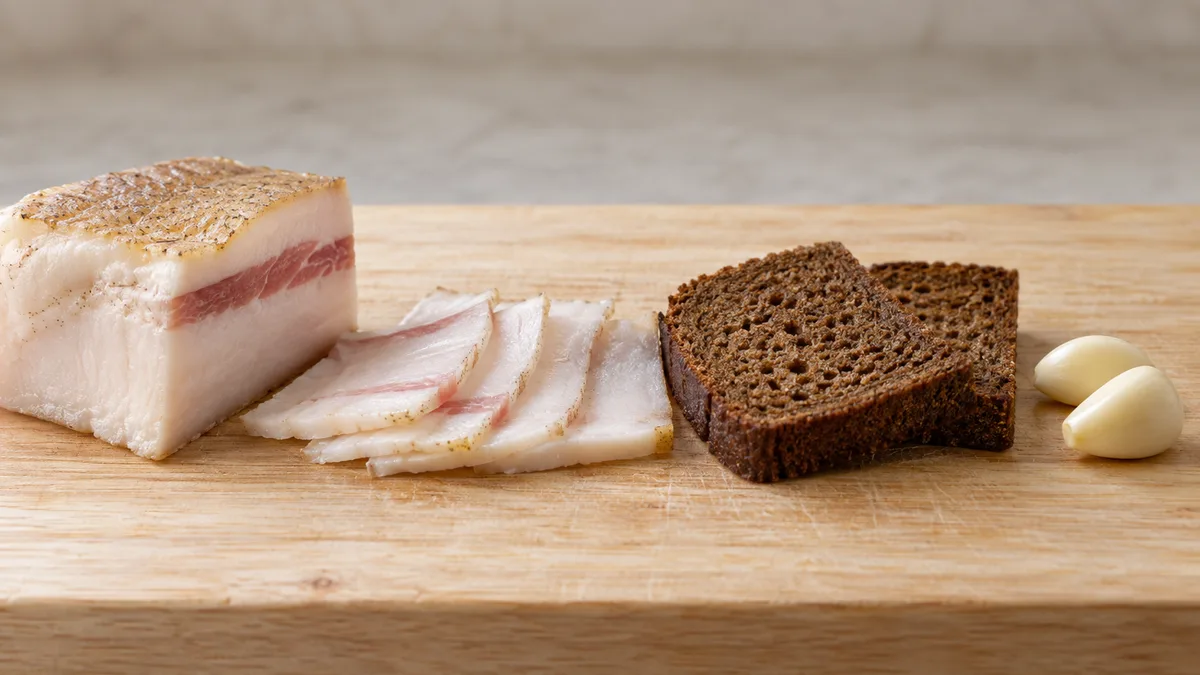
Salo has about 800 kcal per 100 g: the FoodGPT reference card for salted salo lists 816 kcal, and the USDA record for raw pork back fat lists 812. A thin 10 g slice is about 80 kcal, and a rye bread sandwich with it is about 160. Pork belly with its layers of meat is more than a third lighter than back fat, while the salt in salted salo can be around 3 g per 100 g or more than 6, depending on the cure.
Why salo is so high in calories
Salo is subcutaneous pork fat, and it is almost 90% fat. Back fat has less than 3 g of protein per 100 g, no carbohydrate and about 8% water. Its calorie count is therefore close to that of pure fat: 9 kcal per gram.
The FoodGPT salo card in the calorie table lists 800 kcal per 100 g. Raw pork back fat in USDA FoodData Central (FDC 167811) has 812 kcal. The sources differ by about 2%.
For comparison, butter (FDC 173430) has 717 kcal per 100 g and rendered pork fat, lard (FDC 171401), has 902. Salo sits between them.
Back fat, streaky salo, belly, jowl
What sets the calories of a piece is how much meat it contains. Meat is water and protein, with several times fewer calories than fat, so every pink layer makes the piece lighter. The values below come from USDA FoodData Central for raw, uncured cuts.
| Cut | FDC record | Kcal per 100 g | Fat, g | Protein, g |
|---|---|---|---|---|
| Back fat, no meat layers | 167811 | 812 | 88.7 | 2.9 |
| Jowl | 168269 | 655 | 69.6 | 6.4 |
| Belly with layers of meat | 167812 | 518 | 53.0 | 9.3 |
Salo with a thin streak of meat is closer to back fat, and salo with a thick one is closer to belly. The difference is noticeable: 30 g of back fat gives 244 kcal, 30 g of belly gives 155.
Salted, smoked, lard
Salted. Salt adds no calories, and the value per 100 g barely changes: salted back fat on the FoodGPT reference card has 816 kcal, raw back fat in USDA has 812. The American "salt pork" record (FDC 168287) has 748 kcal, but that is a different product with more meat in it, 5 g of protein per 100 g.
Smoked. USDA has no separate record for smoked salo. Smoking adds no fat, so smoked salo stays in the same range as salted salo when the share of meat is the same. For salo you bought, the exact figure is on the label.
Cracklings and lard. When salo is fried, fat renders out into the pan. The cracklings lose some of their fat, and the rendered lard is pure fat at 902 kcal. If it is poured off, it is not eaten. If potatoes are fried in it, it is counted with the potatoes like any other cooking fat, as covered in the article on calories from frying.
Calories in a slice and in a sandwich
The weight of a slice depends on how thin it is cut and how wide the block is. The FoodGPT reference card treats a thin slice as 10 g, and the calorie table uses a 20 g slice.
| Portion | Kcal |
|---|---|
| Thin slice of back fat, 10 g | 81 |
| Thicker slice, 20 g | 162 |
| Three thin slices, 30 g | 244 |
| Slice of rye bread, 30 g | 78 |
| Sandwich: 30 g rye bread and 10 g salo | 159 |
| Sandwich: 30 g rye bread and 20 g salo | 240 |
The bread value is the rye bread record (FDC 172684), 259 kcal per 100 g. A clove of garlic or some mustard on top changes almost nothing.
In a sandwich with thinly sliced salo, the salo supplies more than half of the calories; with a thick slice, two thirds.
What fats are in salo
According to USDA (FDC 167811), back fat has 42 g of monounsaturated fatty acids per 100 g, 32 g of saturated and 10 g of polyunsaturated. Salo contains more monounsaturated fat than saturated fat.
| Per 100 g | Saturated | Monounsaturated | Polyunsaturated |
|---|---|---|---|
| Pork back fat (FDC 167811) | 32.2 g | 42.0 g | 10.4 g |
| Butter (FDC 173430) | 50.5 g | 23.4 g | 3.0 g |
| Olive oil (FDC 171413) | 13.8 g | 73.0 g | 10.5 g |
Salo has less saturated fat than butter and more than olive oil. The WHO lists lard among sources of saturated fat and recommends that saturated fat supply no more than 10% of total energy intake. On a 2,000 kcal diet that is about 22 g. Thirty grams of back fat contain 9.7 g of saturated fat, more than 40% of that limit; a thin 10 g slice contains 3.2 g.
How the types of fat differ and what expert bodies say about them is covered in the guide to healthy fats.
How much salt is in salted salo
Raw back fat has almost no sodium, 11 mg per 100 g (FDC 167811). All the salt in salted salo comes from curing, and the amount depends on the method and how long it cured.
- The FoodGPT reference card for salted salo lists 2.9 g of salt per 100 g. Three thin slices give about 0.9 g.
- The American "salt pork" record (FDC 168287) has 2,684 mg of sodium per 100 g, which is about 6.7 g of salt. The same 30 g then give 2 g of salt.
The WHO recommends that adults eat less than 5 g of salt a day. A 30 g slice of rye bread adds about 0.45 g more to the sandwich. If your doctor has limited your salt, keep in mind that the amount in home-cured salo is not known in advance, while bought salo has salt or sodium on the label. Other places salt hides are covered in the article on hidden salt.
How to count your own salo
- Take the calories per 100 g. About 810 kcal for back fat without meat layers, about 520 for belly. If the package gives its own figure, use that.
- Weigh the block before and after slicing. The difference is what you cut. This is more accurate than counting slices.
- Multiply the weight by the calories and divide by 100. For 25 g of back fat: 25 × 812 ÷ 100 = 203 kcal.
- Add the bread and everything else on the plate. Weigh the bread too: slices from different loaves weigh differently.
Without scales, the guide on estimating portion size by eye helps. With salo, a guess costs a lot: an extra 10 g is an extra 80 kcal.
Frequently asked questions
- How many calories are in 100 grams of salo?
- About 800 kcal. The FoodGPT reference card for salted salo lists 816 kcal per 100 g, and the USDA FoodData Central record for raw pork back fat (FDC 167811) lists 812. Pork belly with layers of meat is lighter at 518 kcal per 100 g.
- How many calories are in one slice of salo?
- It depends on the weight of the slice. A thin 10 g slice has about 81 kcal, a 20 g slice about 162 kcal. The most accurate way is to weigh the block before and after slicing.
- How many calories are in a salo sandwich?
- A 30 g slice of rye bread with a thin 10 g slice of salo has about 159 kcal; with a 20 g slice, about 240 kcal. Most of the calories come from the salo, so its weight matters more.
- Which has more calories, salo or butter?
- Salo: about 810 kcal per 100 g against 717 for butter (FDC 173430). Salo has less saturated fat, though: 32 g per 100 g against 50 g in butter.
- How much salt is in salted salo?
- It depends on the cure. The FoodGPT reference card lists 2.9 g of salt per 100 g, the American salt pork record (FDC 168287) about 6.7 g. Three thin slices weighing 30 g give 0.9 to 2 g of salt, against the WHO recommendation of less than 5 g a day.
Read next
- Which fats are healthy and which are not — Dividing fats into "healthy" and "unhealthy" is convenient for a headline but almost useless at the grocery shelf: a single product usually contains all types at once, and the difference between them is not about general health benefits, but about specific effects.
- How to determine portion size without a scale — Portion weight is the most inaccurate variable in any calculation, including analysis by photo.
- Salt in processed food: where it is most abundant and why the salt shaker is not the culprit — The WHO recommendation is less than five grams of salt per day, but the actual intake is about twice that.
- How many calories does frying add — The cooking method adds more calories to a dish than any choice between "healthy" and "unhealthy" foods.
This article is for general information. It is not medical advice, a diagnosis, or a prescription for treatment or a diet, and it does not replace a consultation with your doctor. If you have a health condition, are pregnant, take medication, or follow a diet prescribed to you, decisions about food belong with your doctor.
Figures from regulations, guidelines and studies are given as they stood when this article was prepared and may since have changed; check them against the primary sources. This article is not advertising, an offer, or individual advice, and neither the author nor the site owner is responsible for decisions taken on the basis of it.