The FoodGPT raw vs cooked weight calculator: how it works and where it goes wrong
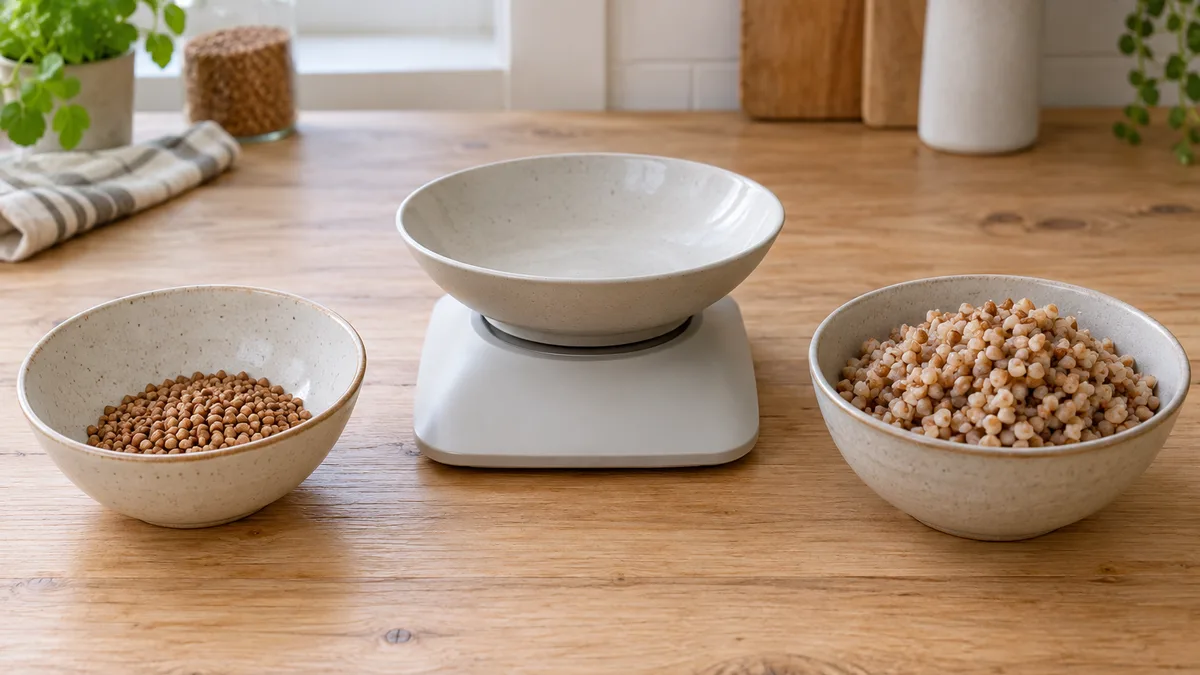
The calculator converts the weight of raw food into cooked weight and back, and counts calories from the raw food: cooking changes the weight, not the calories. It answers with a range, because the factors come from kitchen norms and USDA tables, not from measurements on your stove. The simplest way to get your own factor is to weigh the food before and after cooking.
What goes in and what comes out
The raw vs cooked weight calculator takes three inputs: a food with its cooking method, what is on the scale (raw or cooked food), and the weight in grams. It accepts any weight above zero up to 10,000 g.
The list has 18 entries: seven grains and pastas, seven entries for meat, poultry and fish, and four vegetables. Beef, pork and chicken breast have separate rows for boiling and for frying or roasting, because meat loses weight differently in each. There are no other foods in the calculator.
The answer has three numbers:
- the weight of the food in the other state;
- the calories in the amount you entered;
- the calories per 100 g in the other state.
If raw food is on the scale, the cooked weight is shown as a range and the calories as one number. If cooked food is on the scale, both the raw weight and the calories are ranges: there may have been more or less raw food, and the calories follow it. Why this matters is covered in the article on raw and cooked weight: calories are counted from what is on the scale, and a reference row may describe another state of the food.
Example: buckwheat in both directions
Raw buckwheat is 308 kcal per 100 g in the site’s calorie table. The calculator’s factor is 2.1 to 4.0.
- 100 g of dry groats on the scale. The cooked porridge will weigh 210 to 400 g, the calories are 308, and 100 g of cooked porridge has 77 to 147 kcal.
- 250 g of cooked porridge on the scale. There were 63 to 119 g of dry groats, and the plate holds 193 to 367 kcal.
In the second case the two ends differ almost twofold. Crumbly and sticky porridge from the same grain differ that much, and the weight of a cooked plate cannot tell them apart.
What the calculation is based on
The factor is the weight of the cooked food divided by the weight of the raw food. For grains it is above one, because they absorb water; for meat it is below one, because it loses water. The ends of the range are the smallest and the largest values among the sources listed for that food. The calculator does not show an average.
There are three sources.
- Order no. 818 of the Federal Penitentiary Service of Russia (FSIN) of 24 September 2019, annexes 3, 4 and 5 (meat and fish, potatoes and vegetables, grains). These are yield norms for cooked dishes from the rules for feeding staff of the penal system. For porridges they give how much porridge comes from 100 g of grain at a set amount of water and salt, separately for crumbly and sticky. For meat and vegetables they give the yield of a cooked portion from a set weight of prepared food.
- The USDA Table of Cooking Yields for Meat and Poultry (USDA Agricultural Research Service, 2012). It gives the change in the weight of meat in cooking as a percentage: the mean and the lowest and highest values across samples.
- USDA FoodData Central, the SR Legacy data. Here the factor is derived indirectly: the calories in 100 g of the dry food divided by the calories in 100 g of the cooked food. The method relies on energy not changing in boiling, only the water. That is how 3.8 for roasted buckwheat (346 and 92 kcal per 100 g) and 3.0 for lentils (352 and 116 kcal) were obtained.
The calories of the raw food come from the site’s calorie table, the same one used in the reference section, so that numbers do not diverge between pages.
| Food and method | Factor | Basis |
|---|---|---|
| Buckwheat, boiled | 2.1–4.0 | FSIN: 210 g crumbly or 400 g sticky porridge from 100 g of groats; USDA: 3.8 times |
| White rice, boiled | 2.8–4.5 | FSIN: 280 and 450 g; USDA: 2.8 times |
| Pasta, boiled | 2.35–3.5 | FSIN: 250 g drained or 350 g undrained; USDA: 2.35 times |
| Rolled oats, cooked in water | 4.0–5.3 | FSIN: 400 g of sticky porridge; USDA: 5.3 times |
| Lentils, boiled | 3.0 | USDA, one source |
| Beef tenderloin, fried or grilled | 0.64–0.8 | FSIN: 47 g from 74 g; USDA: grilled, 80% on average |
| Chicken breast, fried or roasted | 0.72–0.79 | USDA: roasted 72%; grilled 79% (120 kcal raw and 151 kcal cooked per 100 g) |
| Chicken breast, boiled | 0.76–0.77 | USDA: braised 76% (120 and 157 kcal per 100 g), simmered 77% |
| Peeled potato, boiled | 1.0 | FSIN, one source |
| Pumpkin, boiled | 0.83 | FSIN: 58 g from 70 g, one source |
The full table with all 18 entries and the basis of each is at the bottom of the calculator page.
Where the calculator goes wrong
The range is the spread between sources, not between pots. For boiled chicken breast the calculator shows a factor of 0.76–0.77, because two sources almost coincide. For 200 g of cooked breast that is 260–263 g raw. But in the USDA table the same method gives 70 to 88% across individual samples, which would make the same 200 g of cooked breast 227–286 g raw, and 257 to 323 kcal instead of 294–297. A narrow range in the calculator means the sources agree, not that it is accurate for your piece of meat.
Method and time. In the FSIN norms every grain has two figures, nearly twofold apart. For meat the weight depends on how well done it is and how thick the cut is: grilled beef tenderloin is 80% on average in the USDA table and 71–86% across samples. The calculator knows nothing about your kitchen.
Drained water and fat. The calculator assumes the calories of a portion do not change in cooking, only the weight. For grains that is a reasonable assumption. For meat, some fat renders out into the pan or the broth, and if you do not eat it, the plate holds fewer calories than shown. The calculator does not estimate by how many.
Cooking oil. The calculator does not add it: there is no oil in the calculation. If you fried in oil, add its calories separately; how is described in the article on calories from frying.
One source. Lentils, peeled potato and pumpkin have no range because only one source was found, and the calculator says so on the page. That is not precision but the absence of a second number to compare with: variety, amount of water and cooking time shift the result.
Peeled and boneless. The factors apply to peeled vegetables and boneless meat. For potatoes, the FSIN norms give a cooked yield equal to the peeled weight (80 g raw and 80 g boiled), while peeling waste is a separate column and depends on the season. If you weighed potatoes with their skins or meat on the bone, subtract the inedible part first, as in the article on bones and peel.
Three sources, three methods. The FSIN norms describe a recipe with set water and salt. The USDA table was measured on samples of American meat. The grain factors from FoodData Central come from dividing the calories of two different database records. The calories of the raw food come from the site’s table, and for the same grain they can differ from the USDA record: buckwheat is 308 kcal in the site’s table against 346 for roasted buckwheat in USDA. That is why the calculator shows a range and not an average: the numbers were obtained in different ways and do not add up to a single point.
How to find your own factor
Weigh the food once before and after cooking. The factor then belongs to your stove, your pot and your usual amount of water.
- Weigh the dry food and write the weight down. For meat, weigh the boneless flesh.
- Cook it the way you usually do.
- Weigh the cooked food in the same dish, subtracting the weight of the empty dish: zero the scale with it or subtract by hand.
- Divide the cooked weight by the dry weight. If 80 g of dry groats made 240 g of porridge, the factor is 3.0.
Repeat the measurement two or three times: the spread between batches shows how stable the factor is for you. When you cook for several days, it is more reliable to weigh the whole dry batch and the whole cooked dish, and count a portion as a share of the total. Calories are counted from the dry weight.
When you do not need the calculator
- You weigh the dry food before cooking. Calories are counted from it, and no factor is needed.
- You have your own measured factor. It is more accurate than a reference range.
- The dish is composite: milk porridge, pilaf, a stew. It is counted from the ingredients, as in the article on calories in home cooking, not from the row of one food.
- The package gives values for the food as cooked: use the label.
A range of tens or hundreds of kilocalories per portion is no reason to chase grams. If counting brings anxiety or guilt, it is worth talking to a specialist. Estimating a portion without a scale is covered in the article on portion weight.
You can run your own case in the raw vs cooked weight calculator. The data are as of 6 October 2026.
Frequently asked questions
- Where do the raw vs cooked weight calculator’s factors come from?
- From three sources: the yield norms for cooked dishes in Russian FSIN order no. 818 of 24 September 2019, the USDA Table of Cooking Yields for Meat and Poultry (2012), and the ratio of the calories of dry and cooked food in USDA FoodData Central.
- Why does the calculator show a range and not one number?
- The weight of cooked food depends on the method and time, the amount of water and how the food is cut. In the FSIN norms every grain has two values, crumbly and sticky porridge, and the ends of the range come from different sources.
- Do calories change in boiling and frying?
- The calculator assumes that the calories of a portion do not change, only the weight does. It does not add cooking oil, and it does not subtract fat left in the pan or the broth.
- Why is there one source and no range for lentils, potatoes and pumpkin?
- Only one source was found for these foods: USDA for lentils, the FSIN order for potatoes and pumpkin. There is no range not because the number is exact, but because there is nothing to compare it with.
- How do I find my own raw to cooked factor?
- Weigh the dry food, cook it as usual, weigh the cooked food and divide the second weight by the first. Repeat two or three times, and count calories from the dry weight.
- Do I need the calculator if I weigh grains dry?
- No. Calories are counted from the dry weight, and a factor is only needed when you managed to weigh the food cooked.
Read next
- Raw or cooked weight: how to count grains, pasta, and meat — "100 g of buckwheat" can mean 346 kcal or 92, depending on the state of the grain.
- Bone-in chicken, watermelon with rind, nuts in the shell: log only what you ate — Log the weight of what you ate, not what was on the plate.
- How many calories does frying add — The cooking method adds more calories to a dish than any choice between "healthy" and "unhealthy" foods.
- How to determine portion size without a scale — Portion weight is the most inaccurate variable in any calculation, including analysis by photo.
This article is for general information. It is not medical advice, a diagnosis, or a prescription for treatment or a diet, and it does not replace a consultation with your doctor. If you have a health condition, are pregnant, take medication, or follow a diet prescribed to you, decisions about food belong with your doctor.
Figures from regulations, guidelines and studies are given as they stood when this article was prepared and may since have changed; check them against the primary sources. This article is not advertising, an offer, or individual advice, and neither the author nor the site owner is responsible for decisions taken on the basis of it.