How many calories are in an egg: boiled, fried, omelette, white and yolk
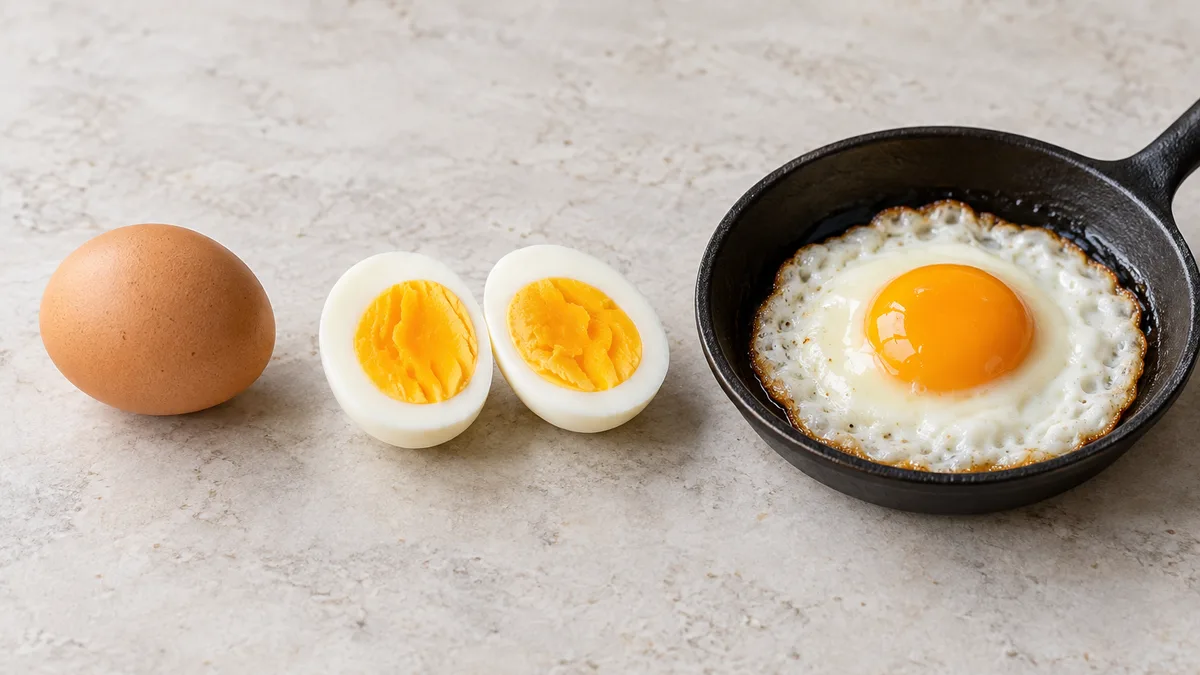
A large egg without its shell weighs about 50 g and has 72 kcal. A boiled egg is almost the same as a raw one: 155 kcal per 100 g against 143. A fried egg gains the oil it soaked up: the USDA record gives 90 kcal for a large fried egg. Of the 72 kcal in a raw egg, 55 are in the yolk and 17 in the white.
How many calories are in one egg
The calories in an egg depend first of all on its weight. In USDA FoodData Central a raw whole egg (FDC 171287) has 143 kcal per 100 g. The same record gives the weight of the edible part, without the shell, for eggs of different sizes.
| USDA size | Weight without shell | Raw | Boiled |
|---|---|---|---|
| Small | 38 g | 54 kcal | 59 kcal |
| Medium | 44 g | 63 kcal | 68 kcal |
| Large | 50 g | 72 kcal | 78 kcal |
| Extra large | 56 g | 80 kcal | 87 kcal |
| Jumbo | 63 g | 90 kcal | 98 kcal |
For boiled eggs the hard-boiled record (FDC 173424) is used, 155 kcal per 100 g. Boiling adds no oil, and a difference of five to eight calories per egg does not matter for counting.
С0, С1, С2: what the category on a Russian pack means
Egg categories in Russia are set by the interstate standard GOST 31654-2012. The category depends on the weight of one egg:
| Category | Mark | Weight of one egg |
|---|---|---|
| Highest | В | 75 g and over |
| Selected | О | 65–74.9 g |
| First | 1 | 55–64.9 g |
| Second | 2 | 45–54.9 g |
| Third | 3 | 35–44.9 g |
The first letter of the mark is the type of egg: Д for dietary, С for table. A dietary egg is one with a storage time of no more than 7 days. The selected category is marked with the letter О, so the correct mark is «СО» with a letter, not «С0» with a zero.
The weight in the standard is the weight of the whole egg, shell included. The edible part is lighter, so for accurate counting it is worth cracking one egg from the pack into a bowl on the scales. Within one category the weight in the shell varies by no more than 10 g, so one weighing covers the whole pack.
Fried, omelette, poached
Values per 100 g from FoodData Central.
| How cooked | FDC record | Kcal per 100 g |
|---|---|---|
| Raw | 171287 | 143 |
| Poached | 172186 | 143 |
| Scrambled | 172187 | 149 |
| Omelette | 172185 | 154 |
| Hard-boiled | 173424 | 155 |
| Fried | 173423 | 196 |
Frying changes the most. A large fried egg in the USDA record weighs 46 g and gives 90 kcal, 18 more than a raw one. That is the oil it absorbed. In practice it all depends on the pan: a teaspoon of sunflower oil (FDC 171025) weighs 4.5 g and brings 40 kcal, and 5 g of butter (FDC 173430) brings 36.
If you poured oil and ate the egg together with it, count all of the oil. How to count what stayed in the pan is covered in the article on calories from frying. An omelette with milk, cheese or ham is counted by its ingredients; for a guide there are the omelette and fried eggs cards in the calorie table.
The white and the yolk separately
According to FoodData Central, raw egg white (FDC 172183) has 52 kcal per 100 g and yolk (FDC 172184) has 322. A large egg holds about 33 g of white and 17 g of yolk.
| Part of a large egg | Weight | Kcal | Protein, g | Fat, g |
|---|---|---|---|---|
| White | 33 g | 17 | 3.6 | 0.1 |
| Yolk | 17 g | 55 | 2.7 | 4.5 |
Three quarters of an egg's calories are in the yolk, but the yolk has almost as much protein as the white: 2.7 g against 3.6. An egg-white omelette is lighter, but vitamins A, D and E go with the yolk: according to FoodData Central, the white has none. More on counting protein in your diet in the article on daily protein intake.
Cholesterol in eggs has an article of its own: dietary cholesterol.
How to count the eggs in your breakfast
- Find the weight of the egg without its shell. Crack one egg on the scales once, or take the weight from the size table.
- Multiply the weight by the calories. 55 g × 143 ÷ 100 = 79 kcal raw, 55 g × 155 ÷ 100 = 85 kcal boiled.
- Add the oil if you fried it. Weigh the bottle before and after, or count by the spoon.
- Add the milk, cheese and anything else that went into the omelette or onto the plate.
Frequently asked questions
- How many calories are in one boiled egg?
- A large boiled egg without its shell weighs about 50 g and gives about 78 kcal by USDA data (FDC 173424, 155 kcal per 100 g). An egg weighing 44 g without its shell is about 68 kcal.
- How many calories are in a fried egg?
- In the USDA record a large fried egg weighs 46 g and gives 90 kcal, 18 more than a raw one. The exact figure depends on the oil: a teaspoon of sunflower oil adds about 40 kcal.
- How many calories are in the white and the yolk?
- The white of a large egg, about 33 g, has 17 kcal, and the 17 g yolk has 55 kcal. Per 100 g that is 52 and 322 kcal by USDA data.
- What do С0 and С1 on Russian eggs mean?
- Under GOST 31654-2012 the first letter is the type of egg (Д for dietary, С for table), followed by the weight category. «СО» is a selected table egg, 65–74.9 g; «С1» is a first-category table egg, 55–64.9 g. The weight includes the shell.
- How many calories are in a two-egg omelette?
- Two large eggs without their shells are about 144 kcal. Add the oil in the pan, the milk and the filling. The USDA record for a finished omelette lists 154 kcal per 100 g.
Read next
- How many calories does frying add — The cooking method adds more calories to a dish than any choice between "healthy" and "unhealthy" foods.
- How much protein do you need per day — There are two opposing figures regarding protein: the official recommendation of about 0.
- Cholesterol in food: do eggs affect blood cholesterol — Cholesterol from food and cholesterol in blood tests are not the same substance in different places, but two weakly related values.
- Three protein-rich breakfasts that take ten minutes to prepare — The usual breakfast has one problem, and it's not the calories: porridge made with water, toast with jam, and coffee contain almost no protein.
This article is for general information. It is not medical advice, a diagnosis, or a prescription for treatment or a diet, and it does not replace a consultation with your doctor. If you have a health condition, are pregnant, take medication, or follow a diet prescribed to you, decisions about food belong with your doctor.
Figures from regulations, guidelines and studies are given as they stood when this article was prepared and may since have changed; check them against the primary sources. This article is not advertising, an offer, or individual advice, and neither the author nor the site owner is responsible for decisions taken on the basis of it.