Bread units: how to count them and who needs them today
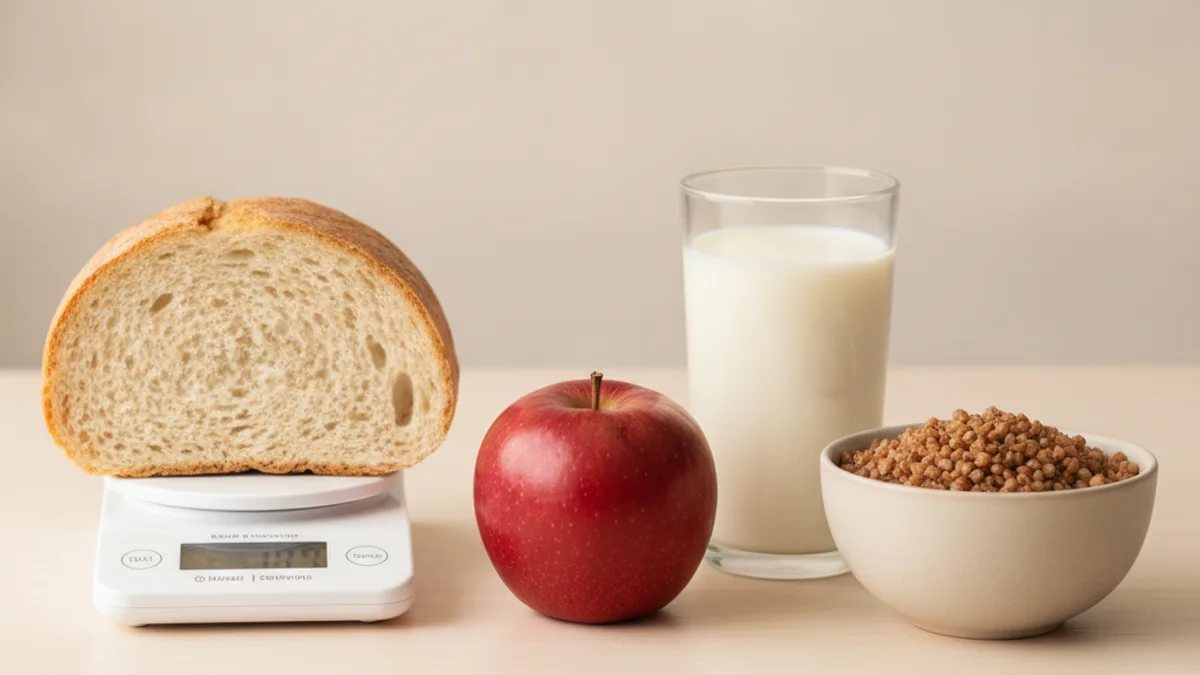
A bread unit is a measure of carbohydrates designed to convert food into an insulin dose. It does not have a single value: in Russia and the UK, they count 10–12 g of carbohydrates per unit, in German-speaking countries it is 12, and in the US it is 15. Therefore, two BU tables from different sources may differ by half, and this is not an error in either of them.
How many grams is one carbohydrate unit
There is no single standard. A review on carbohydrate counting for type 1 diabetes lists four national versions: 1 carbohydrate unit in Poland is 10 g of digestible carbohydrates, in the UK it is 10 g, in German-speaking countries it is 12 g, and in the US one "carbohydrate serving" is 15 g.
In Russian-speaking practice, a "bread unit" (HE) is usually understood as 10–12 g of carbohydrates. The variation is due to the origin of the value: it is a convention for ease of calculation, not a physical constant.
There is one practical consequence that should be checked before counting: in any HE table, first check what value it is based on. A 15 g table and a 10 g table will give different units for the same apple.
Why the system appeared
It is not intended for weight loss or "healthy eating." HE converts a plate of food into a value that insulin therapy works with: how many carbohydrates will be consumed and what dose of rapid-acting insulin corresponds to that. The ratio of "insulin units per one HE" is individual, changes throughout the day, and is determined by a doctor—it is part of medical treatment, not arithmetic from an article.
The benefits of learning this type of counting have been measured. In the British DAFNE study, adults with type 1 diabetes were trained in flexible dose adjustment based on consumed carbohydrates; after 6 months, HbA1c was 8.4% versus 9.4% in the delayed training group, with significant improvements in perceived dietary freedom and quality of life, while the frequency of severe hypoglycemia remained unchanged.
How to calculate HE on your plate
The formula is simple: portion weight in grams × carbohydrates per 100 g ÷ 100 ÷ 12. Or vice versa, if you need to find the weight of one unit: 1200 ÷ (carbohydrates per 100 g).
Carbohydrate values are approximate, based on the USDA food composition database; specific packages have their own values listed on the label.
| Product | Carbohydrates per 100 g | 1 HE (12 g) is approximately |
|---|---|---|
| Wheat bread | about 49 g | 25 g |
| Cooked buckwheat | about 20 g | 60 g |
| Boiled potatoes | about 17 g | 70 g |
| Apple | about 12 g | 100 g |
| Milk 2.5% | about 5 g | 240 ml |
| Sugar | about 100 g | 12 g |
The main mistake here is the same as in calorie counting: taking a value from a reference book for a dry product while eating a cooked one. Grains absorb water during cooking and lose carbohydrates per 100 g by a factor of three or four. There is a separate article about this discrepancy — dry or cooked weight.
What the system does not account for
HE only counts the amount of carbohydrates. It does not account for:
- Rate of absorption. 12 g of carbohydrates from juice and from lentils behave differently; this is described by the glycemic index, not the carbohydrate unit.
- Fat and protein in the same dish. They slow down gastric emptying, and the glucose rise is spread out over time.
- Accuracy of weight estimation. This is the weakest point: in a study of adults with type 1 diabetes, the discrepancy between their carbohydrate estimation and a dietitian's calculation averaged 15.4 ± 7.8 g per meal — about 21% of the plate's content, with carbohydrates being underestimated in 63% of cases.
Units or grams
The trend in recent years is to count carbohydrates directly in grams: pumps and apps work with grams, and an intermediate conversion into units is unnecessary for them. The same review describes this as established practice.
The extent to which carbohydrate counting itself improves control was evaluated in a meta-analysis of seven trials (599 adults and 104 children with type 1 diabetes). Across all studies combined, the difference in HbA1c did not reach significance (−0.35%, p = 0.096), but in five parallel studies in adults, the reduction was 0.64 percentage points. The variation was attributed to different study designs.
It is worth noting separately that for type 2 diabetes without insulin therapy, HE is usually not needed; simpler things work better—total food quantity, plate composition, and weight. What is known about this from trials is analyzed in the article on nutrition for type 2 diabetes.
How to count faster
You have to count units in your head when the composition is unknown. Three things speed up the process:
- Weigh what can be weighed. Grains, pasta, and potatoes—before cooking, if possible: values for dry products are more stable.
- Memorize five of your own portions. A regular bowl of porridge, a habitual slice of bread, a glass of milk: if you weigh them once, your visual estimation will be more accurate later. Techniques are described in the article on portion weight without scales.
- Look at the label, not the table. For a finished product, carbohydrates are listed on the packaging—this is more accurate than any averaged reference book.
Analyzing a dish from a photo provides carbohydrates along with other macronutrients, and from there, it is just one step to units. How to keep such a count when the dish composition is unknown is described in the article on macronutrient tracker.
Frequently asked questions
- How many grams of carbohydrates are in one bread unit?
- It depends on the country: in Poland and the UK, a unit equals 10 g of digestible carbohydrates, in German-speaking countries it is 12 g, and in the US, a carbohydrate portion is 15 g. In Russian-language practice, it is usually calculated as 10–12 g.
- How to convert a product into bread units?
- Divide the amount of carbohydrates in a portion by the unit value. For 12 g: portion weight × carbohydrates per 100 g ÷ 100 ÷ 12. The reverse calculation — 1200 ÷ carbohydrates per 100 g — immediately gives the weight of one unit.
- Do I need to count bread units for type 2 diabetes?
- In non-insulin therapy, usually not: a doctor determines the nutritional approach, and it is often based on the total amount of food and weight rather than converting meals into units.
- Why does the bread unit count not match the actual glucose response?
- A unit only accounts for the amount of carbohydrates. The rate of absorption, as well as fat and protein in the same meal and weight estimation errors, are not included: in a study of adults with type 1 diabetes, the discrepancy with a dietitian's calculation averaged 15.4 g per meal.
- Should I count in units or grams of carbohydrates?
- Apps and insulin pumps work with grams, and an intermediate conversion to units is unnecessary for them. Units remain convenient where calculations are done mentally and based on familiar portions.
Read next
- What is KBZHU — KBZHU represents four numbers that describe food: caloric content and the three macronutrients that make it up.
- Glycemic index: what it measures and when it is useless to use — Glycemic index tables look like a list of allowed and forbidden foods: buckwheat has one number, potatoes have another, and it seems straightforward from there.
- Diabetic products: what changes in them besides the price — The label "for diabetic nutrition" describes one property of a product — it contains fewer simple sugars than its standard counterpart.
This article is for general information. It is not medical advice, a diagnosis, or a prescription for treatment or a diet, and it does not replace a consultation with your doctor. If you have a health condition, are pregnant, take medication, or follow a diet prescribed to you, decisions about food belong with your doctor.
Figures from regulations, guidelines and studies are given as they stood when this article was prepared and may since have changed; check them against the primary sources. This article is not advertising, an offer, or individual advice, and neither the author nor the site owner is responsible for decisions taken on the basis of it.