BJU counter: how to use it when the dish composition is unknown
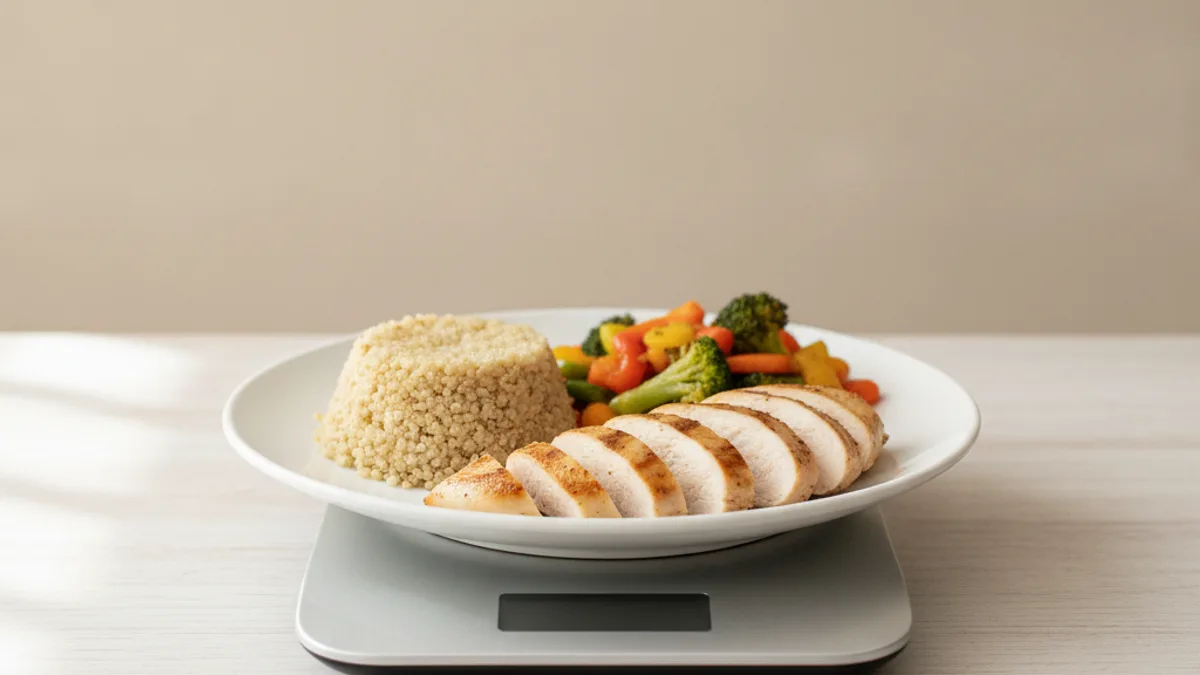
A calorie counter answers one question, a BJU counter answers four. Proteins, fats, and carbohydrates are added, and with them, three new sources of discrepancies. The most frequent question, however, is not about formulas, but about practice: what to enter when the dish composition is unknown — and it is unknown for most of what a person eats outside the home.
Why four numbers are more complex than one
Caloric content in databases is most often not measured, but calculated from macronutrients. This means that an error in proteins, fats, and carbohydrates is already embedded within the calorie count, rather than being added to it.
There is also an inverse relationship. Carbohydrates in reference books are usually obtained by subtraction: water, protein, fat, ash, and fiber are subtracted from the product mass. Everything that could not be accounted for flows into carbohydrates. Therefore, this specific column is the noisiest of the four.
Hence a typical situation: proteins, fats, and carbohydrates, multiplied by 4, 9, and 4, do not yield the stated caloric content. Why this is normal and when it should actually be a cause for concern is covered in the article on nutritional labels. What the letters themselves mean is covered in the article what is KBZHU.
Three levels of composition knowledge
Practically everything a person eats falls into one of three categories, and they must be handled differently.
- Packaging with a table. The numbers are there. The error lies within the permissible deviations plus the difference between the stated and actual portion mass.
- Homemade dish. The numbers are calculated based on ingredients. The main source of error is oil and what happens to water during cooking.
- Dish without a recipe. Restaurant, cafeteria, delivery, deli counter. There is nowhere to get the numbers from.
What to do with the third category
This is the main practical question. It cannot be solved completely, but the scale of the error is known.
A study of the energy value of frequently ordered restaurant dishes yielded 1205 ± 465 kilocalories per dish in independent establishments — a value that did not differ significantly from comparable dishes at large chains. Ninety-two percent of the dishes exceeded the typical energy requirement for a single meal. Publication in the Journal of the Academy of Nutrition and Dietetics.
Note the spread: ±465 kilocalories with an average of 1205. This is not a measurement error, but a real difference between dishes — and it is greater than the daily deficit that is usually planned.
A separate study checked the accuracy of the stated nutritional value of menus in university catering by recalculating based on recipes — Appetite. The general pattern: a discrepancy exists and more often leans toward underestimation, because fat in cooking is the most underestimated variable. With a coefficient of 9 kilocalories per gram, an error of one tablespoon of oil is about one hundred kilocalories that no one noticed.
What is known about the figures in delivery app cards is in the article on nutritional values in delivery apps, and about restaurant dishes — in the article how to count calories in a restaurant.
What analyzing a dish by photo provides
The model determines what is on the plate from a snapshot and estimates the portion weight. This is not a measurement: estimating weight from an image has its own margin of error, and the composition of the sauce and the amount of oil remain invisible. How the recognition itself works is in the article on how neural networks recognize food, and where it confidently makes mistakes — in the article on confidently stated incorrect figures.
The advantage here is not in accuracy, but in the fact that the entry is made at the moment of eating, rather than reconstructed from memory in the evening. A missed item causes a greater error than an inaccurate estimate of one that was recorded.
Three sources of error that are immediately visible
- Raw or cooked weight. 100 grams of dry buckwheat and 100 grams of cooked buckwheat are different things: when boiled, the grain absorbs water and the weight increases approximately threefold. Both items are in the databases, and it is easy to confuse them.
- Oil that is not visible. Absorbed into a cutlet, left in a salad, poured into a frying pan. It is accounted for by how much was poured, not by how much is visible on the plate.
- Weight including non-edible parts. Bones, peels, brine, shells. An entry in the database may refer to the edible part, while the scale shows everything.
How to estimate portion weight when there are no scales is covered in the article on determining weight without scales.
What is actually needed from a calorie counter
Not the accuracy of absolute numbers, but the consistency of the method. One database, one way to determine weight, one rule for raw and cooked. Then weeks are comparable to each other, and from the four columns, you can see what they are usually kept for: how much protein you are actually getting. How much is needed is covered in the article on daily protein intake.
Frequently asked questions
- How does a calorie-protein-fat-carbohydrate tracker differ from a calorie tracker?
- It tracks four values instead of one. Calorie counts in databases are most often calculated from proteins, fats, and carbohydrates, so any error in macronutrients is already embedded within the calorie figure rather than added to it.
- Why do proteins, fats, and carbohydrates not provide the stated caloric value?
- Carbohydrates in reference books are usually obtained by subtraction: water, protein, fat, ash, and fiber are subtracted from the total mass, and everything unaccounted for flows into this column. In addition, polyols and fiber are calculated using reduced coefficients.
- What should I enter if the composition of a dish is unknown?
- The closest item from the database, acknowledging that the error often leans toward underestimation. The main oversight is fat used during cooking: at a coefficient of 9 kilocalories per gram, one unnoticed tablespoon of oil provides about one hundred kilocalories.
- Should I count raw or cooked weight?
- Either, but always the same one. One hundred grams of dry grains and one hundred grams of cooked grains differ by about three times in weight due to water, and both positions are available in databases.
- Is it more accurate to analyze a dish by photograph?
- This is not a measurement: estimating weight from a snapshot has its own margin of error, and the amount of oil and the composition of a sauce are not visible in a photograph. The advantage lies elsewhere — the entry is made at the time of eating rather than reconstructed from memory in the evening.
Read next
- What is KBZHU — KBZHU represents four numbers that describe food: caloric content and the three macronutrients that make it up.
- Calories and macros on the label: why the numbers don't match reality — The same buckwheat in three different apps gives three different calorie counts, and the package shows a fourth.
- Nutritional values in delivery apps: where the numbers in the dish card come from — In the dish card, below the photo, there are four numbers, and they look like a measurement.
This article is for general information. It is not medical advice, a diagnosis, or a prescription for treatment or a diet, and it does not replace a consultation with your doctor. If you have a health condition, are pregnant, take medication, or follow a diet prescribed to you, decisions about food belong with your doctor.
Figures from regulations, guidelines and studies are given as they stood when this article was prepared and may since have changed; check them against the primary sources. This article is not advertising, an offer, or individual advice, and neither the author nor the site owner is responsible for decisions taken on the basis of it.