How to lose weight without counting calories
Counting calories is a tool, not a requirement. In a large randomized trial, participants were taught not to count, but to change the composition and quality of their diet. Over a year, they lost weight just as effectively as in studies with strict tracking. Below is what actually works instead of numbers and what you still cannot avoid.
What the trial without counting showed
In the DIETFITS study, 609 people were assigned to two diets — low-fat and low-carbohydrate. The sessions — 22 group meetings over a year — focused on how to maintain the lowest possible fat or carbohydrate intake for themselves and improve the quality of their diet.
The result after 12 months: −5.3 kg in the first group and −6.0 kg in the second, with no significant difference between them. In other words, people who were not forced to count calories lost weight — a deficit occurred naturally as a result of changes in food composition.
This is an important fact for those for whom counting does not work: the absence of numbers does not negate the result. But it also does not negate physics — a deficit still occurs; the person simply does not calculate it manually.
Five markers instead of numbers
- Protein in every meal. It provides the greatest satiety among macronutrients; how much you need is in the article about protein intake.
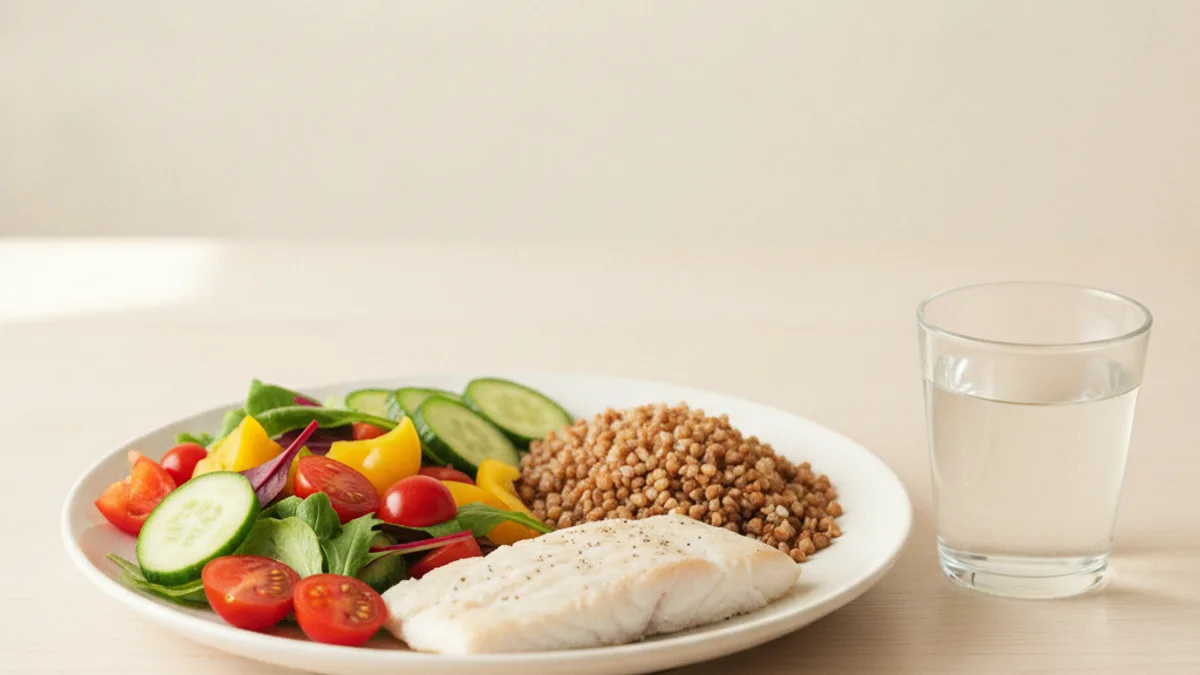
- Half the plate is vegetables. This is a way to increase volume and fiber without increasing caloric density; more on fiber in a separate article.
- Do not drink your calories. Sugary drinks, juices, and coffee cocktails are the most inconspicuous part of a diet; see the articles about coffee shop drinks and juices.
- Count oil, not food. Measuring the amount of oil with a spoon when cooking saves more than a week of approximate counting: see calories in frying.
- One serving, seconds after a pause. Not a ban, but a delay: it returns the decision about a second serving to a conscious mode.
What you cannot avoid
Giving up counting is giving up one form of feedback, not feedback in general. In a review of self-monitoring studies for weight loss, the consistency of self-monitoring proved to be associated with better outcomes; the form, however, can be anything.
A minimum set that replaces a diary:
- Weight once a week under identical conditions and comparing averages, not individual days — see the article about weight fluctuations.
- Food photos. A snapshot of a plate is a record without numbers; you can always go back to it and see what was happening during a week when the weight did not move.
- Habit checklist. Three or four items a day: protein at breakfast, vegetables at lunch, water instead of sugary drinks, steps.
When numbers are still needed
There are situations where counting is necessary:
- Weight has been stagnant for a month while feeling like "I eat very little." Here you need facts, not feelings: see the article about plateaus.
- Sports goals — muscle gain or preparation for competitions where precision is required.
- Medical situations — conditions where the diet composition is prescribed by a doctor.
- Strong fluctuations between days. When the diet is unstable, markers work less effectively than numbers.
An intermediate option is to count not always, but selectively: one week of tracking every couple of months shows where portions have drifted and does not turn eating into bookkeeping. Where to start such tracking is in the article about counting macros.
When counting is contraindicated
If counting calories turns into an obsession, causes anxiety, or feelings of guilt about food, this is a reason to stop and consult a specialist. In cases of eating disorders, counting can exacerbate the condition, and the decision about any form of dietary control should be made together with a doctor.
Such a choice is not a "lack of willpower": the approaches discussed above work even without numbers, as shown by the trial with 609 participants.
Frequently asked questions
- Can you lose weight without counting calories?
- Yes. In the DIETFITS trial, participants were taught to change the composition and quality of their diet rather than count calories, and over the course of a year, they lost an average of 5.3 and 6.0 kg in the two groups.
- What can be used instead of counting?
- Protein at every meal, half a plate of vegetables, avoiding liquid calories, measuring oil with a spoon when cooking, and taking a pause before having seconds.
- Do you need to track anything if you don't count calories?
- It is advisable: in a review of self-monitoring studies, the consistency of self-monitoring was associated with better outcomes. Weekly weighing under the same conditions, food photos, and a short habit checklist are suitable options.
- When is counting unavoidable?
- When weight remains stagnant for a month despite feeling like you are eating very little, for athletic goals like muscle gain, and in medical situations where a doctor prescribes the diet.
- What should you do if counting causes anxiety?
- Stop doing it and discuss the situation with a specialist. In cases of eating disorders, counting can worsen the condition, and the format of nutritional control should be determined together with a doctor.
Read next
- How to lose weight correctly — Weight loss is boring: a slight energy deficit, enough protein, strength training, and time.
- Eating habits: what works and what doesn't — Almost all nutrition plans fail not because of a lack of knowledge, but because of execution.
- Why weight changes by a kilogram in a day — Fat cannot be gained overnight: a kilogram of adipose tissue is thousands of kilocalories that cannot be acquired in eight hours of sleep.
- How to return to tracking after a break — People don't stop keeping a food diary because they run out of motivation.
This article is for general information. It is not medical advice, a diagnosis, or a prescription for treatment or a diet, and it does not replace a consultation with your doctor. If you have a health condition, are pregnant, take medication, or follow a diet prescribed to you, decisions about food belong with your doctor.
Figures from regulations, guidelines and studies are given as they stood when this article was prepared and may since have changed; check them against the primary sources. This article is not advertising, an offer, or individual advice, and neither the author nor the site owner is responsible for decisions taken on the basis of it.