What to eat before bed: cottage cheese, banana, fruit and tomatoes
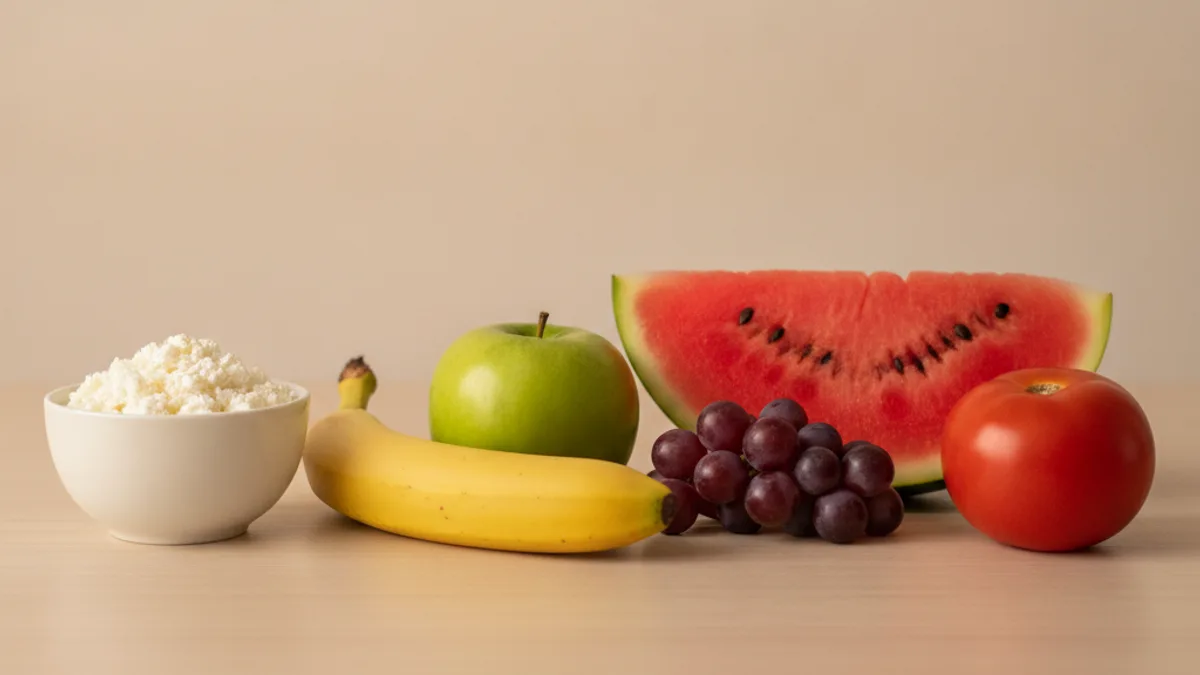
You can eat any of these foods in the evening: your weight depends on the total for the day, not on the hour of the last bite. Timing affects other things — heartburn if you lie down right after eating, and waking up at night if you eat a lot of water before bed. Below are the calories in typical portions and what has been tested for each food.
Weight follows the daily total
In a randomised crossover trial by Ruddick-Collins and colleagues (Cell Metabolism, 2022), 30 people with overweight or obesity twice spent four weeks on the same reduced calorie intake. In one period breakfast supplied 45% of calories and dinner 20%; in the other it was the reverse. Weight loss was the same, and so was energy expenditure. The only difference was hunger: participants rated it lower with the large breakfast.
So the question "what can I eat at night without gaining weight" comes down to how many calories are left in your daily budget by the evening. If the snack fits, the hour does not matter. Why the "no food after six" rule works through behaviour rather than metabolism is covered in the article on eating after six. If you get much hungrier in the evening than during the day, the reasons are in the article on evening overeating.
Calories in a typical portion
Values for the fruit and tomato come from USDA FoodData Central, SR Legacy: banana FDC 173944, apple with skin 171688, watermelon 167765, grapes 174683, tomato 170457. Portion weights are from the same entries. Cottage cheese is the Russian tvorog 5% from the VkusVill "Tvorog 5%, 180 g" product card, Lebedyanmoloko LLC entry: 121 kcal, 16 g protein, 5 g fat and 3 g carbohydrate per 100 g, as of October 12, 2026.
| Food | Portion | kcal | Protein, g | Fibre, g |
|---|---|---|---|---|
| Cottage cheese (tvorog) 5% | half a pack, 90 g | 109 | 14.4 | 0 |
| Banana | medium, 118 g | 105 | 1.3 | 3.1 |
| Apple with skin | medium, 182 g | 95 | 0.5 | 4.4 |
| Watermelon | wedge, 286 g | 86 | 1.7 | 1.1 |
| Grapes | cup, 151 g | 104 | 1.1 | 1.4 |
| Tomato | medium, 123 g | 22 | 1.1 | 1.5 |
The portions are a unit for calculation, not advice on how much to eat. For your own weight use weight × kcal per 100 g ÷ 100. For example, a 140 g banana: 140 × 89 ÷ 100 = 124.6 kcal.
Cottage cheese: what is known about casein before sleep
The best-known study is by Res and colleagues, 2012. Sixteen young men did a resistance workout in the evening and, 30 minutes before sleep, drank a beverage with 40 g of casein, the main milk protein, or the same beverage without protein. The casein was digested and absorbed during sleep, blood amino acids stayed elevated until morning, and muscle protein synthesis was about 22% higher — at the edge of statistical significance.
Casein before sleep has little effect on appetite and metabolism. A 2021 systematic review covered 11 studies that gave 24–48 g of casein 30 minutes before sleep and found limited or no effect on energy expenditure, appetite and food intake. Cottage cheese was tested separately: in Leyh and colleagues, 2018, ten physically active women ate cottage cheese with 30 g of protein before bed. Their morning energy expenditure and appetite did not differ from a calorie-free drink.
For sleep, there is a small crossover trial by Aussieker and colleagues, 2026. Nine trained people drank 40 g of casein, 40 g of whey protein or a carbohydrate drink with the same calories after a resistance workout. With casein, sleep measured by actigraphy and questionnaire did not differ from the carbohydrate drink; with whey, people fell asleep faster. Nine people are too few to draw conclusions for everyone.
In numbers: half a pack of 5% tvorog is 109 kcal and 14 g of protein, a whole 180 g pack is 218 kcal and 29 g of protein, close to the Leyh study. It is an evening snack with protein and predictable calories. It does not promise faster weight loss. How to choose tvorog by its label is covered in the tvorog guide.
Banana: 105 kcal and melatonin in the blood
A medium banana has 105 kcal, 1.3 g of protein and 3.1 g of fibre. For comparison, half a pack of tvorog with similar calories has 14 g of protein. Which snacks are more filling and why is covered in the article on 100-calorie snacks.
Bananas before bed are often said to contain melatonin. This was measured: in Sae-Teaw and colleagues, 2013, twelve healthy men ate two bananas each, and two hours later serum melatonin rose from 32 to 140 pg/mL. Sleep was not assessed in that study, so it does not show that bananas help you fall asleep.
Apple and grapes: similar calories, different fibre
A medium apple has 95 kcal and 4.4 g of fibre; a cup of grapes has 104 kcal and 1.4 g. Grapes are eaten one at a time, and a portion from a shared bowl is hard to judge: ten grapes weigh about 49 g and provide 34 kcal. It is easier to set a portion aside in advance or weigh it.
If your question is about fruit sugar in the evening, see the article on fruit and blood sugar.
Watermelon: few calories, a lot of water
A 286 g wedge of watermelon has 86 kcal and about 261 g of water, more than a glass of liquid. If you wake up to go to the toilet after watermelon at night, this may be why. A York hospitals (NHS) leaflet on nocturnal polyuria lists evening fluid among the causes, including foods with a high water content such as fruit and vegetables, and suggests eating them earlier in the day.
If you get up several times a night and it is not linked to evening drinks and food, tell your doctor: frequent night-time urination has medical causes, and they can be treated.
Tomatoes at night and heartburn
A medium tomato has 22 kcal, the lightest food in the table, so the question about tomatoes at night is usually about heartburn.
The American College of Gastroenterology 2022 clinical guideline on GERD lists acidic foods, including citrus and tomatoes, among those people are commonly told to avoid, while noting that the data supporting such advice are limited. The guideline itself suggests avoiding foods that trigger symptoms in the individual and not eating within 2–3 hours of bedtime. Both are conditional recommendations with a low level of evidence.
The link with the interval before bed also shows up in observational data. A Japanese case-control study by Fujiwara and colleagues, 2005 compared 147 patients with GERD and 294 people without symptoms. Those who went to bed less than 3 hours after dinner had 7.45 times higher odds of GERD than those who went to bed 4 hours or more after dinner. This is an association, not proof of cause.
If you do not get heartburn, a tomato at night is no different from a tomato during the day. Regular heartburn is a reason to see a gastroenterologist rather than pick foods on your own. How night-time heartburn develops is explained in the article on eating after six.
If you take glucose-lowering medication
With diabetes, whether to eat at night is decided with your doctor. According to the US National Institute of Diabetes and Digestive and Kidney Diseases (NIDDK), insulin and some tablets — sulfonylureas and meglitinides — can lower blood glucose below a healthy level. The risk rises when a meal is skipped or delayed. Dropping an evening meal that is part of your treatment plan can end in night-time hypoglycaemia. How eating is planned with type 2 diabetes is covered in a separate article.
How to log an evening snack
Log the food and its weight the same way as during the day: tvorog from the label on your pack, fruit by weight or by photo. The log shows how much of the daily total the snack took up.
Frequently asked questions
- Can I eat cottage cheese before bed?
- Yes. Half a pack of 5% tvorog is about 109 kcal and 14 g of protein. In studies, casein taken before sleep was digested overnight and did not worsen sleep, but it had little effect on morning appetite and energy expenditure.
- Is it OK to eat a banana before bed?
- Yes, a medium 118 g banana is about 105 kcal. In one study blood melatonin rose after two bananas, but sleep was not measured.
- What can I eat at night without gaining weight?
- Any food that fits your daily calorie budget. In a study with the same daily calories, people lost the same weight whether they ate more in the morning or in the evening.
- Can I eat tomatoes at night?
- If you do not get heartburn, yes: a medium tomato is about 22 kcal. For people with reflux, gastroenterologists suggest not eating within 2–3 hours of bedtime and avoiding foods that trigger their symptoms.
- Why do I wake up to pee after eating watermelon at night?
- A 286 g wedge of watermelon contains about 261 g of water. A lot of fluid in the evening, including from fruit, increases night-time urine.
Read next
- What happens to food eaten after six — The "no eating after six" rule has outlived dozens of diets and continues to serve as the primary advice for weight loss.
- Why you feel hungrier in the evening — You manage to eat moderately during the day, but after eight o'clock, it starts.
- What to eat for dinner — For most people, dinner is the largest meal of the day, and this is not a mistake in their routine.
This article is for general information. It is not medical advice, a diagnosis, or a prescription for treatment or a diet, and it does not replace a consultation with your doctor. If you have a health condition, are pregnant, take medication, or follow a diet prescribed to you, decisions about food belong with your doctor.
Figures from regulations, guidelines and studies are given as they stood when this article was prepared and may since have changed; check them against the primary sources. This article is not advertising, an offer, or individual advice, and neither the author nor the site owner is responsible for decisions taken on the basis of it.