What happens to food eaten after six
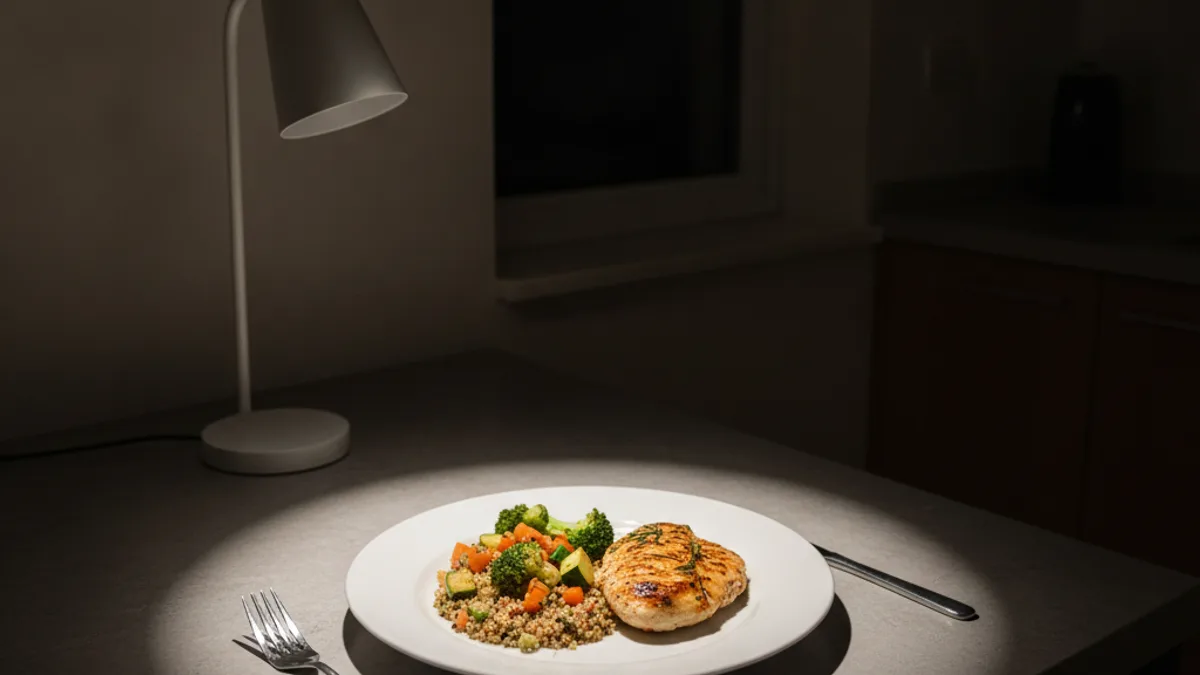
The "no eating after six" rule has outlived dozens of diets and continues to serve as the primary advice for weight loss. The question behind it is quite specific: does anything in the body change by evening enough for the same plate of food to behave differently? It is easiest to trace the path of a late dinner step by step and see where the claim is confirmed and where it falls apart.
What happens to dinner physically
Digestion does not know what time it is. Hydrochloric acid and pepsin work in the stomach, pancreatic enzymes—amylase, lipase, and proteases—join in the duodenum, and carbohydrates, fats, and amino acids broken down into simple molecules are absorbed through the wall of the small intestine. None of these steps turn off at 6 p.m. or operate at half-capacity.
There is one measurable difference: the rate of gastric emptying slows down slightly toward the night. The same volume of food leaves the stomach a bit slower than in the morning. The difference is small and does not affect the total number of calories absorbed—it affects the feeling of heaviness and, as will be seen later, heartburn.
The main point is something else. Fat is stored not when food is eaten, but when more has been consumed over the day than has been spent. The body maintains this balance continuously: it spends reserves between meals and replenishes them after eating. A late dinner shifts the replenishment point by a few hours but does not create extra energy out of thin air. If the daily total balances out to zero, weight does not increase, regardless of what time the food entered the stomach.
Hence the prediction that is easy to verify: a person who eats their 2,000 kilocalories from 8 a.m. to 3 p.m. and a person who eats the same 2,000 from noon to midnight should weigh roughly the same, assuming equal activity. Studies where meal timing was changed while keeping caloric intake the same generally show this: differences are either absent or small compared to the effect of calorie deficit itself.
Where there is a basis: circadian rhythms
The body works according to an internal circadian cycle, and metabolism follows it. Insulin secretion and tissue sensitivity to it change throughout the day: by evening, cells respond to insulin more weakly than in the morning. The same portion of carbohydrates eaten at 8 p.m. causes a higher and longer glucose spike in the blood than the same portion at 8 a.m.
This is measured by instruments and is not a matter of dispute. What is debatable is what this implies for a healthy person. A higher glucose peak after a late dinner remains within the limits of normal physiology: glucose returns to normal values, just later. There is no diagnosis here; it is a feature of how the circadian clock works.
For weight, this difference is secondary to the total amount of food. It becomes significant in another situation—when carbohydrate metabolism is already impaired. In diabetes and prediabetes, the distribution of carbohydrates throughout the day is part of the treatment plan, and it is created by a doctor, not an article: specific times, portions, and medication doses depend on the therapy regimen and the specific person's indicators.
Where there is a real basis: behavior
Evening is the time when almost everything extra is eaten. There are several reasons, and none of them are about biochemistry.
- Fatigue. By the end of the day, the ability to track what has been eaten and to stop decreases. The same person who is careful at breakfast eats half a pack of cookies at 11 p.m. without noticing.
- Lack of structure. If breakfast is skipped and lunch is reduced to coffee, hunger accumulates by evening, which cannot be satisfied by one plate. Then the person eats not a portion, but everything they can reach.
- Screen time. While watching a series or scrolling a feed, food goes unnoticed, and satiety is registered with a significant delay—this is one of the most reproducible observations in studies of eating behavior.
- Alcohol. It removes control over quantity and simultaneously brings its own calories, which are almost never accounted for.
This is where the real benefit of the rule lies. The "no eating after six" ban changes nothing in metabolism, but it closes the very window in which a person usually consumes an extra 500–700 kilocalories. It works as a time limiter, not as a physiological measure—on the same principle as intermittent fasting, where the effect comes not from the regimen itself, but from shortening the eating window.
Distinguishing these two explanations is important from a practical standpoint. If the rule works through behavior, it can be replaced by any other limiter—and for a person who gains extra weight not in the evening but throughout the day, a dinner ban will provide nothing but a hungry night.
Late dinner and sleep
The third basis is sleep quality. A heavy meal shortly before lying down impairs falling asleep and makes sleep more shallow; alcohol acts even more clearly—it speeds up falling asleep but ruins the second half of the night.
This creates a vicious cycle. Lack of sleep changes appetite the next day: hunger intensifies, and one craves high-calorie and sweet foods first. That is, a late heavy dinner affects weight not by itself, but through the sleep of the following day. The mechanism is analyzed separately in the article on how lack of sleep affects weight and appetite.
The flip side also exists: many people cannot fall asleep on an empty stomach at all. A small, light dinner in this case improves sleep rather than spoiling it. It is about volume and composition, not time as such.
Heartburn: the only place where "not eating before bed" is a medical recommendation
Between the esophagus and the stomach, there is a ring muscle—the lower esophageal sphincter. It keeps the acidic contents of the stomach down. When its tone is reduced, the contents are refluxed back into the esophagus, and this is felt as heartburn.
Body position matters a lot here. Standing and sitting, gravity works for the person: even with a weak sphincter, the contents remain in the stomach. In a lying position, this help is absent; the stomach and esophagus end up at the same level, and reflux happens easily. Add to this a full stomach, which empties slower than usual toward the night, and you get classic nocturnal heartburn.
Therefore, for gastroesophageal reflux disease, the recommendation not to eat two to three hours before sleep is included in standard prescriptions along with elevating the head of the bed. Here, the rule has a direct medical justification, and it applies to a specific condition, not to everyone. Alcohol, coffee, chocolate, mint, and fatty foods further reduce sphincter tone—they are removed from the evening menu first.
Regular heartburn is a reason to see a doctor, not to adjust dinner time on your own. Constant acid reflux damages the esophageal mucosa, and the consequences of this are not treated with a diet regimen.
Who actually needs a late dinner
There is no universal rule here, and there are people for whom the ban is directly contraindicated.
- Those receiving insulin. The meal schedule is tied to the injection schedule, and skipping an evening meal can end in nocturnal hypoglycemia. You can change the regimen only together with the doctor who prescribed the therapy.
- Pregnant women. With nausea, long intervals without food are tolerated worse than frequent small portions, including late ones. At the same time, heartburn in the third trimester is common—and then the volume of the evening meal is reduced, not canceled.
- Those exercising in the evening. After a workout at 9 p.m., the body needs protein and carbohydrates for recovery. Dinner here is part of the workout, not a violation of the regimen.
- Those working the night shift. Their day is shifted entirely, and "6 p.m." means nothing to them. The guide is not the time on the clock, but their own sleep-wake cycle.
- Children and adolescents. For a growing body, dietary restrictions by the clock are not prescribed without indications.
What to do if hunger comes at 11 p.m.
Evening hunger almost always means that there was not enough food during the day or it was unsuitable in composition. It is treated not by a ban, but by redistribution.
- Check how much was eaten before evening. If breakfast and lunch accounted for a third of the daily norm, an evening binge is inevitable—this is not a lack of willpower, but arithmetic.
- Distribute protein across all meals. Protein satiates more strongly than carbohydrates and fats, and in a typical diet, almost all of it falls on dinner. Twenty to thirty grams in each meal noticeably change evening appetite.
- Do not leave a gap of more than five to six hours between daytime meals. A long break during the day is paid for in the evening.
- If hunger still comes—eat. Two to three hundred kilocalories of protein food at 11 p.m. will cost less than a breakdown on half a kilo of cookies after half an hour of patience.
- Evaluate exactly what is eaten in the evening. Usually, the problem is not the dinner itself, but what comes after it—and by volume, this is visible only when it is written down.
Separately, there is the case where a person wakes up at night and eats, unable to stop, or does not remember in the morning what they ate. This is not a question of discipline and not a topic for an article on diet regimens—one goes to a doctor for this.
Practical conclusion: the time on the clock does not determine whether food will be stored as fat. This is determined by the daily balance and what happens with the evening window—how much falls into it and how it affects sleep. The "no eating after six" rule should be perceived as a blunt tool that accidentally hits the target for some people. If it works, you can use it; if it turns into nocturnal hunger and breakdowns, you need to change the distribution of food throughout the day, not your willpower. It is easier to see what exactly is eaten during the day when portions are recorded rather than reconstructed from memory.
Frequently asked questions
- Is it true that eating after six leads to fat storage?
- No. Fat is stored due to a daily calorie surplus, not because of late-night eating itself. Digestion works the same way in the evening as it does during the day: the same enzymes and the same absorption processes. The rate of gastric emptying slows down slightly at night, but this does not affect the total number of calories absorbed.
- What time should I have dinner to lose weight?
- There is no single correct time; what matters is the total daily food intake. There is one practical guideline: have your last meal two to three hours before bedtime if you experience heartburn or have trouble falling asleep. Everything else should be adjusted to your daily schedule, work, and workouts.
- Why do I feel hungrier in the evening than during the day?
- Most often, it is because you didn't eat enough during the day: a skipped breakfast and a light lunch are paid for in the evening. Fatigue, eating in front of a screen, and alcohol, which lower your control over portion sizes, also contribute. The solution is not restriction, but moving a portion of your calories and protein to the first half of the day.
- What can I eat late at night if I am very hungry?
- Something protein-rich and small: cottage cheese, yogurt, eggs, or a piece of fish or poultry with vegetables. Two to three hundred kilocalories of such food will satisfy your hunger without interfering with sleep. It is better to avoid fatty or spicy foods, chocolate, coffee, and alcohol before bed, as they reduce the tone of the esophageal sphincter and trigger heartburn.
- Can I eat at night if I work out in the evening?
- Yes, and it is actually recommended. After an evening workout, the body needs protein and carbohydrates to repair muscles and replenish glycogen stores. Dinner after a workout is part of a nutrition plan, not a violation of your routine.
Read next
- Food combining: what happens when protein and starch reach the stomach together — Almost everyone has heard some version of the rule: meat on one plate, potatoes on another.
- Calorie deficit: how to calculate it and how to hold it — A calorie deficit is the one thing without which weight does not come down.
- Eating habits: what works and what doesn't — Almost all nutrition plans fail not because of a lack of knowledge, but because of execution.
This article is for general information. It is not medical advice, a diagnosis, or a prescription for treatment or a diet, and it does not replace a consultation with your doctor. If you have a health condition, are pregnant, take medication, or follow a diet prescribed to you, decisions about food belong with your doctor.
Figures from regulations, guidelines and studies are given as they stood when this article was prepared and may since have changed; check them against the primary sources. This article is not advertising, an offer, or individual advice, and neither the author nor the site owner is responsible for decisions taken on the basis of it.