Food combining: what happens when protein and starch reach the stomach together
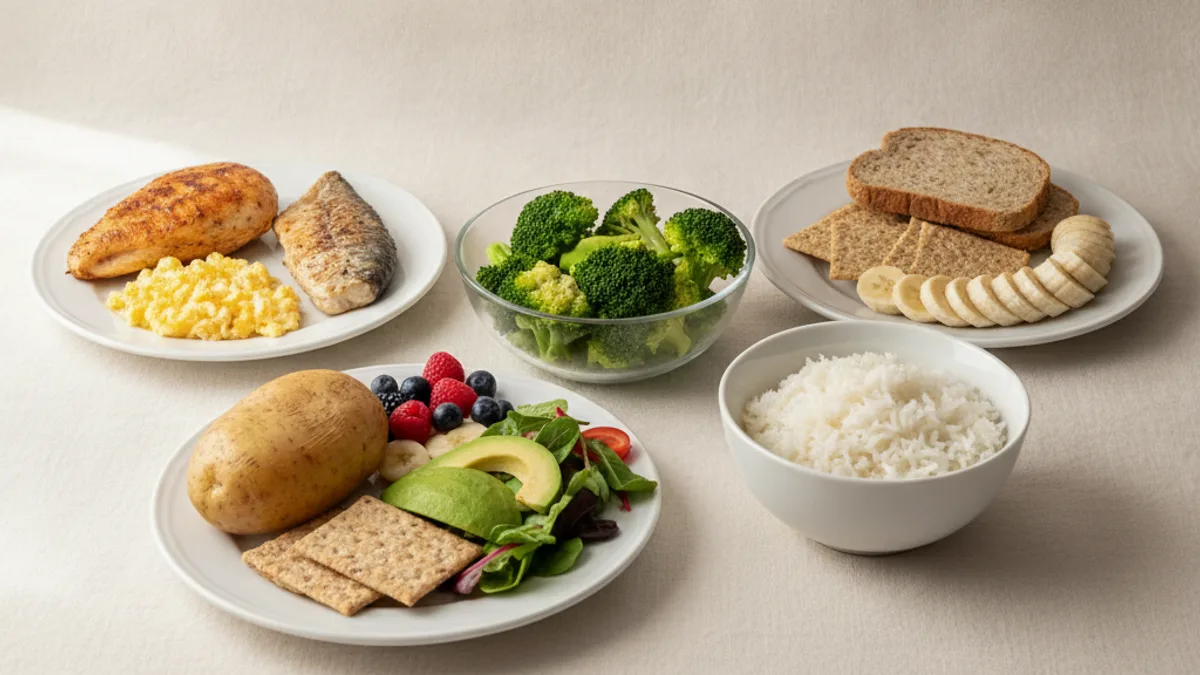
Almost everyone has heard some version of the rule: meat on one plate, potatoes on another. The reasoning sounds physiological — protein needs an acid environment, starch needs an alkaline one, put them together and each cancels the other out while the food rots in the gut. The claim can be checked in the place it describes, which is the digestive tract itself.
What the system actually asks
Food combining in its modern form comes from two men. William Howard Hay, an American physician, laid out the rules in the 1920s and sorted foods into "acid" and "alkaline" groups. Herbert Shelton, a naturopath, expanded them into the charts that still circulate today. Both were writing long before anyone could measure what the pancreas releases and when. Versions differ in the details, but the core is always the same.
- Protein foods must never be eaten with starchy ones: no meat with potatoes, no fish with rice, no chicken with bread, no cheese with a sandwich.
- Two different proteins in one meal are also forbidden: meat with egg, fish with cheese.
- Fruit is eaten alone and on an empty stomach; melon strictly by itself.
- Acid foods do not go with starch, which makes tomato sauce on pasta a mistake.
- Several hours must pass between meals so the previous food does not "mix" with the next one.
The explanation never varies. Protein demands an acid environment, starch an alkaline one. Arriving in the stomach together, they neutralize each other's conditions, digestion stalls, the undigested mass putrefies and ferments, and the products of that fermentation are absorbed and poison the body. Hence the promise: separate them and the heaviness, the bloating and the excess weight will go.
What the stomach does with food
An empty stomach is strongly acidic — pH sits around one to two, sharper than vinegar. That acid does two jobs. It unfolds coiled protein molecules so they can be cut apart, and it switches on pepsin, an enzyme that exists as an inactive precursor and only converts to its working form at low pH.
On one point the system has a real observation. Salivary amylase, which starts breaking down starch in the mouth, does lose activity in acid. It keeps working for a while inside the bolus, until gastric juice soaks all the way through, and then it stops.
The conclusion drawn from that is wrong. Starch digestion in the stomach was never the plan — it barely begins there. The stomach produces no amylase of its own at all: of the enzymes that take food apart, it secretes pepsin, and pepsin works only on protein. Starch is not digested in the stomach in the company of meat, and it is not digested there alone either. A plate of plain rice lands in the same acid and waits for the same next stage further down.
The stomach is busy with something else: acid treatment, grinding, and releasing its contents onward in measured portions. The real digestion and absorption of everything a person eats happens not here but one floor below.
Below the stomach there are no separate environments
From the stomach, the acid slurry passes into the duodenum in small portions. The first thing done to it there is neutralization. The pancreas releases bicarbonate, bile is added, and the pH rises to roughly neutral, slightly alkaline.
Then pancreatic juice arrives in that same stretch of gut. It is one secretion from one gland, and it contains, simultaneously:
- proteases — trypsin and chymotrypsin, which finish cutting up protein;
- pancreatic amylase — which takes apart starch and does the bulk of the work on carbohydrate;
- lipase — which handles fat together with bile acids.
All three groups are built for the same mildly alkaline conditions and are released together, in one juice. The pancreas cannot send amylase today and proteases tomorrow: it has no mechanism for sorting a plate into components. On top of that sit the enzymes anchored to the surface of the intestinal wall cells, which finish off the fragments of both protein and carbohydrate — again at the same time and in the same place.
So the contrast between an acid and an alkaline environment is half right, but the two are separated by segment of the tract, not by plate. The acid stage is in the stomach, the alkaline stage immediately after it. Every meal passes through both, whatever it is made of.
The body does not ignore the composition of a meal — it adjusts to it. Fat and protein reaching the duodenum send hormonal signals that slow gastric emptying, which is why meat with a side dish takes longer than rice alone. Slower does not mean undigested: that is the pace being regulated, not a failure.
Food is mixed before the cook touches it
The incompatibility rules quietly assume that pure-protein foods and pure-starch foods exist. In nature almost none do.
| Food | What is in it at the same time |
|---|---|
| Beans, lentils, chickpeas | Plenty of protein and plenty of starch in the same seed |
| Oats, buckwheat, any grain | Starch plus a substantial share of protein |
| Milk | Casein protein plus the milk sugar lactose |
| Nuts and seeds | Fat, protein and carbohydrate together |
| Breast milk | The same combination every human lives on for the first months |
If protein meeting carbohydrate really halted digestion, the hardest food on earth would be a bowl of lentils, and the first forbidden combination in every human life would be mother's milk. A cutlet and a scoop of mashed potato can be put on separate plates. A lentil cannot be divided into its protein half and its starch half by any means at all.
Some of the pairings the system splits across different meals actually work better together. Vitamin C from vegetables and herbs improves the absorption of iron from plant sources such as beans, buckwheat and spinach. Vitamins A, D, E and K are fat-soluble: a salad gives them up only in the presence of fat, so one dressed with oil delivers more of them than a dry one.
What direct comparisons found
Food combining has been tested the way any weight-loss scheme is tested: two groups, the same calorie intake and the same deficit, the same length of time. One group sorts foods by the compatibility rules, the other eats the same foods mixed.
The results are monotonous. Weight falls in both groups, and the difference between them lands inside the noise. No advantage for the separated version turns up in body composition or in blood markers — glucose, insulin, lipids. Nor does any sign appear that mixed meals are digested worse, or that they generate something toxic in the gut.
The quality of this evidence is middling: there are few trials, they enrol dozens of people, and they run for weeks. Work like that could not catch a subtle effect. But the claim on trial is not subtle — the system promises a visible advantage at the same amount of food — and that is what the measurements fail to find.
The central claim can also be checked head-on, because gastric acidity after a meal has been measurable by probe for a long time. It moves in the opposite direction to the one claimed. Any food temporarily buffers acid, so pH rises for a while, and the stomach answers by secreting more — with protein foods being the strongest stimulus of all. An ordinary meal does not create a state in which the environment becomes unfit for pepsin and for everything downstream.
A separate word about "putrefaction". Part of what is eaten does reach the large intestine undigested, where bacteria ferment it. That is not a breakdown and not the consequence of an unlucky pairing: it is what fiber does, and it is what the gut flora lives on. Whether the meat and the potatoes sat on one plate or two changes nothing about the scale of it.
Why people lose weight on it anyway
People who switch to food combining often do lose weight, and the testimonials are not invented. The mechanism is simply not the advertised one.
- Whole categories of food drop out. Burgers, pizza, pasta with meat, dumplings, sandwiches, wraps — all of it is banned by "protein apart from starch". That is also the most calorie-dense, fastest-eaten food in an ordinary diet.
- Meals have to be planned. Food combining cannot be run on autopilot: before every meal you have to decide what goes with what. A person starts noticing everything they put in their mouth, which is keeping track of intake in a different wrapper.
- Dishes get simpler. A grain, some vegetables and some meat served separately are easier to size up by eye than a composite dish under a sauce.
- The interval rule removes snacking. Several hours between meals shuts off the calorie source people most often fail to remember.
Add the four together and you get a calorie deficit reached by a detour. It holds exactly as long as the rules hold, and it is no different from a deficit produced any other way. Most popular diets behave the same: what works is the restriction of choice, not the explanation attached to it. The same is true of the promises made for so-called negative-calorie foods — a rule about which items are allowed does the work that the biochemical story claims to do.
What the system costs
The scheme is safe in the sense that it forbids no food outright. It is not free, though.
Eating away from home becomes hard: in a canteen, at someone's house or on a plane the food is usually mixed, and every meal turns into a negotiation. Protein is easy to under-eat on this plan — meat without a side dish gets eaten in smaller quantities, and older adults, people who train and people losing weight need more protein than average, not less. Anyone who is pregnant, or who lives with diabetes, has a further reason to be careful: stretching hours between meals and cutting protein are exactly the two things that need medical supervision in those situations, not a chart. Several of the rules rest on nothing measurable at all — no recorded effect stands behind eating fruit as a separate meal, or behind the ban on melon in company and tomato beside pasta.
There is a worse problem. If bloating and heaviness follow meals regularly, a compatibility rule offers an explanation that sounds convincing and leads away from the answer. Complaints like that usually come from lactase deficiency, irritable bowel syndrome, or a reaction to particular groups of carbohydrates — things that can be identified and treated. Separating foods may mute the symptom by accident and postpone the real investigation for years. The same trap catches people who cut out one food group and decide the problem is settled, which is how a gluten-free diet ends up hiding an untested celiac diagnosis.
What follows from this
The idea that proteins and carbohydrates are incompatible appeared before anyone knew how pancreatic juice is put together. The enzymes for protein, starch and fat are released into the small intestine together, at one pH, and the pancreas cannot separate them. The acid environment of the stomach and the alkaline environment of the intestine both exist, but they run one after the other rather than being selected to suit the plate.
Weight loss on this system is explained by the same things as on the others: the range of available meals shrinks, and attention to what is eaten appears. The same result is reachable without any rules about pairings — and that version is easier to hold, because it does not have to be abandoned every time you eat somewhere other than home. The acidity argument shows up elsewhere, too: the promises made for alkaline water are built on it, and they break on exactly the same physiology.
Frequently asked questions
- Is it true that proteins and carbohydrates need different environments and cannot be digested together?
- The different environments are real, but they are separated by segment of the digestive tract, not by plate: acid in the stomach, mildly alkaline in the small intestine right after it. The pancreas releases the enzymes for protein, starch and fat in one juice, at the same time, whatever the meal was made of.
- Why does meat with potatoes feel heavy, then?
- Fat and protein slow gastric emptying through hormonal signals, so that kind of meal takes longer to digest. Portion size usually plays a part as well: meat with a side dish almost always means more food at once than either one alone.
- Can you lose weight on food combining?
- Yes, and many people do. What works is the narrowing of choice — burgers, pizza, dumplings and sandwiches all fall outside the rules — plus the need to think through every meal. That produces a calorie deficit, which is reachable without any compatibility rules.
- What did the studies comparing food combining with ordinary eating show?
- At equal calories both groups lost about the same amount of weight, with the difference inside the noise. No advantage for the separated version was found in body composition or in glucose, insulin and lipids. The trials are few, short and small, but an effect of the claimed size would have been visible.
- Does fruit have to be eaten alone and on an empty stomach?
- No measured effect supports that rule. Fruit at the end of a meal is digested the same way as fruit before it. The difference lies elsewhere: eaten as dessert it adds to the meal, eaten instead of a snack it replaces something else.
Read next
- Gluten in a healthy gut: what actually happens to it — Gluten has become the word people reach for to explain bloating, fatigue and stubborn weight, and also the word people say with a smirk.
- Negative calorie foods: is celery really more expensive to digest than it is worth? — Celery is the food people name when they want an example of negative calories: eat it and you end the day lower than you started, because digesting it supposedly costs more than it delivers.
- Calorie deficit: how to calculate it and how to hold it — A calorie deficit is the one thing without which weight does not come down.
This article is for general information. It is not medical advice, a diagnosis, or a prescription for treatment or a diet, and it does not replace a consultation with your doctor. If you have a health condition, are pregnant, take medication, or follow a diet prescribed to you, decisions about food belong with your doctor.
Figures from regulations, guidelines and studies are given as they stood when this article was prepared and may since have changed; check them against the primary sources. This article is not advertising, an offer, or individual advice, and neither the author nor the site owner is responsible for decisions taken on the basis of it.