Negative calorie foods: is celery really more expensive to digest than it is worth?
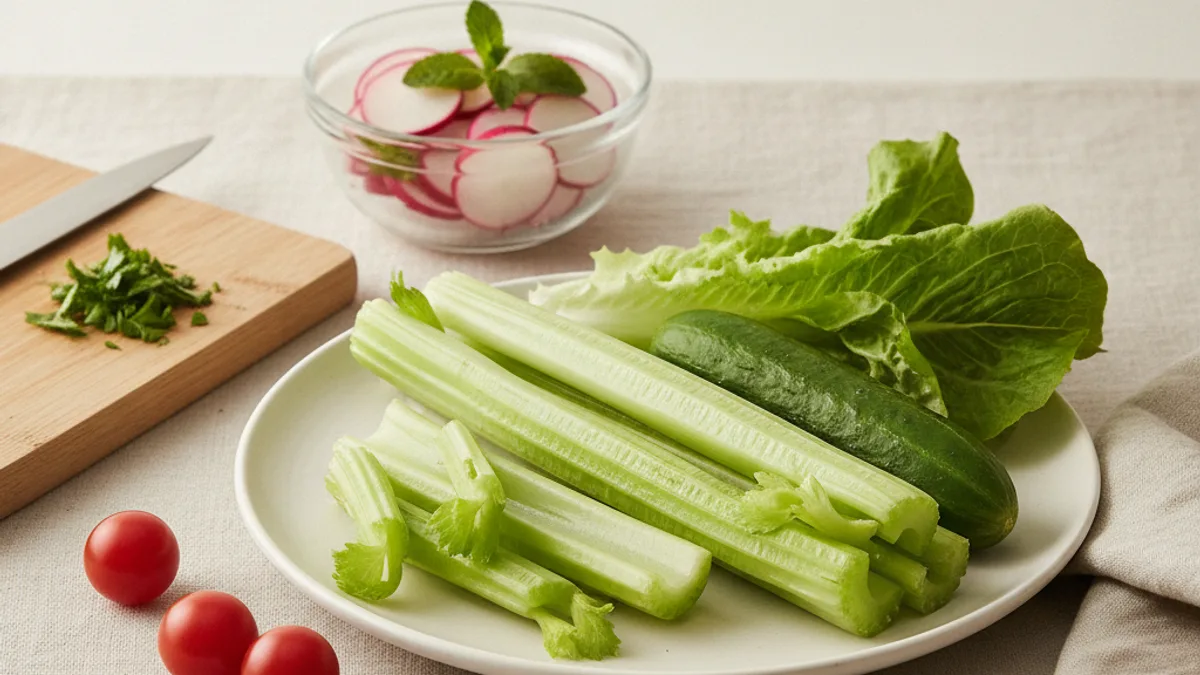
Celery is the food people name when they want an example of negative calories: eat it and you end the day lower than you started, because digesting it supposedly costs more than it delivers. The cost of digestion is real and has been measured. The only question is how large it is, and that is easy to work out.
Where the idea came from
Lists of negative calorie foods circulate with almost the same lineup everywhere: celery, cucumber, cabbage, grapefruit, lemon, watermelon, green apples. The promise never changes — the body spends more energy digesting the food than it extracts from it, so the more of it you eat, the lower the day's total ends up.
The claim rests on something real. Digestion genuinely costs energy: food has to be broken up, flooded with enzymes, taken apart into molecules, absorbed through the gut wall and processed in the liver. All of that is paid for out of the same energy budget, and physiologists were measuring the cost more than a century ago, long before any diet list existed. The argument is not about whether the cost exists. It is about its size.
What keeps the lists plausible is that they broadly work. Someone who replaces snacks with cucumber and cabbage does lose weight, and "you went negative on digestion" fits the observed result more neatly than the dull "you ate fewer calories". The pedigree is long — grapefruit and cabbage-soup diets have been passed around since the middle of the last century — and each new generation of lists inherits from the previous one not only the produce but the explanation. It follows the same pattern as food combining: a real observation about eating less, wrapped in a mechanism that was never checked.
The thermic effect of food
The cost of processing what you eat is called the thermic effect of food. It is measured as a share of the energy in the food itself: a hundred calories arrive, and some part of those hundred is spent on taking them in.
The share depends on what had to be processed.
- Protein — roughly 20–30%. The most expensive part of any diet. Amino acids cannot simply be put into storage: the surplus has to be dismantled, and the nitrogen in it converted to urea and excreted by the kidneys. That work happens in the liver and it is not cheap.
- Carbohydrate — roughly 5–10%. Starch is cut down to glucose fairly easily; packing the excess away as glycogen costs more than the digestion itself.
- Fat — roughly 0–3%. The cheapest of the three. Fat on the plate is structurally close to fat in storage, so very little has to be rebuilt.
For a mixed diet the total comes to about a tenth of daily intake. On 2,000 kcal that is around 200 — a real quantity, but one that has already been counted. The equations behind a daily calorie target describe the body's whole expenditure, digestion included. Subtracting it a second time from what you ate means the same calories are removed twice, and the deficit you think you are running is larger than the one you actually are.
The ranges above are wide by nature, not out of caution. The thermic effect shifts with portion size, with how processed the food is, with time of day and from one person to the next, and it is measured by indirect calorimetry with a considerable spread. There is no single exact figure. A source that quotes "exactly 23%" is presenting the middle of a range as a fact.
Processing is the one item on that list you choose in the shop. A whole food has to be dismantled by you: ground down, its cell walls opened, the starch inside the grain reached. In heavily processed food that work has already been done in the factory, and less of it is left to the body. Between a meal of whole grain and meat and a meal of ready-made products at the same calorie count, the difference runs to tens of calories in favour of the first. Against a full day's expenditure that is small, but the direction is always the same.
Running the numbers on celery
A hundred grams of celery stalk holds about 14 kcal. There is a fraction of a gram of protein in it, almost no fat, and the rest is carbohydrate, a good part of that fibre. The weighted thermic effect of a composition like that does not reach ten per cent: about one calorie out of the fourteen. Thirteen stay with you.
Even on the most generous assumption — crediting celery with the protein figure of 30% — the cost comes to four calories, still three times less than the food contains. To end up negative the share would have to exceed a hundred per cent, meaning it would take more energy to take a molecule apart than that molecule stores. No such food exists, among vegetables or anywhere else.
| Food, 100 g | Calories | Spent on digestion | Left with you |
|---|---|---|---|
| Celery stalk | ≈14 | about 1 | ≈13 |
| Cucumber, with skin | ≈15 | about 1 | ≈14 |
| Green cabbage, raw | ≈25 | 2–3 | ≈22 |
| Grapefruit | ≈35 | 3–4 | ≈31 |
| Chicken breast, cooked | ≈165 | 35–50 | ≈115–130 |
The chicken breast is there for comparison: its thermic effect is the highest of anything that reaches a plate. Even so, less than a third of what it contains goes on digesting it. Vegetables lose to protein on the percentage and win only on the fact that their absolute numbers are tiny.
One further confusion sits inside celery itself. The myth always means the stalks. Celeriac — the root — is a different food at roughly 40 kcal per 100 g, three times as much, and it is the root that turns up more often in recipes.
Three things that do not add up
Chewing. A tough, fibrous stalk feels like work the body ought to be paying for. It does pay, but very little: measurements of continuous chewing put the cost at somewhere around ten calories an hour. Nobody chews celery for that long, however diligently.
Fibre. Human enzymes cannot touch part of it, so it travels to the large intestine, where bacteria go to work on it. The products of that fermentation — short-chain fatty acids — are absorbed and supply the body with energy. Fibre does not push the balance negative. A small part of the energy it carries actually comes back to you, and food law says so explicitly: under EU Regulation 1169/2011, the conversion factor used to calculate the energy on a label is 2 kcal per gram of fibre, against 4 for carbohydrate and protein and 9 for fat.
The number in the table. The calorie figure in any food database is not the total heat of combustion of the food. It is the energy the body can get out of it, with corrections for the unabsorbed fraction and for losses in urine already built in. The thermic effect, however, is not subtracted from that figure, and subtracting it yourself breaks the whole accounting system, in which intake targets were calculated on the same rules.
It is worth noting what is missing from the shelf as well. The EU register of authorised health claims contains nothing resembling "negative calories". A claim like that cannot legally be printed on a package in the EU, which is precisely why it lives on websites instead.
The one case that really does go negative
There is exactly one, and it is not food. Iced water has to be warmed to body temperature, and the energy that takes is real. Half a litre out of the fridge at around 5 °C, brought up to 37, absorbs about 16 calories on the way. Water contains none, so the balance genuinely ends up below zero.
Sixteen calories is less than a teaspoon of sugar. Two litres of cold water across a day comes to roughly 60. You can calculate them; you will not see them on a scale. Drink water for the other reasons, and treat it as an expenditure line that disappears inside the error margin of any kitchen scale.
The same arithmetic applies to anything else sold as free. A drink sweetened with a non-nutritive sweetener carries essentially no energy, which is a genuine difference from sugar and nothing more than that — the reasons those sweeteners are argued about are covered separately under artificial sweeteners.
Why bulky food helps anyway
The observation the myth grew out of is correct: people who add a lot of vegetables to their diet do eat less and do lose weight. What works is not the arithmetic of digestion but energy density — how many calories fall on each gram of food.
Almost the entire mass of these vegetables is water. In cucumber and celery it runs to about ninety-five per cent, in cabbage a little less. Water supplies weight and volume without supplying a single calorie, and that is what makes the calorie count of a 100-gram portion so small. Dry the same celery to a powder and the negative calorie act collapses: a hundred grams of the dried product holds many times more, because what was removed was the part that never counted.
Fullness translates badly into calories. The body registers the volume of the stomach's contents, the time spent eating and the stretch of the stomach wall. Three hundred grams of cucumber and cabbage is a large bowl, roughly 60 calories, and about ten minutes of chewing. A hundred grams of biscuits goes down in three minutes, takes up almost no room and costs around 500. The gap in calories is eight-fold; the gap in fullness runs the other way.
A few practical consequences follow.
- Volume comes from vegetables almost free. Half a plate given over to cabbage, cucumber or salad adds about fifty calories to the meal and visibly changes what the plate looks like — and what the plate looks like affects how full it feels.
- Water and fibre hold food in the stomach. Emptying is slower, and the sense of fullness lasts longer.
- Chewing stretches the meal out. Satiety signals reach the brain over roughly twenty minutes, and food that cannot be swallowed in five falls inside that window.
Where this usually breaks is the dressing. A tablespoon of oil adds about 120 calories to a salad, a tablespoon of mayonnaise around 100. In a bowl of negative calorie vegetables with dressing, nearly all the energy sits in what was poured over them — and that is exactly where the counting fails too, because the vegetables get estimated by eye and the oil does not get counted at all. If you weigh one thing in a salad, weigh the oil.
What a celery diet actually costs
A diet assembled out of negative calorie foods does lower weight, for the same reason any sharp cut in food does. The problem is what the lost weight is made of. On a vegetable mono-diet daily intake falls to a few hundred calories, there is almost no protein in it, and the body takes its own muscle apart for amino acids. Muscle burns energy at rest, so when normal eating resumes the weight comes back faster than it left.
At that intake the risk is not only a disappointing result. A diet of a few hundred calories a day does not cover protein, essential fats, iron, calcium or B12, and it is not something to run unsupervised. If you take insulin or any medication that lowers blood glucose, cutting intake this far can drop it dangerously without a matching change in dose — that is a conversation with the prescribing doctor before the first day, not after a bad one. The same applies in pregnancy and while breastfeeding, where a deficit of this size is not appropriate at all.
Grapefruit deserves its own line, since it appears on every one of these lists. It interferes with the enzyme that clears a long list of drugs — among them several statins and some blood pressure medicines — and can push their concentration in the blood well above the intended level. If you take regular medication, that interaction is worth checking on the patient leaflet before you start eating grapefruit by the kilo.
The version of the same logic that works looks duller: a moderate deficit, enough protein, and plenty of bulky vegetables as a side dish rather than as the only dish. The size of the deficit has its own discussion under calorie deficit.
What this leaves you with
The thermic effect of food is real, comes to about a tenth of daily intake, and is already inside the numbers used to estimate expenditure. Protein has the highest share and fat the lowest, but for no food does that share reach a hundred per cent. Celery, cucumber and cabbage hand over very nearly everything written on them — there is simply not much written.
None of which damages the practical case for eating them. A hundred grams of celery is still thirteen calories left in the balance, against five hundred for a hundred grams of biscuits. That is a good enough reason on its own, and it has the advantage of being true.
Frequently asked questions
- Do negative calorie foods exist?
- No. Digestion costs a share of the energy in the food — from 0–3% for fat to 20–30% for protein — and that share never exceeds a hundred per cent. The one exception is not a food: iced water, which the body spends energy warming while the water itself supplies none.
- How many calories are in celery?
- About 14 kcal per 100 g of stalk, of which roughly one goes on digesting it. Celeriac, the root, is a different food at around 40 kcal per 100 g. The negative calorie claim is always made about the stalks, while recipes more often call for the root.
- Should I subtract the thermic effect from what I ate today?
- No. The equations behind a daily calorie target already describe the body's full expenditure, digestion included. Subtract it a second time from your intake and the same calories are counted twice, leaving you with a deficit larger than the one you planned.
- Is it true that high-protein food burns more calories?
- Protein does have the highest thermic effect of the three macronutrients. But on a normal diet that amounts to a few tens of calories a day — a small addition to a result, not the cause of one.
- Does drinking cold water help with weight loss?
- Warming half a litre of fridge-cold water costs roughly 16 calories, and two litres across a day about 60. The number is real, but against a daily expenditure of 1,500 to 2,000 it disappears inside the error margin of ordinary calorie counting.
Read next
- Calorie deficit: how to calculate it and how to hold it — A calorie deficit is the one thing without which weight does not come down.
- Food combining: what happens when protein and starch reach the stomach together — Almost everyone has heard some version of the rule: meat on one plate, potatoes on another.
- Artificial sweeteners: are they harmful, and do they help you lose weight? — Arguments about sweeteners are conducted as though the choice were between them and plain water.
This article is for general information. It is not medical advice, a diagnosis, or a prescription for treatment or a diet, and it does not replace a consultation with your doctor. If you have a health condition, are pregnant, take medication, or follow a diet prescribed to you, decisions about food belong with your doctor.
Figures from regulations, guidelines and studies are given as they stood when this article was prepared and may since have changed; check them against the primary sources. This article is not advertising, an offer, or individual advice, and neither the author nor the site owner is responsible for decisions taken on the basis of it.