Gluten in a healthy gut: what actually happens to it
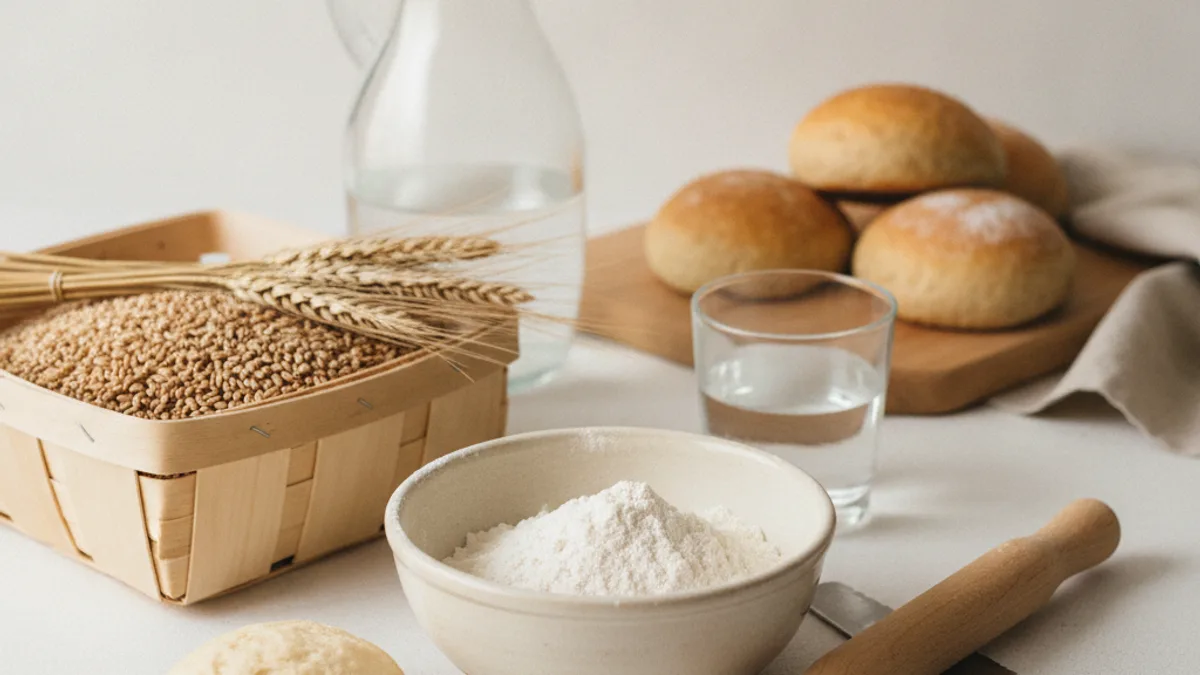
Gluten has become the word people reach for to explain bloating, fatigue and stubborn weight, and also the word people say with a smirk. Behind it sits a specific piece of biochemistry and three separate conditions that are managed in three different ways. The clearest way through is to follow gluten from the plate to the intestinal wall and see exactly where the paths diverge.
What gluten is
Gluten is not one substance but a family of storage proteins found in grain. In wheat they are the gliadins and glutenins, in rye the secalins, in barley the hordeins. The grain uses them to bank nitrogen for the future seedling; bakers use their mechanical behavior. Knead them with water and they cross-link into an elastic network that traps gas bubbles. That is why a wheat loaf rises and holds its shape, while a loaf made from buckwheat or rice flour with nothing added crumbles.
Oats sit apart. Their own storage proteins, the avenins, are built differently and do not provoke a reaction in the large majority of people with celiac disease. The trouble with porridge is usually not the oat but the mill: oats are carried, stored and ground in the same facilities as wheat. That is what the "gluten-free oats" label is about — controlled contamination, not a special variety. The claim itself is regulated rather than decorative: under Codex Alimentarius, and under the EU rules that follow it, food sold as gluten-free must contain less than 20 mg of gluten per kilogram.
Grains without gluten include rice, corn, buckwheat, millet, quinoa, amaranth and sorghum. Spelt, emmer, einkorn, khorasan wheat, farro and bulgur all contain it — they are varieties or forms of wheat, and for someone with celiac disease they behave exactly like ordinary wheat flour.
Why our enzymes never finish the job
Dietary protein is dismantled by proteases: pepsin in the stomach, pancreatic enzymes in the small intestine, and enzymes anchored on the surface of the intestinal cells for the last step. Each of them cuts the chain at particular points, next to particular amino acids.
Gliadin is an awkward substrate for that toolkit. It carries an unusual amount of proline and glutamine, and proline bends the protein chain sharply and shields the neighbouring bonds from the enzyme. Humans have no protease that cleaves next to proline in any meaningful quantity. Some bacteria do; we do not.
The result is that where an ordinary food protein ends up as free amino acids and fragments two or three units long, gliadin leaves behind long, stubborn peptides. The best known of them is a stretch of thirty-three amino acids that survives the entire digestive process essentially untouched.
This happens in everyone. In a person without celiac disease those fragments simply travel through the gut and leave, meeting nobody who reacts to them. Incomplete digestion of gluten is a property of the protein itself, identical in every person who eats wheat.
Celiac disease: where incomplete digestion becomes a problem
Celiac disease is an autoimmune condition, and that is what separates it from a food intolerance. What reacts is not a gut struggling with a difficult protein but an immune system attacking the body's own tissue.
The sequence has been worked out in detail. The stubborn gliadin fragments reach the intestinal lining. There an enzyme called tissue transglutaminase converts some of their glutamine into glutamic acid — in itself a routine chemical step. But the altered fragment picks up a negative charge that lets it sit tightly in the groove of particular immune molecules, HLA-DQ2 or HLA-DQ8. T cells read that combination as an alarm, inflammation follows, and among the targets of the resulting antibodies is transglutaminase itself, a protein belonging to the body.
The inflammation destroys the villi — the fine folds lining the small intestine that give it its absorptive surface. As the villi flatten, absorptive area collapses, and deficiencies of iron, vitamin B12, folate, calcium and vitamin D follow. This is why celiac disease so often looks like anything other than a bowel disease: anemia that does not respond to iron tablets, osteoporosis at an unexpected age, recurrent miscarriage, faltering growth in children. Diarrhea and bloating occur, but they can be entirely absent, and their absence rules nothing out.
The genetic background is obligatory: without HLA-DQ2 or HLA-DQ8, celiac disease essentially does not develop. The converse does not hold — a large share of the general population carries one of those variants and only a small minority of carriers ever fall ill. That asymmetry is what makes the genetic test useful in one direction only: it can confidently exclude celiac disease, and it cannot confirm it.
There is one treatment: lifelong exclusion of wheat, rye and barley, down to trace amounts. In celiac disease this is not a diet for how you feel on a given day. It is the means of stopping the damage to the intestine and reducing the risk of the long-term complications that follow untreated disease. Because the diet removes a large part of the usual sources of fiber and B vitamins, it is worth setting up with a dietitian rather than improvised.
Get tested before you remove gluten
Diagnosis of celiac disease rests on the body's reaction to gluten: both the antibodies in blood and the changes in the villi seen on biopsy are present only while gluten is being eaten. Someone who dropped bread a month or two before the test will have falling antibody levels and a lining that has begun to repair itself, and the result comes back negative. What the workup has demonstrated in that case is not the absence of disease but the absence of gluten.
The practical consequence is blunt. If celiac disease is suspected, the tests are done while gluten is still in the diet, and the diet changes afterwards. Anyone already several months into a gluten-free diet has to put gluten back for several weeks under medical supervision before testing can mean anything — an unpleasant procedure that exists only because the steps were taken in the wrong order.
The usual first step is a blood test for IgA antibodies to tissue transglutaminase, ordered together with total IgA, because in people with IgA deficiency the first result is misleading on its own. What follows is a clinician's call, and most often it is endoscopy with a biopsy of the small intestine. None of these steps is replaced by giving up bread for a while to see what happens.
Wheat allergy
This is a third mechanism and a different part of the immune system. Here the actors are IgE antibodies, and the reaction is fast — minutes to a couple of hours after eating: hives, swelling, wheeze and bronchospasm, and in severe cases anaphylaxis. The villi are not destroyed, and the long-term deficiencies of celiac disease do not arise. Anaphylaxis is a medical emergency: it is treated with an adrenaline auto-injector and an emergency call, not with waiting to see whether it passes.
Gluten is not always the target — other wheat proteins cause allergy too. One distinct form is triggered only by the combination of wheat and physical exertion in the hours after the meal; without the exercise the same portion passes unnoticed. Bakers can develop a version in which flour acts by inhalation rather than through food.
Wheat allergy is more often a condition of childhood and is frequently outgrown. It is diagnosed by an allergist, and that workup does not overlap with the celiac one: different tests, different criteria, and a different scope of restriction at the end.
Non-celiac gluten sensitivity
This is the most contested of the three categories. The label is applied to a person who gets bloating, abdominal pain and disturbed stools from wheat-based food, sometimes with fatigue and brain fog, in whom celiac disease has been excluded by testing and allergy has been excluded as well, and whose symptoms go when wheat goes and return when it returns.
The weakness of that definition is that it is built on exclusion and on self-report. There is no biomarker, no damage to the lining, nothing to confirm in a laboratory. Expert criteria have been proposed, but none of them has produced a test the field agrees on.
A separate line of research questions whether gluten is the culprit at all. In double-blind studies where participants were given gluten or placebo without knowing which, a reaction specific to gluten has often failed to reproduce. Wheat, meanwhile, contains other components capable of explaining the same symptoms:
- Fructans — short carbohydrate chains that humans cannot digest and that gut bacteria ferment, producing gas and distension. Wheat is one of the largest sources of them in an ordinary diet, and in several trials symptoms tracked fructans more closely than gluten.
- Amylase-trypsin inhibitors — small wheat proteins that defend the grain against pests, and whose capacity to stimulate the innate immune system of the gut is under discussion.
- Expectation. When a person knows they are eating the suspect food, symptoms intensify even with no active ingredient present. Blinded challenges show this share of the effect clearly.
The complaints themselves are real and reproduce in the same individual. What is unclear is what causes them. "Gluten sensitivity" remains a working name for a group of conditions of unestablished cause, and in any given case the culprit may be wheat as a whole, or one component of it, rather than gluten.
The three side by side
| Celiac disease | Wheat allergy | Gluten sensitivity | |
|---|---|---|---|
| Mechanism | Autoimmune | Allergic, IgE-mediated | Not established |
| Onset | Hours to days, cumulative | Minutes to hours | Hours, by patient report |
| Damage to the gut | Yes, villi flatten | No | No |
| How it is confirmed | Antibodies and biopsy | Allergy workup | Only by excluding the other two |
| Strictness of the diet | Lifelong, down to traces | Wheat excluded; rye and barley usually fine | Usually to tolerance |
A gluten-free diet without a diagnosis
No benefit has been shown for a healthy person who gives up gluten. Gluten is not toxic, it does not damage villi in the absence of HLA-DQ2 or DQ8, and it contributes nothing to weight gain — the calories in bread come from starch, not from the protein that makes the dough stretch. Where weight does fall after cutting gluten, the reason is the same as always: fewer calories eaten, which is worth reading about as a deficit rather than as a property of the protein.
Gluten-free products, meanwhile, share features you can read off the label. With no gluten network to hold the dough together, wheat flour gives way to rice flour and corn or potato starch, and the missing structure is bought back with fat and thickeners. The bread and biscuits that result often carry more fat and sugar, less fiber and less protein than the ordinary versions, and cost noticeably more.
There is also a practical side effect. Someone who drops gluten without being investigated feels better — sometimes because the fructans left along with the bread and pastry, sometimes because the diet as a whole got tidier — and stops there. If celiac disease was behind the symptoms, it stays undiagnosed: the tests no longer work on a partial gluten-free diet, while the intestine keeps meeting gluten in traces and in food nobody thought to check.
When cutting wheat genuinely does help, guessing is the expensive option. Bread usually leaves the plate together with a good deal else, and the change in what was actually eaten is often visible in the volume alone. A food diary with photographs of the portions answers that question faster than working through one diet after another.
If you suspect a problem
- Do not remove gluten before the workup. The diet invalidates both the blood tests and the biopsy.
- Start with IgA antibodies to tissue transglutaminase together with total IgA, then follow the clinician's plan.
- Tell the doctor about relatives with celiac disease — first-degree relatives carry a risk well above the population average.
- With confirmed celiac disease the diet is lifelong and strict, including trace amounts in sauces, seasonings and medicines. In the EU, cereals containing gluten are among the allergens that must be declared on the label of packaged food under Regulation 1169/2011, which makes the label the first place to look.
- If celiac disease and allergy have both been excluded and wheat still causes trouble, reducing the amount is a reasonable response; lifelong strictness is not required for that.
Frequently asked questions
- Can I just drop bread for a month and see whether I feel better?
- Not as a way of diagnosing anything. Celiac antibodies and the changes seen on biopsy are only present while gluten is in the diet, so after a month without it the result will be falsely negative. The tests come first, the change in diet afterwards.
- Does gluten harm the gut of a healthy person?
- No damage to the villi has been described in people without celiac disease. Gluten genuinely is broken down incompletely and stubborn fragments do remain, but without the HLA-DQ2 or DQ8 genetic background the immune reaction to them never gets going.
- Does cutting gluten help with weight loss?
- There is no direct link: the calories in baked goods come from starch, fat and sugar, not from gluten. When weight falls, it is because bread, biscuits and fast food left the diet along with the gluten. Gluten-free versions of those same products are usually more calorie-dense than the originals.
- Do oats contain gluten?
- Oat storage proteins are built differently and do not provoke a reaction in most people with celiac disease. The risk comes from wheat picked up during transport, storage and milling, which is why people with celiac disease buy oats labeled gluten-free.
- How does gluten sensitivity differ from celiac disease?
- In mechanism and in consequences. Celiac disease is an autoimmune condition that damages the small intestine and is confirmed by antibodies and biopsy. Sensitivity is diagnosed only after celiac disease and allergy have been ruled out, involves no damage to the gut, and may turn out to be caused by other wheat components rather than gluten.
Read next
- Food combining: what happens when protein and starch reach the stomach together — Almost everyone has heard some version of the rule: meat on one plate, potatoes on another.
- Artificial sweeteners: are they harmful, and do they help you lose weight? — Arguments about sweeteners are conducted as though the choice were between them and plain water.
- Activated charcoal for “detox”: what it actually binds — Activated charcoal is cheap, sold without a prescription, and taken for almost anything: the morning after, a weekend cleanse, sometimes a course of capsules for weight loss.
This article is for general information. It is not medical advice, a diagnosis, or a prescription for treatment or a diet, and it does not replace a consultation with your doctor. If you have a health condition, are pregnant, take medication, or follow a diet prescribed to you, decisions about food belong with your doctor.
Figures from regulations, guidelines and studies are given as they stood when this article was prepared and may since have changed; check them against the primary sources. This article is not advertising, an offer, or individual advice, and neither the author nor the site owner is responsible for decisions taken on the basis of it.