Activated charcoal for “detox”: what it actually binds
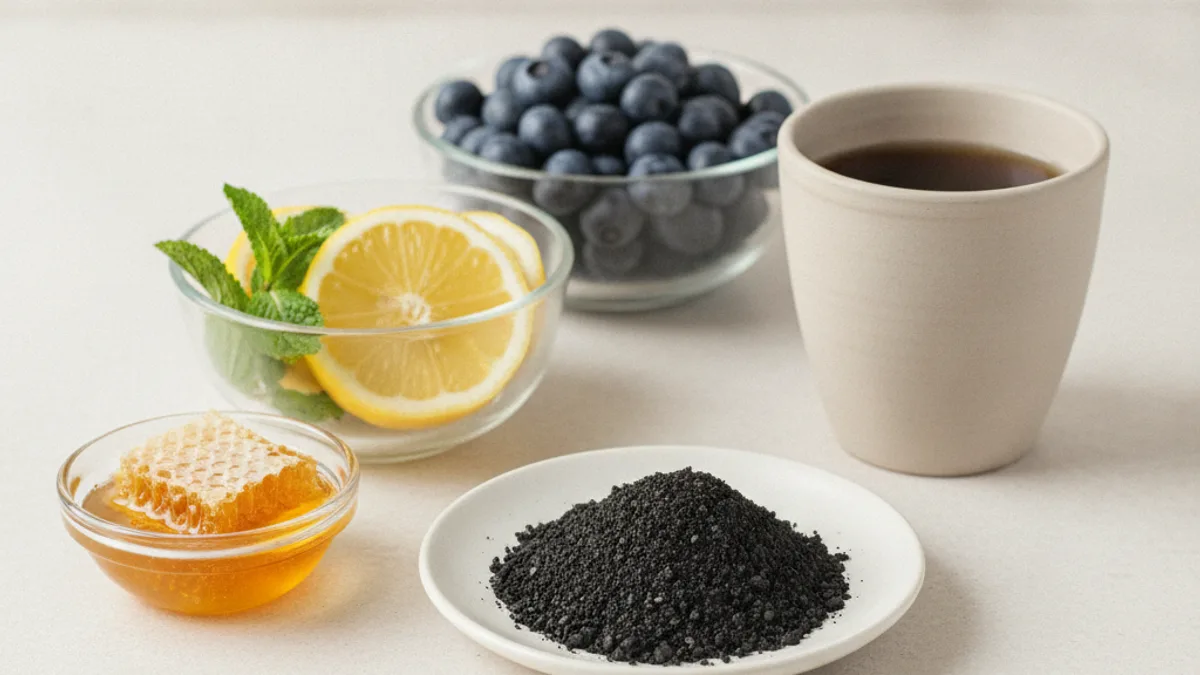
Activated charcoal is cheap, sold without a prescription, and taken for almost anything: the morning after, a weekend cleanse, sometimes a course of capsules for weight loss. The odd part is that charcoal does work. It just does not work the way, or in the place, people expect.
What it is
Activated charcoal is carbon that has been treated at high temperature, with steam or with chemicals, until it is riddled with pores. The pores are the whole point: one gram carries an internal surface area usually quoted between 500 and 1,500 square meters, and every useful thing charcoal does happens on that surface.
The process is adsorption, not absorption. Molecules stick to the pore walls and stay there. Nothing is dissolved, digested, or chemically broken apart — the charcoal simply holds whatever managed to stick while it travels down the gut and out.
From that follows the limit that almost everything else in this article depends on: charcoal is not itself absorbed. It never enters the bloodstream, never reaches the liver, the kidneys, or fat tissue. Everything it is capable of happens inside the tube of the intestine, and that is where its reach ends.
What it binds, and what it does not
Charcoal holds large organic molecules well. It does badly with small molecules, charged ones, and anything that dissolves readily in water — the pore surface gets almost no grip on them.
| Binds well | Barely binds at all |
|---|---|
| Many medicines and plant toxins | Alcohol |
| Some organic compounds from food | Strong acids and alkalis |
| Certain bacterial toxins | Iron, lithium, heavy metal salts |
The alcohol row is the one that matters most, because it removes the single most common reason people buy charcoal. Ethanol is a small molecule, freely soluble in water, and it barely sticks to carbon at all. On top of that, by the time a hangover is doing its work, the alcohol has long since crossed the gut wall and is circulating in the blood — a compartment charcoal cannot reach by design.
Emergency clinicians learn the exceptions as a list rather than a principle, because the list is what gets people killed: pesticides, hydrocarbons and solvents, acids and alkalis, iron, and lithium. In each of those cases charcoal does close to nothing, and reaching for it instead of a phone costs the only hour that mattered.
Where charcoal is genuinely used
In medicine, charcoal is a treatment for acute poisoning, given under conditions that a bottle in a kitchen cupboard almost never meets.
Timing decides most of it. The joint position statement of the American Academy of Clinical Toxicology and the European Association of Poisons Centres and Clinical Toxicologists puts the window at roughly one hour from swallowing. Charcoal can only bind what is still sitting in the stomach or the upper intestine; once a substance has crossed into the blood, there is nothing left in the gut to hold.
The dose is not two tablets. Adult doses in poisoning are 25 to 100 grams given at once, as a slurry — grams of charcoal, because the mass of sorbent has to exceed the mass of poison by something on the order of ten to one. Below that ratio the available surface is saturated within minutes and the rest of the poison passes it by untouched.
What was swallowed decides whether it helps at all. The right-hand column of the table above is a list of poisonings in which charcoal is not an option, and treating it as one delays the help that would have worked.
Outside emergency medicine, one narrow everyday use has actually been assessed and permitted. Under EU Regulation 432/2012, activated charcoal may carry a single approved health claim: that it contributes to reducing excessive flatulence after eating, on the condition of 1 g taken at least 30 minutes before a meal and 1 g shortly after. That is the entire claim. Nothing about cleansing, toxin load, skin, energy, or weight passed the same review.
The state in which charcoal must never be given
Do not give charcoal — or water, or anything else by mouth — to a person who is drowsy, confused, semi-conscious, or unresponsive. This holds no matter what they swallowed and no matter how urgent it feels.
The reason is mechanical. Protective swallowing reflexes fail as consciousness fades, and a gritty black slurry poured into someone in that state goes into the airway instead of the stomach. Charcoal in the lungs causes an aspiration pneumonitis that is difficult to treat and, in a number of documented cases, more dangerous than the poisoning it was meant to answer. Hospitals give charcoal to such patients only after the airway has been secured, through a tube, by people who can undo the consequences.
At home, the sequence is the opposite of the intuitive one: call the emergency number or a poison control center, keep the person on their side, keep the packaging of whatever was taken, and give nothing by mouth. Two more cases belong in the same category. After a corrosive substance — drain cleaner, a strong acid or alkali — charcoal does not bind it and coats the burned tissue so that the surgeon cannot assess the damage. And with a suspected bowel obstruction, adding an indigestible powder makes a blockage worse.
Why a cleanse course is a different proposition
The logic of a course rests on a picture in which toxins accumulate somewhere in the body and a sorbent scrubs them out. The objection is anatomical rather than moral: the organs that clear the blood are the liver and the kidneys, and charcoal never arrives at either of them. It is the same structural gap that sinks most cleanse products, including the pH argument behind alkaline water — a claimed effect on the whole body from something that never leaves the gut.
Inside the gut, charcoal does not discriminate either. Pore surface has no way to distinguish a hypothetical toxin from a molecule you swallowed on purpose, so a course of it binds whatever is present, including the things that were supposed to be absorbed.
- Medication. Charcoal lowers the absorption of many drugs taken alongside it, and the loss is invisible while it happens. That includes drugs where a lost dose means a lost effect: oral contraceptives, thyroid hormone, antibiotics, and anticoagulants. If you take a medicine daily for a chronic condition, a sorbent taken casually is a dosing problem, not a wellness routine.
- Vitamins and minerals from both food and supplements. Same mechanism, same result — and the supplements people pair with a cleanse are frequently the ones being neutralized.
- The gut itself. Taken regularly without a reason, sorbents slow transit, and constipation is the ordinary outcome rather than a rare one.
The practical rule follows directly: if charcoal is taken at all, it should be separated from food and from every medication by several hours. That is not excess caution, it is the condition under which everything else continues to work. The rule also covers the versions that do not look like medicine — a charcoal latte, a black lemonade, a black ice cream. A drink is a dose, and the pill you took with breakfast cannot tell the difference.
For weight it does nothing, and the mechanism explains why
Charcoal does not bind fats or carbohydrates in any meaningful quantity, and calories are not a substance that can be adsorbed at all. A calorie is a measure of the energy released when food is broken down, not a particle drifting through the intestine waiting to be caught. There is nothing there for a sorbent to grab.
The feeling of an effect in the first few days has a duller explanation. Charcoal slows the gut, and the number on the scale moves because of gut contents and water rather than fat tissue. Losing fat still requires an energy deficit, and no capsule creates one from a mechanism that ends at the intestinal wall — the same wishful accounting that sits behind negative-calorie foods.
Black stool is worth naming separately, because it is routinely read as proof. It is the charcoal itself, having passed through. It shows that the powder came out, not that anything was taken out with it. One caveat is genuinely useful: black, tarry stool in someone who is not taking charcoal or iron can signal bleeding in the upper digestive tract, and that is a reason to see a doctor rather than to wait it out.
As a contribution to a daily intake, charcoal is zero calories and zero protein, fat, and carbohydrate. There is nothing in it to log.
What to answer instead
Most of the reasons people reach for charcoal have a real answer, and it is usually less interesting than the capsule.
The morning after. Time, water, and food. The liver clears alcohol at a roughly fixed rate — on the order of one standard drink an hour — and nothing taken by mouth speeds that up. A sorbent cannot reach alcohol that is already in the blood, which is where all of it is by the time you feel it.
A suspected poisoning. Vomiting, fever, confusion, or a swallowed substance you cannot identify is a call to emergency services or a poison control center, not a choice between sorbents. They will ask what was taken and how long ago, and those two answers determine whether charcoal helps, does nothing, or makes the next hour harder.
Bloating and gas. This is the one place charcoal has a reviewed, permitted use, at the doses and timing described above — and it is worth trying the boring causes first, since carbonated drinks, sugar alcohols in sweetened products, and a sudden jump in fiber account for a great deal of ordinary gas.
Cleansing in general. No one has described the task that a course of sorbent would perform in a healthy person. The liver and the kidneys do that work continuously, without a schedule and without being asked.
Frequently asked questions
- Does activated charcoal help with a hangover?
- Ethanol is a small, highly water-soluble molecule and barely sticks to charcoal. By the time symptoms appear the alcohol is already in the bloodstream, and charcoal only works inside the gut.
- How much should I take?
- Doses used for poisoning are 25 to 100 grams given once, under medical direction and within about an hour of swallowing. Label doses on retail capsules are far below that and are not a treatment for anything except, at 1 g before and after a meal, excessive gas. A healthy person with no indication needs none of it.
- Can I take charcoal as a cleanse course?
- No benefit from such a course has been described, and the harm follows from the mechanism: charcoal does not choose what it binds, so it also reduces the absorption of medication, vitamins, and minerals. Constipation is a common result.
- Does charcoal help you lose weight?
- It does not bind fat or carbohydrate in meaningful amounts, and calories are not a substance that can be adsorbed. Weight changes in the first days come from gut contents and water, not from fat tissue.
- Why did my stool turn black?
- That is the charcoal itself, having passed through. It shows the powder came out, not that anything was removed. Black tarry stool without charcoal or iron supplements is different and should be checked by a doctor.
Read next
- Alkaline water and “an acidic body”: what the stomach does to it — People talk about “an acidic body” as though it were a condition you can acquire from the wrong breakfast and correct with the right water.
- Gluten in a healthy gut: what actually happens to it — Gluten has become the word people reach for to explain bloating, fatigue and stubborn weight, and also the word people say with a smirk.
- Collagen supplements: what digestion does to them — Two equally confident claims circulate about collagen.
This article is for general information. It is not medical advice, a diagnosis, or a prescription for treatment or a diet, and it does not replace a consultation with your doctor. If you have a health condition, are pregnant, take medication, or follow a diet prescribed to you, decisions about food belong with your doctor.
Figures from regulations, guidelines and studies are given as they stood when this article was prepared and may since have changed; check them against the primary sources. This article is not advertising, an offer, or individual advice, and neither the author nor the site owner is responsible for decisions taken on the basis of it.