Intuitive eating or calorie counting: what to choose and for whom
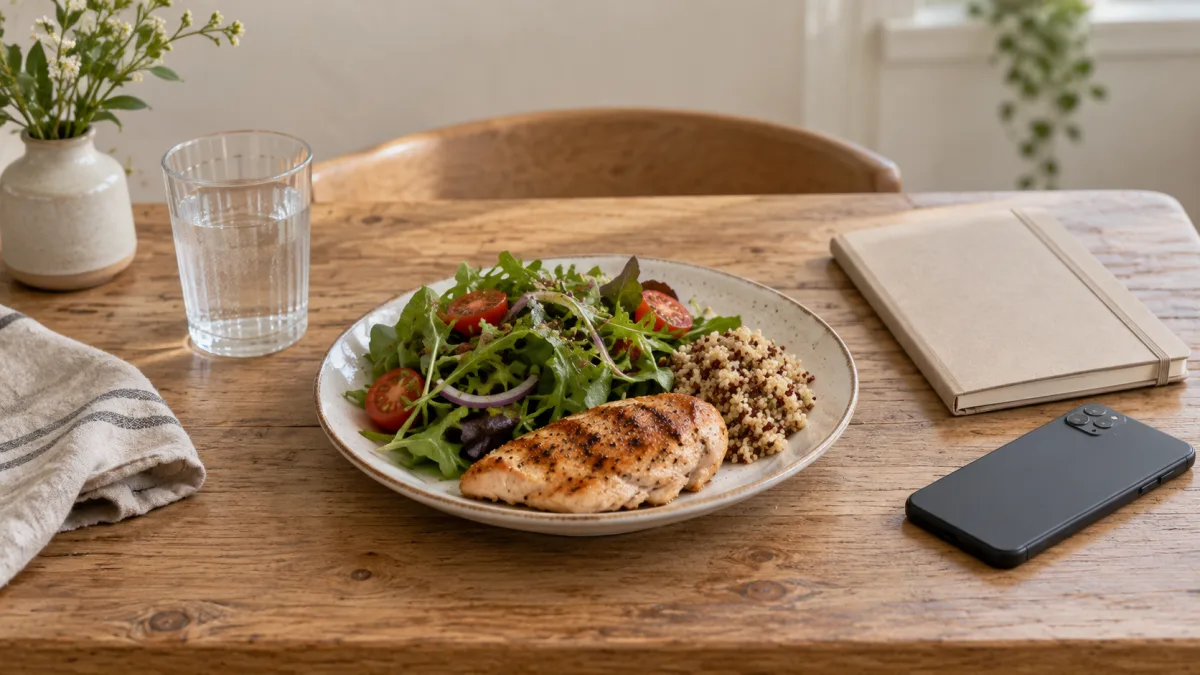
The choice between them should be based not on effectiveness but on your goal: intuitive eating changes your relationship with food, while calorie counting measures energy. Some people benefit from tracking calories, others from avoiding it altogether, and some do well with a combination. There are also those for whom counting calories is unnecessary or even harmful.
What is intuitive eating
American dietitians Evelyn Tribole and Elyse Resch introduced the term in their book “Intuitive Eating” (1995). It is not a diet but a set of ten principles. In the current edition, they are formulated as follows:
- reject the diet mentality;
- honor your hunger;
- make peace with food—allow yourself all foods;
- discover the satisfaction factor;
- feel your fullness;
- challenge the food police—the internal rules labeling foods as “good” or “bad”;
- coping with emotions without using food or self-criticism;
- respect your body;
- move for the sake of feeling good, not to burn calories;
- honor your health through “gentle nutrition”—choose foods that make you feel well, without striving for perfection.
The core idea is to rely on your body’s signals—hunger, fullness, and well-being—rather than external rules and numbers. For more details about these signals themselves, see the article on the difference between hunger and appetite.
What research shows
Two reviews provide the main picture.
A meta-analysis by Linardon, Tylka, and Fuller-Tyszkiewicz (International Journal of Eating Disorders, 2021) combined 97 studies. Intuitive eating was associated with lower levels of disordered eating behaviors and body dissatisfaction, and higher self-esteem and well-being. However, 89% of the included studies were cross-sectional surveys. These show correlation, not causation: people with a positive body image may simply find it easier to eat intuitively. The authors themselves note that prospective and experimental studies are now needed.
A review by Van Dyke and Drinkwater (Public Health Nutrition, 2014) covered 26 articles, including nine clinical studies and eight randomized trials. The authors concluded that intuitive eating improves psychological well-being and supports weight maintenance, but likely does not lead to weight loss. This does not mean the approach is ineffective for weight management—it simply indicates that convincing evidence for weight loss is lacking in the review.
In summary: intuitive eating has evidence supporting its benefits for one’s relationship with food and overall well-being, but there is limited and cautious evidence regarding its impact on weight.
Two approaches address different questions
| Intuitive eating | Calorie counting | |
|---|---|---|
| Question | How do I relate to food and do I listen to my body? | How much energy am I consuming? |
| Guideline | Hunger, fullness, well-being | Numbers in an app |
| What it provides | A peaceful relationship with food | Knowledge of actual intake |
| Weakness | Limited data on weight; hunger cues may be unclear | Risk of obsession in those prone to rigid control |
Therefore, the debate over “which is better” is misguided. One approach helps stop fighting with food; the other reveals how much a person actually eats. Often, these goals do not overlap.
Who benefits from calorie counting
Counting is a measurement tool. It helps when you need to understand your actual diet while your perceptions diverge from reality: “I eat little, yet my weight increases” or “I eat normally, but I have no energy.”
Self-monitoring of eating behavior is a cornerstone of behavioral weight-loss programs. A systematic review by Burke et al. (Journal of the American Dietetic Association, 2011) found a consistent association between food journaling and weight loss, though the authors rated the quality of evidence as weak: samples consisted mostly of white women, and data relied on self-reports.
Counting can also be useful short-term—for two or three weeks—to observe eating habits, then set aside. How to use these insights is discussed in the article on weight loss without calorie counting.
When counting is unnecessary or harmful
Counting is unnecessary if there’s no specific question it answers. Someone with stable weight, good well-being, and no food-related anxiety will gain only extra mental burden from tracking numbers.
Counting is harmful in cases of eating disorders or predisposition to them. In a study by Simpson and Mazzeo (Eating Behaviors, 2017) among 493 students, those who used calorie counters reported greater preoccupation with food and stricter dietary restraint more frequently. This is a correlation, not proof of causation, and the authors describe the findings as preliminary. In a survey by Levinson et al. (same journal), 73% of individuals diagnosed with an eating disorder who used a tracking app believed it contributed to their condition. Signs to watch for are detailed in the article on when counting becomes a problem.
Warning signs that suggest setting counting aside include anxiety when unable to log food, refusing to eat without tracking, compensating for intake through fasting or excessive exercise, and food-related thoughts occupying most of the day (discussed further in the article on food noise).
Counting without pressure: a journal, not a judge
Between these two extremes lies a balanced combination. Use the app as a journal: record what you ate without judgment. Numbers are information, not verdicts.
- Log meals without calculating daily totals or comparing against targets.
- Track briefly or occasionally—e.g., once a month when checking your diet.
- Avoid “working off” consumed calories or skipping meals “for the sake of the number.”
- In your logs, note not just food but also hunger, mood, and fullness: this way, tracking and intuitive signals work together.
- If journaling starts causing anxiety, set it aside without guilt.
Using photos instead of gram-based entries reduces burden: see the article on photo-based food journals. If you need numeric guidance for snacks, refer to the breakdown of snacks under 100 calories: what’s satisfying versus what’s empty.
If you suspect an eating disorder
An eating disorder is a condition where food is used to manage emotions and situations—and it is treatable. Signs include constant anxiety about weight, undereating, and self-induced vomiting after meals. If such signs appear, consult a healthcare professional—a general practitioner, psychiatrist, or psychotherapist—not a new app or diet plan. Descriptions of disorder types and treatments are available on the UK National Health Service (NHS) website.
Pregnancy, childhood, adolescence, and chronic illnesses are also reasons to discuss calorie counting with a doctor.
How to choose
- What do you need to learn: how your diet actually works or how you relate to it? The former calls for counting; the latter, for an intuitive approach.
- How does food feel right now? Calmly—counting is safe. With anxiety or guilt—start with the second approach or consult a professional.
- What’s the timeframe? Counting for two to three weeks as observation; intuitive skills—for the long term.
Neither approach makes a person better or worse. If one doesn’t fit, that reflects on the approach—not on the person.
Frequently asked questions
- Does intuitive eating help with weight loss?
- Evidence is limited. In the Van Dyke and Drinkwater (2014) review, adopting intuitive eating led to weight maintenance but possibly not weight loss. Its benefits for psychological well-being and one’s relationship with food are better documented.
- Can intuitive eating and calorie counting be combined?
- Yes, if tracking serves as a journal: entries without totals or judgments, used for a limited time, and including notes on hunger and how you feel. If recording causes anxiety, it’s best to pause.
- Who should avoid calorie counting?
- People with eating disorders or a predisposition to them, children and adolescents, and pregnant individuals. In these cases, dietary decisions should be made together with a healthcare provider.
- What to do if calorie counting causes anxiety?
- Set the app aside without guilt. If anxiety about food and weight persists or if you develop restrictive behaviors, vomiting after eating, or similar symptoms, consult a doctor: a general practitioner, psychiatrist, or psychotherapist.
- Is intuitive eating suitable for everyone?
- Not for everyone. When hunger and fullness cues are disrupted—for example, in an eating disorder—professional medical support is needed rather than independent application of these principles.
Read next
- How to lose weight without counting calories — Counting calories is a tool, not a requirement.
- Hunger and appetite: how they differ — These are two different mechanisms, and they are constantly confused.
- Food noise: what the new term means and what GLP-1 has to do with it — “Food noise” describes more than an interest in food: it is a persistent, burdensome inner conversation about it.
- Snacks under 100 calories: 25 options and what’s filling versus what’s empty — 100 kcal fits 667 g of cucumber or 17 g of peanut butter: calorie-wise they’re equal, but not in satiety.
This article is for general information. It is not medical advice, a diagnosis, or a prescription for treatment or a diet, and it does not replace a consultation with your doctor. If you have a health condition, are pregnant, take medication, or follow a diet prescribed to you, decisions about food belong with your doctor.
Figures from regulations, guidelines and studies are given as they stood when this article was prepared and may since have changed; check them against the primary sources. This article is not advertising, an offer, or individual advice, and neither the author nor the site owner is responsible for decisions taken on the basis of it.