Fast and slow carbohydrates: what lies behind this classification
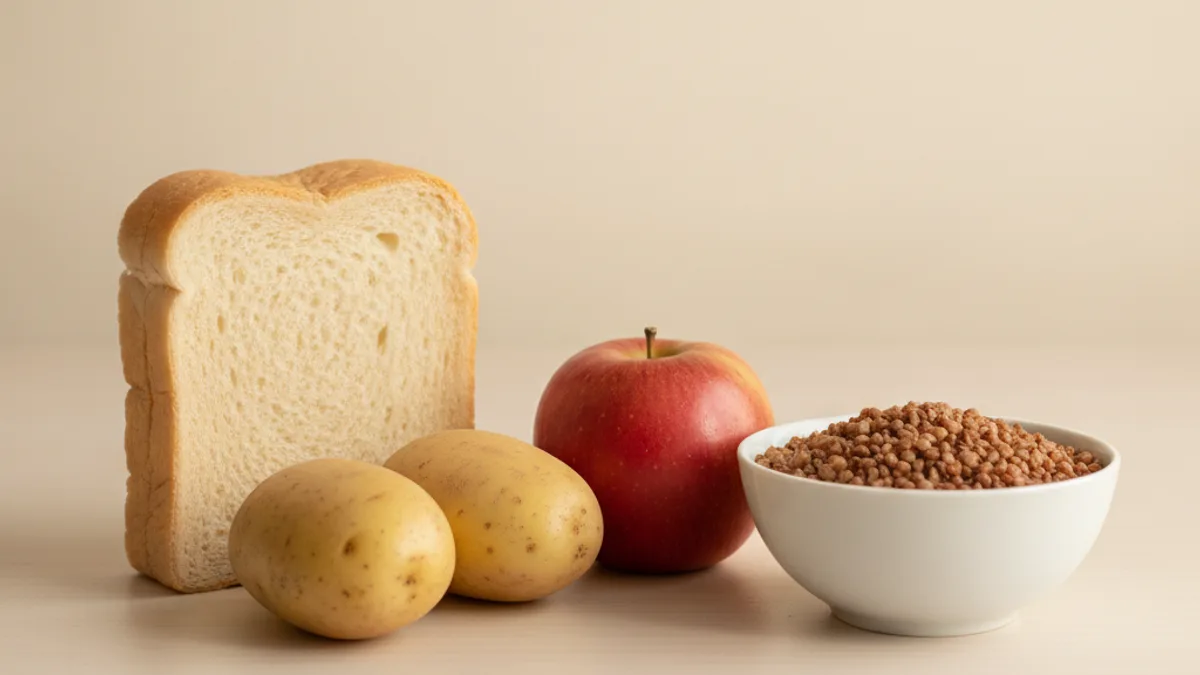
The classification of carbohydrates into fast and slow is older than the data it is supposed to be based on. Initially, it was assumed that simple sugars are absorbed quickly and starch slowly; measurements have shown that this is not always the case. However, the classification itself has persisted, and the food lists attached to it are often inaccurate.
What was assumed and what turned out to be true
The original logic was chemical: monosaccharides and disaccharides are short molecules, meaning they are absorbed quickly; starch is a long chain, meaning it requires time to break down and is absorbed slowly.
When researchers began measuring the body's reaction to specific foods, the picture turned out to be different. Boiled potatoes and white bread are starch, yet they raise blood glucose faster and higher than table sugar. Fruits contain simple sugars, yet the reaction to them is moderate.
The reason is that the speed is determined not by the length of the molecule, but by the accessibility of the starch to enzymes and what is eaten along with it. The tool used to measure this is the glycemic index, which is analyzed separately in the article on the glycemic index.
What actually affects the speed
| Factor | How it acts |
|---|---|
| Grinding | Finer flour is faster; whole grain is slower than flour |
| Heat treatment | Overcooked porridge is faster than loose; cooling after boiling slows it down |
| Fiber nearby | Slows down stomach emptying and absorption |
| Fat and protein in the same meal | Noticeably smooth out the spike |
| Liquid or solid form | Juice is faster than a whole fruit with the same sugar content |
| Ripeness | A ripe banana is faster than a green one |
The table shows the main point: almost all rows are about preparation and combination, not the product itself. The same buckwheat behaves differently in two cooking variants, and lists of "fast" and "slow" foods do not take this into account in principle.
There is a separate article about the role of fiber on fiber.
Who this distinction matters to and who it does not
It is important for diabetes and carbohydrate metabolism disorders, where decisions are made together with a doctor; when selecting nutrition around a workout, where the speed of glycogen replenishment matters; and for those prone to sudden hunger attacks an hour or an hour and a half after eating.
It is not important for weight loss in itself. Weight is determined by the overall energy balance, and a product with a low glycemic index does not become less caloric because of this: nuts and olive oil cause zero glucose spike and are at the same time the most caloric products in the diet. The mechanism is analyzed in the article on calorie deficit.
There is still an indirect connection with weight: food after which hunger returns quickly is more likely to lead to overeating. But this is about satiety, not about "fast carbohydrates that are stored as fat."
Three mistakes in popular lists
- Fruits are listed as "fast." A whole fruit contains fiber and water, and the reaction to it is moderate. Juice is a different matter, and it is usually absent from the lists.
- Potatoes are listed as "slow." The starch in them is very accessible after boiling, and the spike is one of the highest among common foods.
- Quantity is not taken into account. A spoonful of honey and a plate of porridge differ significantly in the total amount of carbohydrates; comparing them by "speed" without considering the portion is meaningless.
What to do in practice
- Do not eat carbohydrates alone. Added protein, fat, and vegetables smooth out the spike more effectively than replacing one product with another from a "slow" list.
- Prefer less processed foods. Whole grain instead of flour, whole fruit instead of juice, loose porridge instead of overcooked.
- Look at the portion. The type of carbohydrate matters only against the background of a clear quantity; how to estimate it is in the article on portion weight.
- Test it on yourself. The feeling of hunger after an hour and a half is a more practical guide than a table. There is an article about observation tools on glucose monitoring, which also analyzes what such devices do not show.
And a general framework from the WHO: it is recommended to obtain carbohydrates primarily from whole grains, vegetables, fruits, and legumes, and for an adult to consume at least 25 g of fiber per day. This wording is more useful than any division into two lists: it tells you where to get them from, rather than what to forbid.
Frequently asked questions
- How do fast carbohydrates differ from slow ones?
- Initially, it was assumed that simple sugars are absorbed quickly, while starch is absorbed slowly. Measurements did not confirm this: boiled potatoes and white bread raise glucose faster than table sugar. The speed is determined by processing and the composition of the meal, not by the length of the molecule.
- Is it true that fruits are fast carbohydrates?
- A whole fruit contains fiber and water, so the body's reaction to it is moderate. Juice with the same amount of sugar is absorbed significantly faster because the fiber has been removed and the form is liquid.
- Do I need to give up fast carbohydrates to lose weight?
- This does not solve the problem on its own: weight is determined by the overall energy balance. Foods with zero glucose spike—nuts, oil—are the most calorie-dense in the diet. There is an indirect benefit in that food with a flatter glucose response provides satiety for longer.
- What slows down carbohydrate absorption the most?
- Fiber, fat, and protein consumed in the same meal, plus the degree of processing: whole grains are slower than flour, loose grains are slower than overcooked ones, and whole fruit is slower than juice.
- For whom is the distinction between fast and slow carbohydrates really important?
- For those with diabetes or carbohydrate metabolism disorders—where decisions are made with a doctor; for nutrition around workouts, where the speed of glycogen replenishment is important; and for those who experience strong hunger an hour or an hour and a half after eating.
Read next
- Glycemic index: what it measures and when it is useless to use — Glycemic index tables look like a list of allowed and forbidden foods: buckwheat has one number, potatoes have another, and it seems straightforward from there.
- Fiber: what it does in the gut and how much you need — We know that we "need more" fiber, but that is usually where the conversation ends: it is unclear what it physically does, why it causes bloating, and where the 25–30 grams per day recommendation comes from.
- Hidden sugar: under what names it appears in ingredients — The word "sugar" appears in ingredients less often than sugar itself does in a product: it has a dozen legal names, and the manufacturer has every right to use any of them.
This article is for general information. It is not medical advice, a diagnosis, or a prescription for treatment or a diet, and it does not replace a consultation with your doctor. If you have a health condition, are pregnant, take medication, or follow a diet prescribed to you, decisions about food belong with your doctor.
Figures from regulations, guidelines and studies are given as they stood when this article was prepared and may since have changed; check them against the primary sources. This article is not advertising, an offer, or individual advice, and neither the author nor the site owner is responsible for decisions taken on the basis of it.