How much fat do you need per day and what happens if you don't get enough
People usually only know the upper limit for fat. The lower limit is just as important: the body cannot synthesize certain fatty acids, and fat-soluble vitamins are absorbed poorly without fat. Expert guidelines are set as a percentage of total calories, and converting them to grams is a simple matter of multiplication.
What the numbers are
The EFSA reference values summary for adults specifies a total fat intake range of 20–35% of energy. Saturated and trans fatty acids are not assigned a separate specific number: it is recommended to keep them as low as possible.
The WHO is more specific: in its guidelines on saturated and trans-fat intake, the benchmark for saturated fat is less than 10% of daily energy.
| Component | Benchmark | At 1800 kcal |
|---|---|---|
| Total fat | 20–35% of energy | 40–70 g |
| Saturated fat | less than 10% of energy | less than 20 g |
| Linoleic acid (omega-6) | 4% of energy | about 8 g |
| Alpha-linolenic acid (omega-3) | 0.5% of energy | about 1 g |
| EPA + DHA | 250 mg per day | 250 mg |
The conversion is simple: the percentage of calories is divided by 9, which is the number of kilocalories provided by one gram of fat.
Why there is a lower limit for fat
The body cannot synthesize linoleic and alpha-linolenic acids—which is why specific adequate intake values are set for them, rather than just upper limits. This is the formal reason why fat intake cannot be reduced to zero.
The second reason is practical: vitamins A, D, E, and K are fat-soluble, and their absorption from food depends on the presence of fat in a meal. A salad of carrots and greens without a single drop of oil is not a lighter option, but a less nutritious one.
The third reason is taste and satiety. A diet with less than 20% fat is difficult to maintain long-term, and usually leads to a breakdown rather than results.
What this looks like in food
50 g of fat—a standard amount for an 1800 kcal diet at 25%—adds up surprisingly quickly:
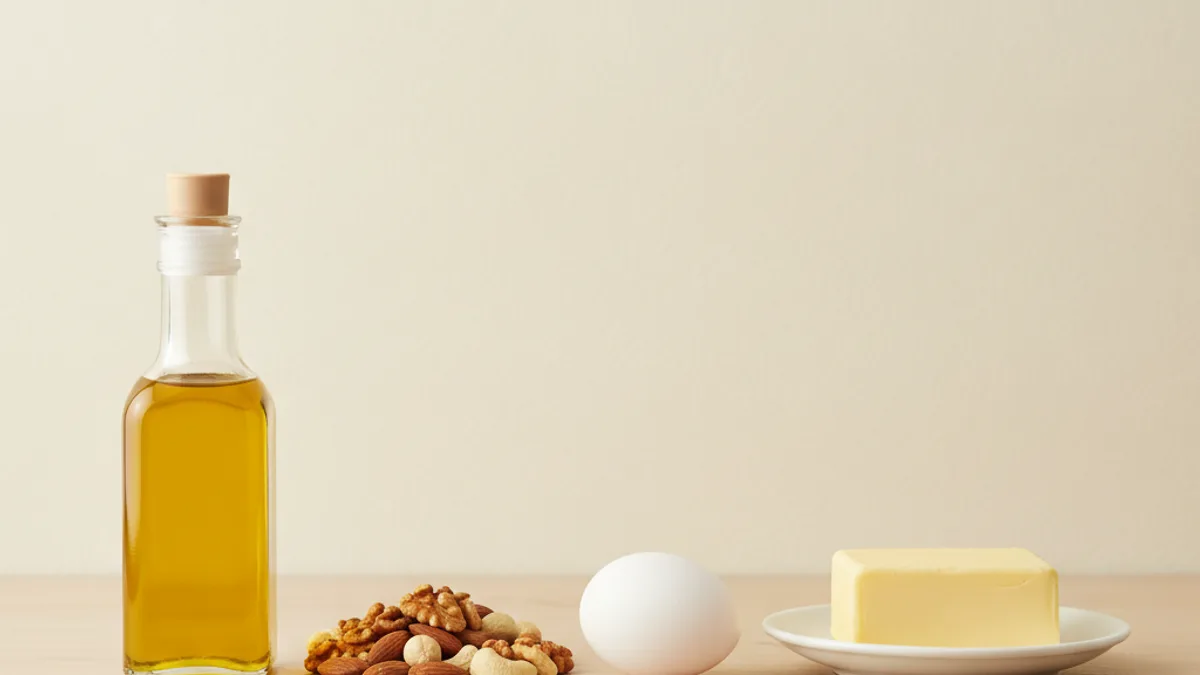
- 2 tablespoons of vegetable oil — about 28 g;
- 30 g of nuts — about 18 g;
- one egg — about 5 g;
- 100 g of 5% cottage cheese — about 5 g.
This means that with a standard diet, the issue is almost never about getting enough fat, but about recognizing where it comes from. The biggest contributor is the cooking method—how much oil food absorbs is analyzed in our article on cooking calories.
Not all fats within the norm are the same
The 20–35% range says nothing about composition. The differences between types of fats, what happens to them when heated, and why trans fats are categorized separately are analyzed in our articles on healthy and unhealthy fats, trans fats, and palm oil.
One clarification worth noting here: dietary cholesterol and dietary fats are different things, and the latter have a greater impact on blood lipids. This is covered in the article on dietary cholesterol.
When the guidelines differ
Pregnancy and breastfeeding, liver, gallbladder, and pancreatic diseases, and lipid metabolism disorders are situations where the amount and composition of fats should be determined by a doctor. General ranges are calculated for healthy adults and do not apply automatically in these cases.
Regarding low-fat diets for weight loss: in trials, they perform no better or worse than low-carb diets, and the choice between them is a matter of feasibility. A comparison is provided in the article on macronutrient ratios.
Frequently asked questions
- How much fat should you eat per day?
- According to EFSA guidelines, 20–35% of daily calories. At 1800 kcal, this is approximately 40–70 g of fat per day; the conversion is done by dividing the calorie percentage by 9.
- How much saturated fat is allowed?
- The WHO recommends less than 10% of daily energy—about 20 g for an 1800 kcal diet. EFSA does not set a separate number and recommends keeping intake as low as possible.
- What happens if you almost completely eliminate fats?
- Linoleic and alpha-linolenic acids are not synthesized by the body, so specific adequate intake values are set for them—4% and 0.5% of energy, respectively. Furthermore, the absorption of vitamins A, D, E, and K depends on dietary fat.
- How much omega-3 is needed per day?
- EFSA sets an adequate intake of alpha-linolenic acid at 0.5% of energy, and separately 250 mg of EPA and DHA per day for adults.
- Is it true that a low-fat diet is better for weight loss?
- In randomized comparisons, low-fat and low-carbohydrate diets yield similar results: the difference in the DIETFITS trial over one year was 0.7 kg and was not significant.
Read next
- Which fats are healthy and which are not — Dividing fats into "healthy" and "unhealthy" is convenient for a headline but almost useless at the grocery shelf: a single product usually contains all types at once, and the difference between them is not about general health benefits, but about specific effects.
- Macro ratio: where percentages come from and what to change first — Proportions like "30/30/40" look like an optimal formula someone has discovered.
- Trans fats: how they differ from regular fats and where they remain today — Trans fats are a rare case where a food scare turned out to be true: the concerns about them are supported by both the mechanism and the statistics.
This article is for general information. It is not medical advice, a diagnosis, or a prescription for treatment or a diet, and it does not replace a consultation with your doctor. If you have a health condition, are pregnant, take medication, or follow a diet prescribed to you, decisions about food belong with your doctor.
Figures from regulations, guidelines and studies are given as they stood when this article was prepared and may since have changed; check them against the primary sources. This article is not advertising, an offer, or individual advice, and neither the author nor the site owner is responsible for decisions taken on the basis of it.