Botulism in home canning: where the risk lies and what eliminates it
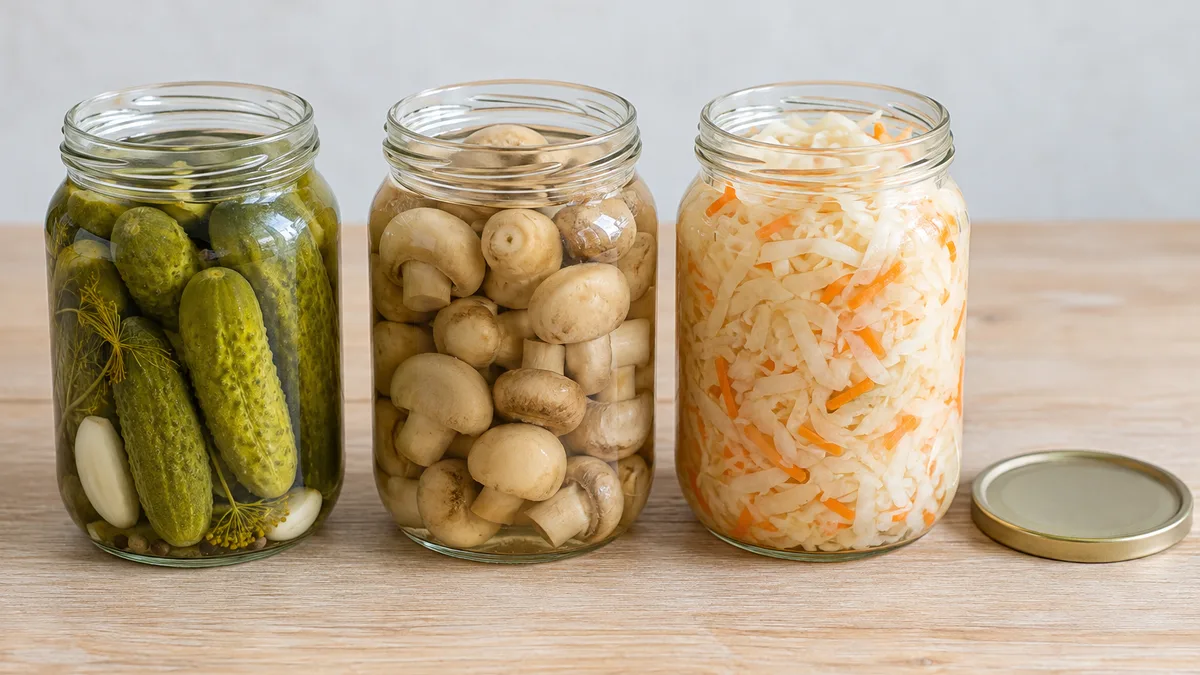
The causative agent of botulism multiplies only without air access and only if the product is not acidic enough. This explains everything else: why hermetically sealed jars are dangerous, why vinegar doesn't always help, and why contamination cannot be determined by appearance, smell, or taste.
Three conditions, and only their coincidence is dangerous
World Health Organization describes the pathogen as follows: Clostridium botulinum is an anaerobic bacterium, meaning it can grow only in the absence of oxygen. Bacterial growth and toxin production occur in low-oxygen foods under certain combinations of storage temperature and preserving factors. This most commonly happens in low-acid preserved foods and in home-canned foods prepared without proper processing.
The second condition is acidity. According to the same WHO fact sheet: in an acidic environment (pH less than 4.6), C. botulinum does not develop, and therefore the toxin is not produced in acidic foods. The threshold is specifically 4.6; the value of 4.5, which is sometimes encountered, has not been stated by any agency. The US Food and Drug Administration formulates the same from the reverse side: in the Bad Bug Book reference guide it states that practically any food that is not very acidic (pH above 4.6) is capable of supporting growth and toxin production.
The third is temperature and time. The pathogen comes in two groups with different limits, and the table of limiting growth conditions from the same agency gives them directly:
| Group | pH | Minimum growth temperature | Salt in aqueous phase, maximum | Oxygen |
|---|---|---|---|---|
| Type A and proteolytic B, F | from 4.6 to 9 | 10 °C | 10 % | strictly without it |
| Type E and non-proteolytic B, F | from 5.0 to 9 | 3.3 °C | 5 % | strictly without it |
From all three conditions together follows the main point, and this is not a list of dangerous dishes: it is not the food that is dangerous, but the combination of airtightness, insufficient acidity, and a temperature above refrigeration level. Mushrooms, meat, and fish fall into the risk group because their inherent acidity is knowingly above 4.6, and a sealed jar removes oxygen. Vegetables fall under the same reason: WHO lists low-acid canned vegetables among the culprit foods, including green beans, spinach, mushrooms, and beets, as well as fish, including canned tuna, salted and smoked fish, and meat products like ham and sausages.
Separately about salt, because the figure from the table is easily applied incorrectly. Ten and five percent refer to salt in the aqueous phase, not salt in the recipe: it is calculated as the proportion of salt to the sum of salt and moisture. A three-percent brine does not reach these values. For a product stable at room temperature, the same agency cites a guideline of 20 % salt in the aqueous phase.
What cannot be said about fermented cabbage
Here we have to correct a widespread statement, including one found in popular reviews: that fermented and salted foods are protected from botulism by definition. Not a single primary source claims this, and WHO states the opposite. Key facts in the fact sheet list: "Home-canned, pickled or fermented foods are frequently a source of foodborne botulism and require special care in their preparation." Fermentation stands on par with canning, rather than apart from it.
What can be said is the mechanism, and it explains why an open barrel of cabbage carries a different risk. The bacterium grows only without oxygen, and fermentation in a non-airtight container does not remove oxygen; fermentation itself lowers the pH in the process. That is, for a properly fermented product, both protective factors work at once. But this is a property of specific conditions, not a property of the word "fermented": the same cabbage, sealed in a jar before the acidity drops below 4.6, loses both. How fermentation works in general is covered in a separate review, and the composition card shows how much salt it contains.
Therefore, this check will not fail: you should look not at the name of the preserve, but at whether the container is airtight and whether the acidity has been reached.
Why vinegar in a marinade is not the same as an acidic food
Vinegar in a recipe does not equal a pH below 4.6 in the jar, and this is the main misconception of home canning. The requirement in the rules is formulated through equilibrium pH: according to the 21 CFR 114.80 standard, cited by guidance from the same agency, acidified foods must be manufactured so that a final equilibrium pH of 4.6 or lower is achieved within a designated time and maintained throughout the finished product.
Equilibrium means measured in the mashed product, not in the brine. The difference between these two values is the source of danger: the marinade may be acidic, but the center of a large mushroom may not be. The Codex Alimentarius Code of Practice explicitly lists the time required to reach equilibrium pH and tolerances for solid particle sizes among critical factors, and considers a low-acid food to be one in which any component has a pH above 4.6. A single mushroom cap not sufficiently penetrated by acid disqualifies the entire jar.
From this follow two consequences that are difficult to verify at home and therefore make it easy to overestimate one's capabilities.
First. Acid must be delivered inside the piece, not poured on top. Codex describes blanching in acidified solutions and holding in acid with concentration control for this purpose. "Poured vinegar over it and sealed it" does not ensure this.
Second. An acidified product can also cause botulism if acidity and other critical factors are not controlled, as written in the guide. Furthermore, Codex notes known instances where mold and other microorganisms developed in improperly processed or loosely sealed acidified preserves, which raised the product pH above 4.6 and opened the way for C. botulinum. Thus, acidity once achieved is not necessarily maintained.
Oil creates the same anaerobic environment as sealing
Mushrooms, garlic, herbs, and sun-dried tomatoes in oil constitute a separate risk category, and the danger there is created not by the jar, but by the layer of oil itself: it cuts off oxygen just like an airtight lid. FDA guidance notes that oxygen-permeable packaging does not compensate for the restriction of gas exchange created by packing in oil or in a deep container from which air has been squeezed out.
How non-theoretical this risk is can be seen from the case that changed the rules. An analysis of an outbreak associated with garlic in oil, published in the American Journal of Public Health in 1990, showed that the pH of the food remnants was 5.7, and high concentrations of C. botulinum and toxin were found in it. Following this, the agency required adding microbial inhibitors or acidifying agents to such products.
Hence the storage regime: homemade oil with garlic or herbs is a short-shelf-life product meant strictly for the refrigerator, rather than a winter preserve. And the refrigerator here specifically slows down rather than stops: the minimum growth temperature for the second group is 3.3 °C, and household refrigerators, as noted by the same guide, are sometimes warmer than 10 °C according to surveys — meaning above the growth limit for the first group as well.
What heating provides and what it does not
Toxin and spores are destroyed under completely different conditions, and they are often confused.
| What | What destroys it |
|---|---|
| Toxin | Boiling: WHO states an internal product temperature above 85 °C for 5 minutes or more |
| Vegetative cells | Easily, by ordinary heating |
| Spores | By boiling — no. WHO: spores can remain viable even after boiling for several hours |
FDA guidance adds two clarifications to this, and both change the matter.
The first is about temperature. Heat treatment at 100 °C, that is, at the temperature of boiling water, and even lower, destroys vegetative cells of C. botulinum, but does not destroy spores. Therefore, boiling water cannot be used for low-acid foods: the temperature that kills spores of the proteolytic group is higher — in scientific literature it is known as "botulinum cook", 121 °C for 3 minutes, and is achieved only under pressure.
The second is about how to treat this. The toxin is indeed destroyed by boiling for 10 minutes, but given its potency, relying on this as a control method should not be done — this is a literal caveat from the fish and fishery products hazards and controls guidance, and it is more important than the figure itself.
Hence the rule to remember in the correct order. Heating is the last line of defense, not the first. It can destroy already produced toxin, but it does not make a questionable jar safe: spores will remain, it says nothing about other causes of spoilage, and the magnitude of error in this disease is incomparable to the cost of a jar. A questionable home preserve is thrown away, not reheated. Acid, by the way, also does not bail you out retroactively: low pH does not destroy toxin produced earlier — as explicitly stated in the WHO fact sheet.
A bulging lid is a sign, but a normal appearance is no guarantee
Two signs work differently and must not be confused: one says "throw away", the second says nothing.
Normal appearance guarantees nothing. The Bad Bug Book reference guide formulates it this way: often there is no visible sign that a food is contaminated — although sometimes the jar may be bulging. Neither color, nor odor, nor taste changes enough to rely on it. Therefore, an airtight home preserve is not tested by taste — tasting "just a tiny bit to figure it out" is prohibited.
A bulging lid is a reason to throw out. The reverse, however, is not true: nothing follows from the fact that the lid is flat. The assertion that the botulism pathogen produces no gas and cannot cause swelling is found in popular memoranda, but is not confirmed by primary sources — the FDA writes directly that the jar is sometimes bulging. The correct logic is therefore one-sided: swelling, leakage, or dent — throw away; a flat jar is not a sign of safety.
Therefore, one must rely on preparation and storage conditions, rather than inspection. Inspection catches some cases and misses the rest, and the second group is larger.
Symptoms and when to seek help
Symptoms usually appear 12–36 hours after consumption, ranging from 4 hours to 8 days. The disease manifests as a descending flaccid paralysis that can lead to respiratory failure. Early signs include marked fatigue, weakness, and dizziness, usually followed by blurred vision, dry mouth, difficulty swallowing, and difficulty speaking. Nausea, vomiting, diarrhea, constipation, and abdominal bloating are also possible. There is no fever or loss of consciousness — and this distinguishes botulism from ordinary poisoning, where fever is expected. According to WHO data, the disease ends in death in 5–10 % of cases.
Botulism is a condition requiring emergency medical care. If the described signs appear after home canning, you must immediately consult a doctor or call an ambulance rather than waiting to see if it passes on its own; food remnants should be saved. This is not treated at home and is not limited to observation.
The rule about honey refers to a distinct form of the disease: honey is not given to infants under one year of age because nothing prevents spores from germinating in their unformed intestinal microflora. More details can be found in the text about honey and syrups.
What follows from this for home preserves
- Acidic preserves are the most understandable strategy. Equilibrium pH below 4.6 throughout the volume, not just in the brine.
- Mushrooms, meat, and fish are not canned at home in airtight containers. Their acidity is above the threshold, and spores are killed only by pressure processing at 121 °C.
- Oil with garlic and herbs goes strictly in the refrigerator and for a few days. Oil removes oxygen just like a lid.
- Boiling before eating is not a way to make a jar safe. It destroys the toxin, but not spores and other causes of spoilage.
- Doubt is a sufficient reason to throw away. A bulging jar is thrown away; a flat but questionable one as well, and they are not tasted.
Commercial canned goods live by different rules: there is pressure sterilization and control, and the risk is of a different order — but a bulging jar is thrown away in this case as well. What package dates actually mean is discussed separately, while preservatives and nitrite in meat products exist precisely to cover this risk in industry. How to store food at home so that shelf lives mean something is covered in a separate text.
Frequently asked questions
- Under what conditions is botulinum toxin produced in canned food?
- When three conditions coincide. According to the WHO, Clostridium botulinum grows only in the absence of oxygen and does not develop in an acidic environment with a pH below 4.6. The third condition is temperature: according to the FDA's limiting conditions table, the minimum growth temperature is 10 °C for type A and proteolytic types B and F, and 3.3 °C for type E and non-proteolytic types B and F. Therefore, the danger is not a specific dish, but the combination of airtight packaging, a pH above 4.6, and a temperature above refrigeration level.
- Does fermentation protect against botulism?
- The word "fermented" alone does not protect. The WHO lists home-canned, pickled, and fermented foods together as a frequent source of foodborne botulism. The mechanism works, not the name: unsealed packaging allows access to oxygen, and fermentation lowers the pH, and it is precisely these two factors that provide protection. The same cabbage, sealed in a jar before reaching a pH below 4.6, loses them.
- Is it enough to add vinegar to make canned food safe?
- No. The requirement is formulated in terms of equilibrium pH — measured in the mashed product, not in the brine: it must be 4.6 or lower throughout the finished product. The Codex Alimentarius classifies foods as low-acid if any component has a pH above 4.6, and designates the time required to reach pH equilibrium and the size of solid particles as critical factors. The acid must penetrate inside the piece rather than remaining only in the marinade.
- Will boiling neutralize home-canned food?
- The toxin — yes, the spores — no. The WHO indicates that the toxin is destroyed at internal product temperatures above 85 °C for 5 minutes or more, whereas spores can remain viable even after boiling for several hours. The FDA notes that the toxin is destroyed by boiling for 10 minutes, but given its potency, this should not be relied upon as a control method. A questionable preserve should be discarded rather than reheated.
- Can botulism be identified by the appearance and smell of a jar?
- No. According to the FDA Bad Bug Book, there is often no visible sign of contamination, although sometimes the jar may be bulging. The logic is therefore one-way: a bulge, leak, or dent is a reason to throw it out, while a flat lid guarantees nothing. Hermetically sealed home preserves must not be tasted.
Read next
- Expiration dates: "best before" and "use by" are not the same — The date on packaging is perceived as a boundary between "safe" and "unsafe," although it means different things for different products.
- Preservatives: why they are needed and what questions arise about them — The word "preservative" on an ingredient label is often seen as a negative, and products "without preservatives" sell better.
- How to store food at home — The expiration date on the package refers to an unopened pack under the specified conditions.
- Fermented foods: what happens inside — Fermentation is a preservation method invented long before the refrigerator: bacteria consume sugars and produce acid, and in an acidic environment, spoilage-causing organisms cannot survive.
This article is for general information. It is not medical advice, a diagnosis, or a prescription for treatment or a diet, and it does not replace a consultation with your doctor. If you have a health condition, are pregnant, take medication, or follow a diet prescribed to you, decisions about food belong with your doctor.
Figures from regulations, guidelines and studies are given as they stood when this article was prepared and may since have changed; check them against the primary sources. This article is not advertising, an offer, or individual advice, and neither the author nor the site owner is responsible for decisions taken on the basis of it.