Honey, syrup and oil in a spoon: measure and count
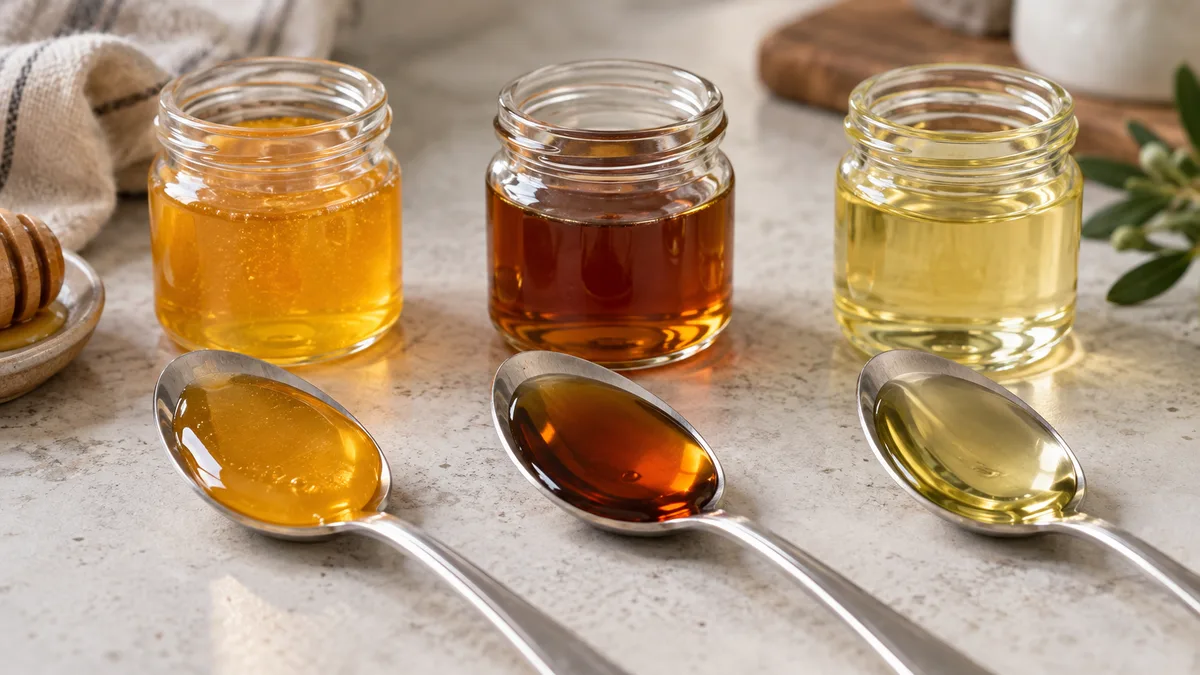
Do not automatically record a tablespoon as 15 g of food. A nutrition table per 100 g needs the addition’s weight; a table per 100 ml needs its volume. For honey and oil, weighing what reaches the dish is convenient, while spoon counts can stay in the recipe.
Check the spoon’s volume first
Look for a millilitre mark on a measuring spoon. In the NIST kitchen conversion table, a teaspoon is approximately 5 ml and a tablespoon 15 ml. This converts volume units for home recipes. It does not establish the capacity of every piece of cutlery or convert millilitres of honey into grams.
You can check an unmarked spoon with water and a measuring jug. Fill it level to the rim several times, transfer the water to the jug and divide the total volume by the number of fills. Keep the filling method consistent. This home check retains the measurement error of the jug and transfer.
For a thick product, measuring weight directly is simpler. Honey piled above the rim and a thin layer of oil in a partly filled spoon do not represent one volume. If a recipe calls for grams, weigh those grams.
What manufacturers call a serving
These three manufacturer examples were checked on 9 October 2026. The values describe the named products and their published labels for overseas markets. Check your own pack’s name, serving and units.
| Product and source | Declared serving | Serving calories |
|---|---|---|
| Gold Medal Honey, Mild Taste | 1 tablespoon, 21 g | 65 kcal |
| Karo Light corn syrup, Foodservice | 41 g | 121 kcal |
| Bertolli Cooking olive oil | 1 tablespoon, 15 ml | 120 kcal |
If you measure the declared serving, you can use its calories directly. Two measured 15 ml servings of the oil in the table give 240 kcal. Half the stated syrup serving, 20.5 g, gives 60.5 kcal. These numbers describe the selected labels, rather than every spoonful of oil or syrup.
Check which syrup you have: corn syrup, maple syrup, coffee syrup and a product made with sweeteners need separate entries. Use the nutrition table for the actual recipe. Sugar, honey and syrups explains the differences between sweet ingredients.
Weigh the addition directly in the dish
- Put the plate containing food on the scales and press tare.
- Add the honey, syrup or oil. Remove the spoon and your hands from the scales before reading the display.
- Record the weight shown and calculate nutrition from your label.
For a table per 100 g, use: addition weight × kcal per 100 g ÷ 100. The Gold Medal Honey above also declares 308 kcal per 100 g. If an illustrative portion adds 8 g of that honey to porridge, the calculation is 8 × 308 ÷ 100 = 24.64 kcal, or about 25.
If the scale’s resolution is too coarse for a small serving, do not report precision to tenths of a gram. For regular cooking, weigh several consistently filled spoons together to obtain an average guide. If five fills in an illustrative measurement total 106 g, the average is 21.2 g. Those numbers are hypothetical: measure your own spoon and product.
Spoon residue and weighing the jar
Weighing a jar before and after shows how much food left it. If some remains on the spoon or falls on the table, that difference is not the amount added to the dish. Weighing the plate after adding the food counts what reached the plate.
If you lick the spoon, that is an additional portion eaten. If you rinse off the residue, it did not enter the dish. Use one measurement method consistently for an ordinary record; do not invent a fixed deduction for residue.
Weigh a piece of crystallised honey rather than estimating a heap by eye. Its measured grams can be used with a table per 100 g regardless of the piece’s shape. Recording it in millilitres requires a volume measurement or the specific product’s density.
When the addition is shared between portions
If honey or syrup is mixed into the whole batch of porridge, include it in the recipe. In an illustrative example, 16 g of honey at 308 kcal per 100 g adds 49.28 kcal to the batch. Distributed equally between four servings, the honey contributes about 12.3 kcal per serving. This calculates the addition; other ingredients are counted separately.
Do not automatically count all frying oil as eaten: some can remain in the cookware. Do not deduct a fixed proportion without measuring it. Counting home-cooked food explains calculating the whole dish.
Check the diary entry
Match the units of the label and portion first. For values per 100 ml, use measured volume; for values per 100 g, measured weight. To connect them, weigh a known volume of your product: weight ÷ volume gives a working coefficient in g/ml.
You can check a pack by barcode. A meal photograph can preserve its ingredients, but does not measure honey hidden beneath berries or oil in a dressing. Clarify the addition in your record using the label and measurement. The sauce table gives prepared sauce examples and their servings.
Frequently asked questions
- Does a tablespoon of honey always weigh 21 g?
- No. The example Gold Medal Honey label declares a tablespoon serving as 21 g. Measure the weight for your own spoon, filling method and product.
- Why can’t I record 15 ml of oil as 15 g?
- Millilitres measure volume and grams weight. Conversion needs the specific product’s density. If the nutrition table is per 100 ml, calculate by volume without converting to grams.
- How do I count honey left on the spoon?
- If you eat it, it is part of the food consumed. If you rinse it off, it did not enter the dish. Weighing the plate before and after adding honey counts what reached the plate.
- How do I count half a spoon of syrup?
- If its volume matches half the declared serving, halve that serving’s calories. Weighing a partly filled piece of cutlery lets you calculate from values per 100 g.
- Should I add honey separately to a porridge serving?
- If it is already included in the recipe and its nutrition divided between portions, do not add it again. Honey added to your plate afterwards is a separate addition.
Read next
- Sugar, honey, and syrups: how they actually differ — Honey, maple syrup, and agave syrup are marketed as sugar substitutes.
- Sauce calories: mayo, ketchup, cheese, garlic, and teriyaki by the spoonful — A tablespoon of sauce can add 20 kcal or 90 kcal to a meal.
- How to determine portion size without a scale — Portion weight is the most inaccurate variable in any calculation, including analysis by photo.
- How to count calories in homemade food — Processed foods are counted by the label, and restaurant meals by a reference guide.
This article is for general information. It is not medical advice, a diagnosis, or a prescription for treatment or a diet, and it does not replace a consultation with your doctor. If you have a health condition, are pregnant, take medication, or follow a diet prescribed to you, decisions about food belong with your doctor.
Figures from regulations, guidelines and studies are given as they stood when this article was prepared and may since have changed; check them against the primary sources. This article is not advertising, an offer, or individual advice, and neither the author nor the site owner is responsible for decisions taken on the basis of it.