Sauce calories: mayo, ketchup, cheese, garlic, and teriyaki by the spoonful
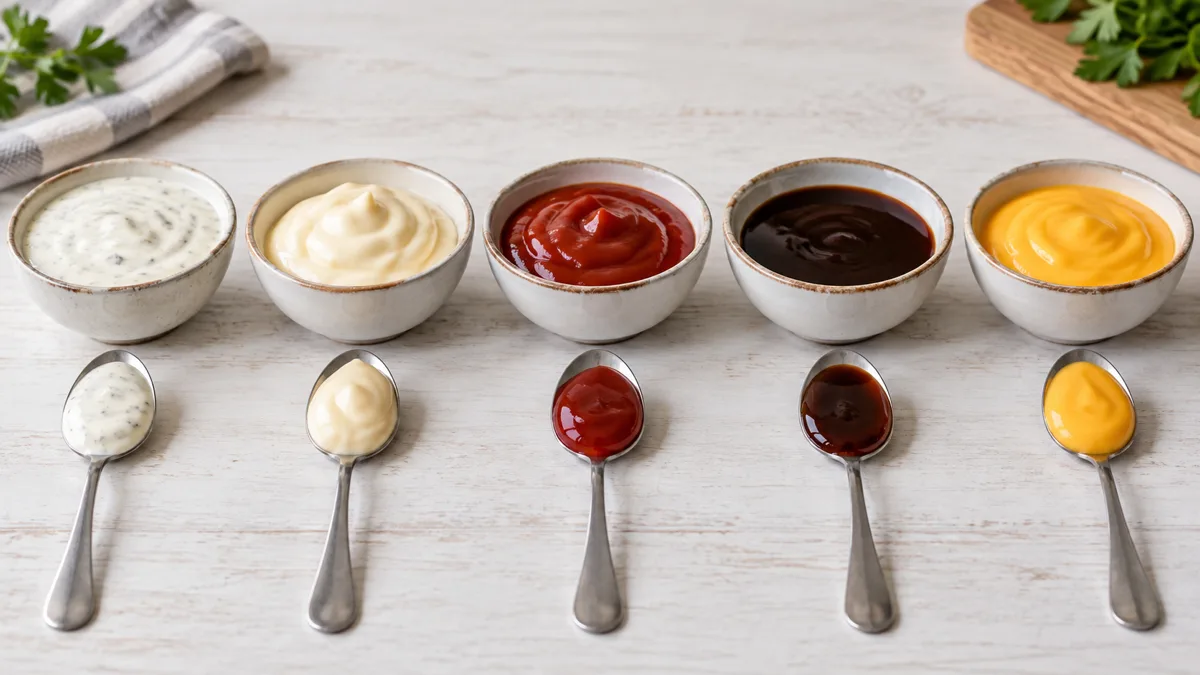
A tablespoon of sauce can add 20 kcal or 90 kcal to a meal. The name alone does not supply an exact number: regular mayonnaise is mostly oil, ketchup has a tomato base with sugar, and cheese and garlic sauces follow many different recipes. Accurate tracking needs the label and the amount you actually ate.
Five sauces in comparable servings
The table contains examples from official manufacturer pages, not an average for every sauce in each category. It shows both the scale of the numbers and the variation between recipes. The data were checked on September 25, 2026.
| Sauce | Label serving | Calories | Example source |
|---|---|---|---|
| Regular mayonnaise | 1 tbsp, 13 g | 90 kcal | Kraft Real Mayo |
| Tomato ketchup | 1 tbsp, 15 ml | 20 kcal | Heinz Ketchup |
| Cheese sauce | 30 g | 70 kcal | Cheez Whiz |
| Garlic aioli | 1 tbsp, 14 g | 70 kcal | Hellmann’s Garlic Aioli |
| Teriyaki marinade | 1 tbsp, 15 ml | 20 kcal | Kikkoman Teriyaki Marinade & Sauce |
For the cheese sauce in the table, 15 g works out to about 35 kcal—half of its 30 g serving. That calculation applies to this product only. Another cheese sauce may contain different proportions of oil, cream, cheese, or water.
Why one tablespoon does not always weigh 15 grams
A tablespoon measures volume—normally 15 ml—while grams measure mass. The mass occupying that volume depends on the food's density. Even among the examples here, manufacturers assign 13 g to a tablespoon of mayonnaise, 14 g to garlic aioli, and 18 g to a thick teriyaki barbecue sauce.
The teriyaki products illustrate variation within one family. The manufacturer's thick teriyaki barbecue sauce has 30 kcal in 18 g, whereas the liquid marinade in the table has 20 kcal in 15 ml. An entry that says only “one spoonful of teriyaki” leaves meaningful uncertainty.
A heaped spoon introduces another variable. Runny ketchup barely forms a mound, while thick mayo can sit above the rim. When sauce materially changes the total, place the plate on a scale, tare it, and add the sauce.
Mayonnaise: most of its calories come from oil
The example mayonnaise has 10 g of fat and 90 kcal per tablespoon. Two such spoonfuls provide 180 kcal. Light versions need their own entries: water and thickeners may replace part of the oil, changing the label value.
Do not transfer a regular-mayo number to a mayonnaise dressing or vice versa. Similar names can hide different oil contents and serving weights. When mayo is part of a salad, enter its measured weight in the recipe, then divide the entire salad by cooked weight or servings. Our mayo-free salad dressing guide compares dressing recipes; this page has the narrower job of logging a prepared sauce.
Ketchup: low in fat, but still recipe-specific
The tomato ketchup in the table has 20 kcal per tablespoon. Its energy comes mainly from carbohydrate: the serving supplies 5 g of carbohydrate, including 4 g of sugars. No-added-sugar products and recipes containing more sugar will differ.
The error from one spoonful is often small. Sixty millilitres, however, equals four of these label servings and 80 kcal. A common tracking error is entering one label serving when several went onto the plate.
Cheese sauce has no universal recipe
“Cheese sauce” can mean a thick dip made with vegetable oil, a milk-and-cheese sauce, or a restaurant sauce built on mayonnaise. Colour and flavour do not reveal the fat proportion. The example above has 70 kcal per 30 g, but that is one formula—not a category standard.
For homemade cheese sauce, create a recipe with the cheese, milk or cream, butter, flour, and other ingredients. Weigh the finished sauce, then calculate the amount you used. The full method is in the guide to counting homemade food.
Garlic sauce: garlic tells you little about the calories
The example garlic aioli provides 70 kcal and 7 g of fat in 14 g. “Garlic sauce” can also describe yogurt with garlic, seasoned sour cream, or a blend of mayo and sour cream. These recipes do not share a calorie value.
Look at the base. Oil- and mayo-based sauces are usually more energy-dense; a yogurt base may be lighter, but only its ingredients and proportions determine the exact figure. Adding garlic does not turn different bases into one food.
Teriyaki: a thin marinade and thick glaze are different entries
The liquid marinade in the table has 20 kcal per tablespoon. The manufacturer's thick teriyaki barbecue sauce has 30 kcal in 18 g. The thick product declares 5 g of added sugar per serving and the liquid one declares 3 g. “Teriyaki” is not specific enough to choose a database entry.
If you discard marinade after raw meat has soaked in it, the whole starting amount did not necessarily reach the plate. Counting all of it provides a practical upper estimate. For a closer record, weigh the marinade container before use and the portion that remains outside the cooked dish. Count sauce brushed on as a glaze after cooking in full.
How to log a sauce
- Use the label on your package. Match the full product name, regular or light version, and serving unit. The guide to calories and macros on the label explains the nutrition panel.
- Weigh the amount added. Put the plate on a scale, press tare, add the sauce, and record the grams.
- Calculate from the per-100-g value. Use serving kcal = sauce grams × kcal per 100 g ÷ 100.
- When the label uses servings, count them. Two tablespoons of a product declaring 20 kcal per tablespoon equal 40 kcal when your spoons match the stated volume.
- Create a recipe for homemade sauce. A similar bottled product cannot stand in for the ingredients in your bowl.
Without a scale, use a level measuring spoon and the serving on the label, treating the result as an estimate. The guide to estimating portion size covers how cups, spoons, and hand measures compare with actual weight.
Frequently asked questions
- How many calories are in a tablespoon of mayonnaise?
- The regular-mayonnaise example on an official label has 90 kcal in 13 g, declared as one tablespoon. Light mayo and mayonnaise dressing have different values, so use the label on your own product for an exact entry.
- How many calories are in a tablespoon of ketchup?
- The tomato-ketchup example here has 20 kcal in 15 ml. Recipes and serving declarations vary; for several spoonfuls, multiply by the number of label servings you actually used.
- Which has fewer calories, cheese sauce or garlic sauce?
- The names cannot answer that. Cheese sauce may use milk or oil, while garlic sauce may use mayo, sour cream, or yogurt. Compare the two labels at the same weight, such as per 100 g.
- Can I count a tablespoon of sauce as 15 g?
- Not reliably. A tablespoon measures volume, and weight depends on density: official labels may assign 13, 14, or 18 g to one tablespoon of different sauces. Weigh the sauce when precision matters.
Read next
- Calories and macros on the label: why the numbers don't match reality — The same buckwheat in three different apps gives three different calorie counts, and the package shows a fourth.
- How to count calories in homemade food — Processed foods are counted by the label, and restaurant meals by a reference guide.
- How to determine portion size without a scale — Portion weight is the most inaccurate variable in any calculation, including analysis by photo.
- Salads without mayonnaise: four dressings and what they pair with — In a salad, calories are almost always found not in the vegetables, but in the dressing: two tablespoons of mayonnaise contain about as many calories as everything else on the plate combined.
This article is for general information. It is not medical advice, a diagnosis, or a prescription for treatment or a diet, and it does not replace a consultation with your doctor. If you have a health condition, are pregnant, take medication, or follow a diet prescribed to you, decisions about food belong with your doctor.
Figures from regulations, guidelines and studies are given as they stood when this article was prepared and may since have changed; check them against the primary sources. This article is not advertising, an offer, or individual advice, and neither the author nor the site owner is responsible for decisions taken on the basis of it.