How much does a spoonful of cottage cheese curds weigh?
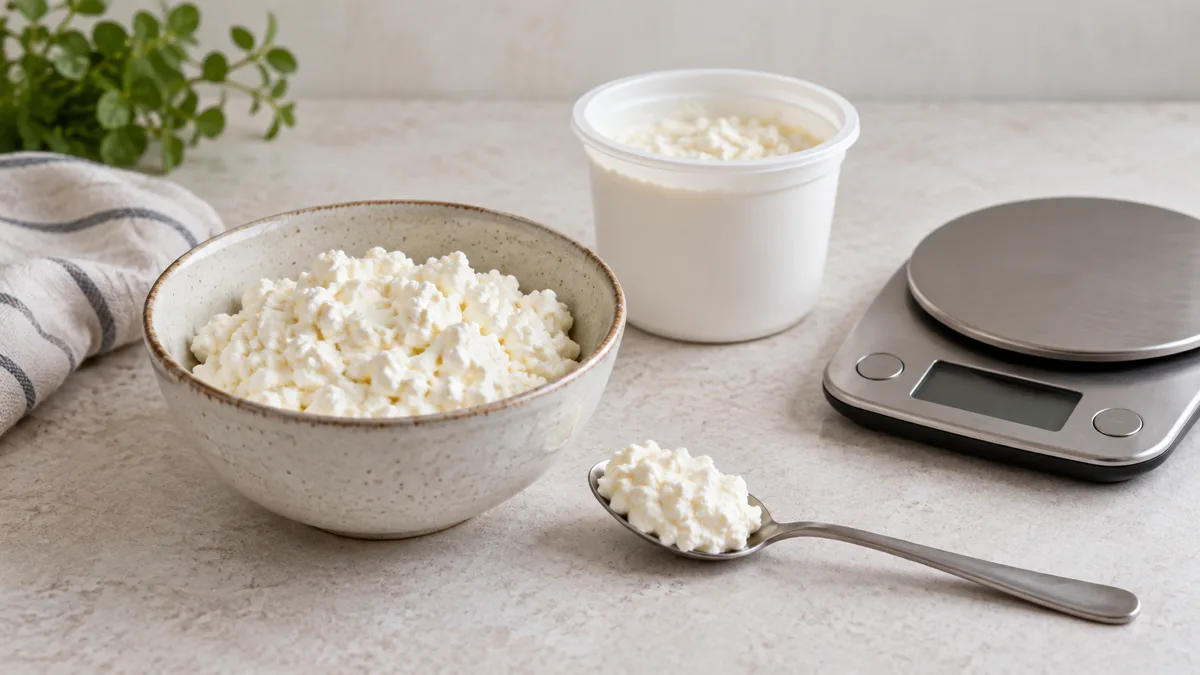
There is no dependable single weight for a tablespoon of cottage cheese curds. The spoon may hold different amounts of curds and cream. Use the net weight on the tub for a whole package, and weigh your usual spoonfuls once for a personal estimate.
Why one tablespoon has no fixed weight
A tablespoon can be level or heaped. It can collect curds with plenty of cream or very little. A gram value for “one spoon of cottage cheese” without specifying the product and how the spoon is filled would imply more precision than the measure offers. To calibrate a spoon you use often, tare a bowl on a scale, add several usual spoonfuls, and divide their combined weight by the number of spoonfuls.
That estimate applies to the mixture you measured. Draining the cream and weighing the curds alone produces a different food portion. The cottage cheese weights-and-measures card lists reference measures, while a scale gives the weight of the spoonful in front of you.
Creamed and dry curds need different entries
The USDA food composition table lists a cup of large-curd creamed cottage cheese at 225 g and a cup of small-curd creamed cheese at 210 g. A cup of uncreamed dry curds is listed at 145 g. These are reference measures for different foods, not competing weights for one tub. A volume conversion for dry curds cannot simply be applied to curds in cream.
Choose a food-diary entry for what you actually ate. If the cream stays in the tub, the label for the original mixture does not precisely describe the drained curds. If you eat the cream with the curds, calculate the whole portion from that product’s label.
Use the net weight of your tub
The package gives its own net weight. For example, one manufacturer lists a 130 g tub of curds in cream and a 320 g tub in the same range. Those weights cover the packaged product, including cream.
If you eat the whole tub, enter its net weight. If some remains, weigh the remainder and subtract it. For packages with a separate topping, read how the net weight is assigned to the compartments before treating it as cottage cheese alone.
Calculate calories from the product label
The manufacturer lists 91 kcal per 100 g for the two creamed products above. At that value, a 130 g tub contains about 118 kcal and a 320 g tub about 291 kcal: 91 × tub weight ÷ 100. Those are calculations for these products, not an average for all cottage cheese.
| Amount eaten | Find its weight | Calculate from the label |
|---|---|---|
| Whole tub | Net weight on the package | Calories per 100 g × net weight ÷ 100 |
| Part of a tub | Net weight minus the weighed remainder | Calories per 100 g × eaten weight ÷ 100 |
| Several spoonfuls | Weighed portion or your calibrated spoon | Calories per 100 g × eaten weight ÷ 100 |
Use the new label when the brand, fat content, or added ingredients change. Our guide to types of tvorog explains the product differences.
When you do not have a scale
You already have the weight for a whole tub on its label. Half of a well-mixed tub can be logged as half the net weight as an estimate. If the cream has separated or some remains in the container, half the apparent volume may not be half the mass or composition. An approximate entry is more honest than a made-up exact spoon weight.
Frequently asked questions
- How many grams are in a tablespoon of cottage cheese curds?
- There is no verified universal number. Spoon size, how full it is, and the amount of cream all matter. Weigh several ordinary spoonfuls and divide their total weight by the count.
- Does a 130 g tub mean 130 g of curds alone?
- For the example product in cream, 130 g is the net weight of the packaged mixture, including the cream.
- Can I use the creamed cottage cheese label for drained curds?
- Not precisely. Removing cream changes the composition of what you eat. Use an entry for dry-curd cottage cheese or separate nutrition data for the curds if the maker provides it.
- How do I calculate calories for a whole tub?
- Multiply the label’s calories per 100 g by the net weight, then divide by 100. For example, 130 g at 91 kcal per 100 g is about 118 kcal.
Read next
- Tvorog: how to distinguish it from a tvorog product — On the tvorog shelf, there are four different products, and the difference between them is specified in the regulation.
- How to determine portion size without a scale — Portion weight is the most inaccurate variable in any calculation, including analysis by photo.
- Raw or cooked weight: how to count grains, pasta, and meat — "100 g of buckwheat" can mean 346 kcal or 92, depending on the state of the grain.
- Why the body gets fewer calories than the label says — No one actually measured the number on the package: it was calculated by multiplying proteins, fats, and carbohydrates by factors over a century old.
This article is for general information. It is not medical advice, a diagnosis, or a prescription for treatment or a diet, and it does not replace a consultation with your doctor. If you have a health condition, are pregnant, take medication, or follow a diet prescribed to you, decisions about food belong with your doctor.
Figures from regulations, guidelines and studies are given as they stood when this article was prepared and may since have changed; check them against the primary sources. This article is not advertising, an offer, or individual advice, and neither the author nor the site owner is responsible for decisions taken on the basis of it.