How much do a cup and handful of blueberries weigh?
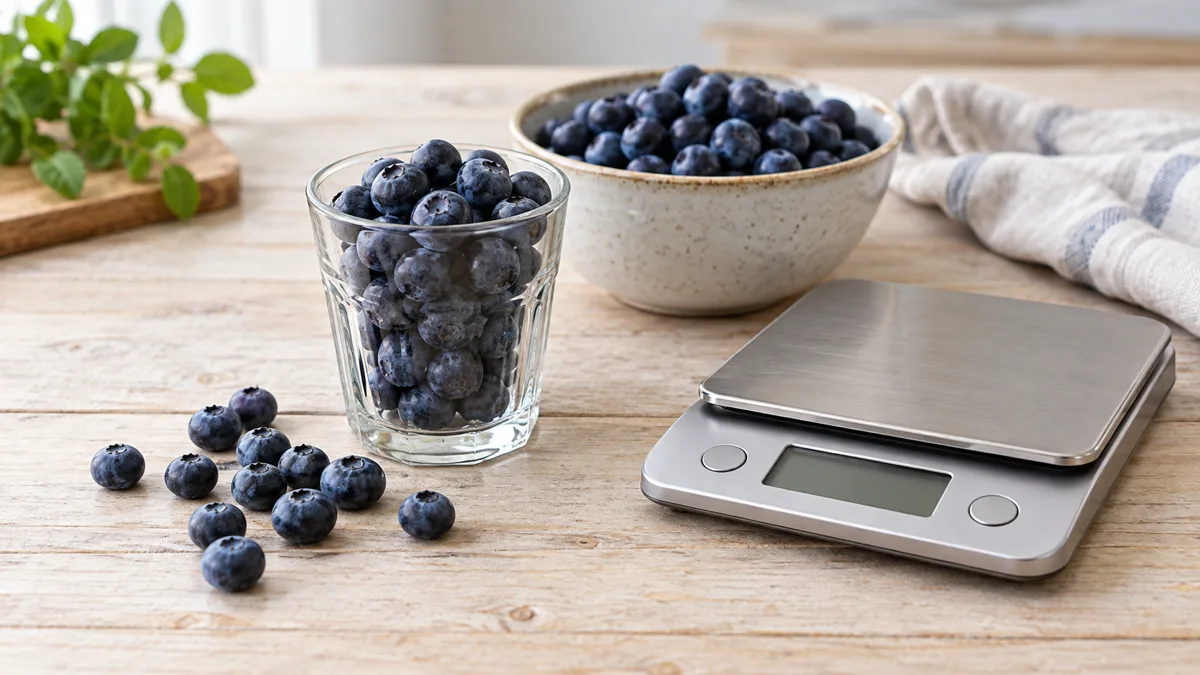
A USDA table lists one cup of fresh blueberries at 148 g and 85 kcal. That is a reference cup, not the weight of every cup in a kitchen. There is no standard weight for a handful; weigh your portion when accuracy matters.
How much a cup of fresh blueberries weighs
The USDA SR28 food composition table lists 148 g and 85 kcal for one cup of raw blueberries. This is a reference value for its cup measure, not a weighing of every home cup.
This is a useful estimate without a scale. A home cup may have a different capacity, and berries can be filled below the rim, level with it, or heaped. The 148 g reference should not be treated as the exact weight of every cup. The blueberry weights-and-measures card gives the reference conversion; weighing your usual filled cup gives you a better personal measure.
A handful has no standard gram weight
Hands vary in size, and people scoop berries differently. The USDA cup value cannot be divided into a fixed number of handfuls: the table does not give a blueberry handful measure. If you regularly use your hand as a measure, weigh a few ordinary handfuls and use the result as your own rough estimate.
Without a scale, record a handful as an approximate serving. You can check it later, but an estimated handful should not be presented as exact grams.
Calories in 100 g and in your serving
USDA lists 57 kcal per 100 g of raw blueberries. Multiply your eaten weight by 57 and divide by 100. For example, 80 g of fresh berries works out to about 46 kcal. The table's 85 kcal per cup uses unrounded data, so multiplying the rounded 57 kcal figure by 148 g gives a slightly different result.
| Fresh blueberries | Weight | Energy from USDA figures |
|---|---|---|
| Weighed serving | 100 g | 57 kcal |
| USDA reference cup | 148 g | 85 kcal |
| Handful | Varies with hand and fill | Calculate after estimating its weight |
The USDA cup entry above is for raw berries. Frozen blueberries packed with sugar have a different composition. Use their product label rather than the fresh-berry conversion.
How to weigh blueberries for a food diary
- Place an empty bowl or cup on the scale and tare it.
- Add the blueberries as you plan to eat them and record their weight.
- Choose a fresh-blueberry entry and enter that weight. Log yogurt or other ingredients separately.
If you leave some berries, weigh what remains and subtract it from the starting amount. For a small package eaten in full, its net weight is another usable measure. Our guide to estimating portion size covers other situations without a scale.
Frequently asked questions
- How many grams of blueberries are in a cup?
- USDA lists 148 g for a reference cup of fresh blueberries. Your cup and how it is filled may differ; weigh the berries for an exact entry.
- How many grams are in a handful of blueberries?
- There is no universal value. Hand size and how you scoop vary. Weigh a few of your normal handfuls to establish a personal estimate.
- How many calories are in 100 g of blueberries?
- USDA lists 57 kcal per 100 g of fresh blueberries. Its reference cup of 148 g contains 85 kcal.
- Can I log sweetened frozen blueberries as fresh?
- Use the label for berries packed with sugar. The fresh-blueberry figures do not include added sugar.
Read next
- How to determine portion size without a scale — Portion weight is the most inaccurate variable in any calculation, including analysis by photo.
- How much does a mango weigh: flesh, pit, and serving — USDA lists one mango without refuse as 336 g and a cup of pieces as 165 g.
- Raw or cooked weight: how to count grains, pasta, and meat — "100 g of buckwheat" can mean 346 kcal or 92, depending on the state of the grain.
- How to count calories in homemade food — Processed foods are counted by the label, and restaurant meals by a reference guide.
This article is for general information. It is not medical advice, a diagnosis, or a prescription for treatment or a diet, and it does not replace a consultation with your doctor. If you have a health condition, are pregnant, take medication, or follow a diet prescribed to you, decisions about food belong with your doctor.
Figures from regulations, guidelines and studies are given as they stood when this article was prepared and may since have changed; check them against the primary sources. This article is not advertising, an offer, or individual advice, and neither the author nor the site owner is responsible for decisions taken on the basis of it.