Chestny Znak and the square code on the packaging: what it shows
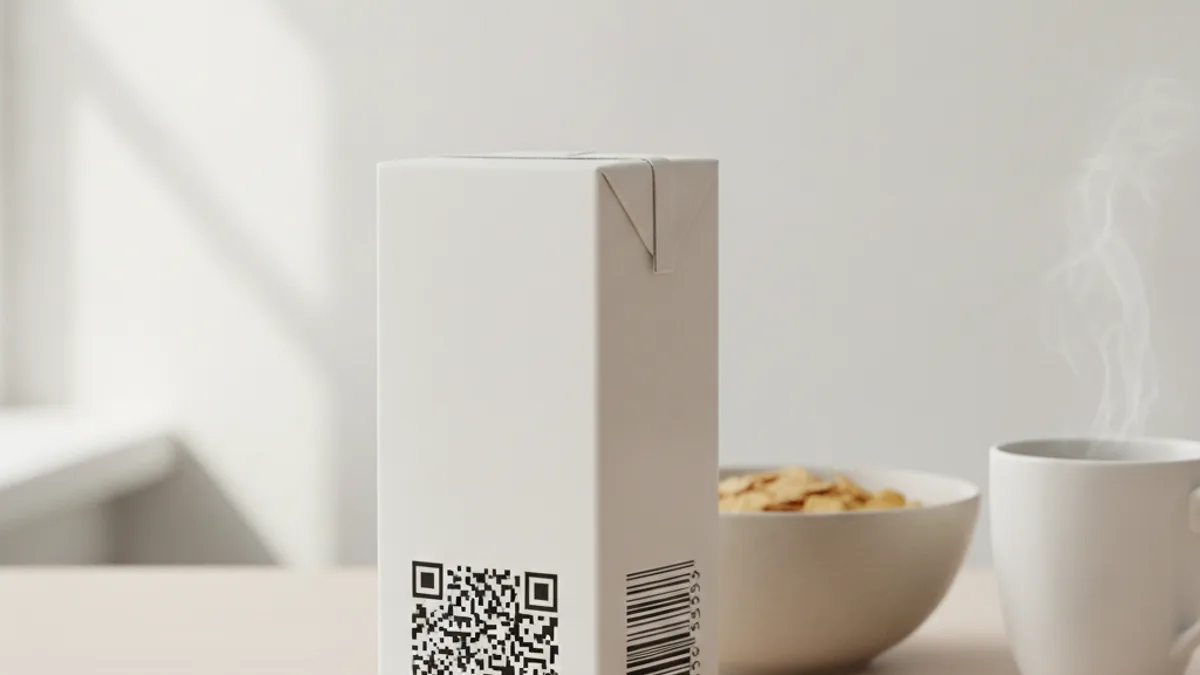
Next to the familiar stripes on packaging, there is increasingly a small square made of dots. It solves a task that a barcode cannot and does not have: to distinguish one specific package from another identical one. At the same time, it does not answer questions about composition and calorie content — and it is worth understanding why.
The barcode describes the item, the Data Matrix describes the specific unit
The difference between the two codes on a single package is fundamental, and it is not just about the shape.
The EAN-13 barcode carries the product item number: it is identical for all packages of the same yogurt of the same weight. What it contains and what it does not is analyzed in our article on barcodes on packaging.
The square Data Matrix code carries not only the item number but also a serial number—unique to each individual package. It also includes a verification component that cannot be calculated without knowing the key: this is what distinguishes a code applied according to the rules from one copied from a neighboring package. This is the basis for everything the system can do: since each unit is distinguishable, its journey can be tracked from the factory to the checkout.
What the labeling app shows
Scanning the square in the system's app provides information about the specific package:
- the name of the product and its manufacturer;
- the production date and expiration date recorded in the code;
- status: whether the code is in circulation or has already been withdrawn, meaning the product has been sold;
- confirmation that the code actually exists in the system.
The practical value here lies primarily in the first three points. The expiration date does not come from the label, where it is printed with ink on hot film and can sometimes be illegible, but from the digital record. A "withdrawn from circulation" status on a product sitting on a shelf means that this code has already passed through a checkout.
What this code does not contain
It contains neither the ingredients list, nor the list of additives, nor proteins, fats, and carbohydrates, nor the calorie count. The reason is structural: the code was designed for traceability, and its payload is dedicated to identifiers rather than product descriptions.
Nutritional value remains where it has always been—printed on the packaging. This is the manufacturer's claim, and how well it matches the actual contents is analyzed separately. The mandatory information on the label is defined by the TR CU 022/2011 technical regulation, and identification labeling does not replace or supplement it.
In other words, two independent mechanisms exist on the packaging. One answers the question, "Is this package what it claims to be?"; the second answers the question, "What is inside?". They only intersect in the product name.
What the check catches and what it does not
It catches substitution at the accounting level: a code that does not exist in the system; a code that has already been withdrawn from circulation; or a mismatch between the declared product and the number under which the code was issued. For expired products, a sales ban is in effect—the checkout will not process an item if its record shows the expiration date has passed.
It does not catch quality issues. A legal code on a legally produced product says nothing about the recipe, how the product was stored, or its taste. Milk with impeccable labeling can be anything within the limits permitted by the regulation; butter replaced with palm oil, if declared as such, will also pass the check—the question of palm oil lies in a different plane.
It also does not catch misleading information on the label. Terms like "sugar-free," "fitness," or "farm-fresh" relate to marketing, not labeling; what actually lies behind them is the subject of our article on label claims.
Why the code might not scan
The Data Matrix is denser than a barcode and more sensitive to imaging. Typical reasons for failure include:
- Glare. The square is often applied to glossy film, and the flash can wash out some of the dots. Using side lighting and shooting without a flash helps.
- Curved surface. On a bottle or jar, the code bends, and the grid of dots ceases to be a grid. You should shoot strictly perpendicular to the center of the code.
- Too close. The camera cannot focus from five centimeters away, and a blurry square will not decode. Moving further away is usually more reliable than getting closer.
- Damage. The format handles the loss of some modules due to redundancy, but a code that is half-worn away cannot be recovered.
How this relates to calorie counting
For someone counting calories, two things from the list above are useful. The first is the exact name of the product, including weight and fat content: these are the details usually missing when trying to find the correct entry rather than just a similar one. The second is the expiration date, because it relates to safety rather than numbers, and it is a separate reason to look at the code.
Everything else is still calculated as before: using the values on the packaging for finished products and the composition and weight of ingredients for food prepared at home.
Frequently asked questions
- What does Chestny Znak show when scanning a product?
- The product name and manufacturer, production date and expiration date from the system record, as well as the code status—whether it is in circulation or has already been withdrawn. The code does not contain information about ingredients, caloric value, or a list of additives.
- How does a square code differ from a barcode?
- A barcode carries the product item number, which is the same for all identical packages. In addition to this, a Data Matrix carries the serial number of a specific package and a verification component, which allows for tracking the journey of an individual item and distinguishing it from a copy.
- Can I find out the nutritional value (calories, proteins, fats, carbohydrates) of a product from the labeling?
- No. Nutritional value is printed on the packaging as text; it is a manufacturer's declaration, and the labeling system does not store or verify it. The code answers the question of the item's authenticity, not its contents.
- Does labeling guarantee product quality?
- No. It confirms that the product was released legally and is accounted for, and it prohibits the sale of expired goods. The recipe, storage conditions prior to reaching the store, and consumer properties are not part of the verification.
- Why is the code not scanning?
- Most often, the issue is caused by glare on glossy film, the curvature of the code on a bottle or can, or attempting to scan from too close, which prevents the camera from focusing. You should scan perpendicular to the center of the code, without a flash, from a distance where the focus is maintained.
Read next
- Barcode on packaging: what is encrypted in it and what is not — There is a persistent belief about barcodes: that you can supposedly tell the country where a product was made from the first digits, and verify its authenticity from the rest.
- Where do apps get calorie and macronutrient data and why do the numbers differ — The same cottage cheese gets different calorie counts in two apps, and people usually assume one of them is wrong.
- "Sugar-free," "fitness," "eco": what these labels actually mean — The front of a package speaks in short words: "light," "fitness," "sugar-free," "eco.
This article is for general information. It is not medical advice, a diagnosis, or a prescription for treatment or a diet, and it does not replace a consultation with your doctor. If you have a health condition, are pregnant, take medication, or follow a diet prescribed to you, decisions about food belong with your doctor.
Figures from regulations, guidelines and studies are given as they stood when this article was prepared and may since have changed; check them against the primary sources. This article is not advertising, an offer, or individual advice, and neither the author nor the site owner is responsible for decisions taken on the basis of it.