Ready-to-eat food by weight: how to find calories without a label
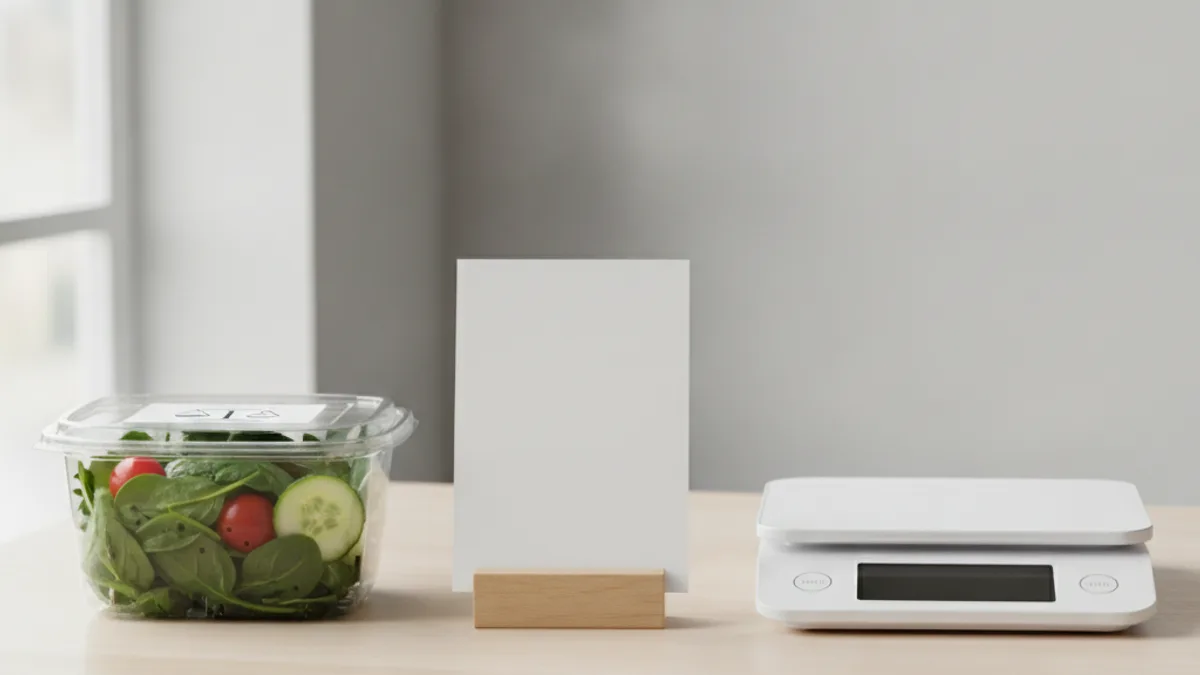
Regulations require four lines on a deli salad container: name, production date, shelf life, and storage conditions. Ingredients and calorie counts are not among them: they may be provided to the customer by "any means" — via a price tag, a folder at the counter, or by asking the staff. If none of these work, you are left to estimate for yourself.
What must be written on the container
When a store pre-packs food — portioning salad into containers in the kitchen and placing them in the refrigerator — four pieces of information are mandatory on the packaging or the attached label: name, production date, shelf life, and storage conditions. This is defined in clause 5 of part 4.12 of TR TS 022/2011.
Ingredients and nutritional value are not on this list. The regulation requires them to be provided by "any means that ensures an informed choice" — such as a price tag, a folder at the counter, a display board, or by asking the staff. They do not have to be on the container itself, and this is not a violation.
If food is weighed in front of you — at a hot food counter or a salad bar — clause 6 of the same part applies: all information, including the name and date, must be provided by any means. This is why there is often no label at all at the deli counter, and all the information is posted on a board to the side.
Where to look for ingredients and calories
In order of reliability:
- Price tag. Most often, nutritional value is listed there in small print under the price per kilogram.
- Folder or display board at the counter. Formally, this is the "any means" required by the regulation, and in chain delis, staff are required to show you the folder upon request.
- Website or app of the chain. Private label items usually have product pages, while smaller producers often do not.
- Ask the staff. This works worse for ingredients and allergens than for shelf life: deli staff rarely keep the recipes in their heads.
If you are checking for an allergen rather than counting calories, the order is reversed: you should ask immediately rather than looking for it yourself. How to do this effectively is covered in our article on allergens in restaurants — the same phrasing works for deli counters.
Why the number on the tag is a calculation, not a measurement
The regulation explicitly allows nutritional values to be determined by "analytical or calculation methods" (clause 12 of part 4.9) and to supplement the labeling with the words "average values" (clause 14 of the same part). No one burned the salad in a calorimeter: its calorie count was calculated by adding up the calories of the ingredients in the recipe.
Calculations based on recipes do not account for how much dressing ended up in your specific portion or how much the cook deviated from the standard recipe. For dishes with a uniform structure — a meat patty or baked fish — the discrepancy is small. For a salad with dressing, where the sauce is distributed unevenly, the difference between two containers from the same shelf can be significant.
There is also a specific exemption for raw products: nutritional value does not need to be indicated for meat, fish, vegetables — including potatoes — fruits, mushrooms, salt, spices, seasonings, vinegar, and tea (item 2 of part 4.9). Bulk deli items and chilled fish are legally sold without any nutritional figures at all.
The scale label code will not find anything
The barcode printed by store scales works differently than the code on a box of pasta. It is a restricted-circulation code: GS1 assigns prefixes 20–29 to them, and such a number is valid only within the country, and often only within a specific retail chain. GS1 Sweden states this clearly: a Swedish variable weight number can only be used in Sweden.
Such a code contains an internal item number and the weight or price—the information the register needs to calculate the cost. There is no product record behind it: a global database for such numbers simply does not exist. Therefore, scanning a scale label returns nothing not because the product is missing from a database, but because there is nothing to search for. How a standard thirteen-digit code is parsed and what it actually contains is explained in the article about barcodes on packaging.
What is easier to estimate here than usual
The main error in calculation usually comes from the portion weight—and that is known here: it is printed on the scale label. There is no need to guess; the visual estimation techniques required when dining out or at a cafe are not needed at the deli counter.
That leaves the ingredients, and three things visible right in the container affect them:
- Dressing. Under the single word "sauce" hides a fivefold difference: the median for mayonnaise on Russian shelves is 501 kcal per 100 g, while ketchup is 96. A breakdown by components with numbers is available in the article about street food.
- Breading and cooking method. Breaded and fried items absorb oil, while baked ones absorb almost none. Exactly how much frying adds is analyzed separately.
- Proportion of grains or potatoes. In a visually uniform side dish, these provide the bulk of the caloric content.
All that remains is to compare the visible components with the known weight. This is exactly the task that photo-based analysis solves: the composition is visible in the frame, and you take the weight from the label.
How accurate is this
The upper limit of accuracy here is determined not by the estimation method, but by the dish itself: even the official figure on the price tag is a calculation based on a recipe, not a measurement of your specific container. There is no point in demanding more from a photo-based estimate than what the manufacturer provides.
For a dish with a visible structure—side dish, meat, vegetables—the photo-based estimate and the price tag figure usually align. For a salad with dressing or a multi-component hot dish, the discrepancy is larger, and it is better to round up. What to do when the composition of a dish is unknown in principle is covered in the material about the calorie counter.
Frequently asked questions
- Is a store required to indicate the caloric content of bulk prepared food?
- On the container itself—no. According to clause 5 of part 4.12 of TR TS 022/2011, when packaging in the absence of the customer, only the name, date of manufacture, shelf life, and storage conditions are mandatory. Composition and nutritional value are provided by any means: price tag, folder at the counter, or a display board.
- Why does the scale barcode not find the product?
- This is a restricted-circulation code from the 20–29 prefix range. It contains an internal item number and the weight or price; it is valid only within a retail chain or country, and no global record for the product exists behind it.
- How accurate is the caloric content indicated on the price tag?
- It is a calculation based on a recipe, not a laboratory measurement: regulations allow nutritional value to be determined by calculation and labeled as average values. For a salad with dressing, two containers from the same shelf may differ noticeably.
- For which products is it not necessary to indicate nutritional value at all?
- For raw products: meat, fish, vegetables, including potatoes, fruits, mushrooms, salt, spices, seasonings, vinegar, and tea. This is clause 2 of part 4.9 of the regulation.
- What causes the most error when estimating a bulk dish?
- Dressing and cooking method. A mayonnaise base is about 500 kcal per 100 g, oil is about 900. You do not need to guess the portion weight, however: it is printed on the scale label.
Read next
- How to determine portion size without a scale — Portion weight is the most inaccurate variable in any calculation, including analysis by photo.
- What to look for in an ingredient list in ten seconds — Reading an entire ingredient list at the shelf is impossible: the print is small, and there is no time.
- Barcode on packaging: what is encrypted in it and what is not — There is a persistent belief about barcodes: that you can supposedly tell the country where a product was made from the first digits, and verify its authenticity from the rest.
This article is for general information. It is not medical advice, a diagnosis, or a prescription for treatment or a diet, and it does not replace a consultation with your doctor. If you have a health condition, are pregnant, take medication, or follow a diet prescribed to you, decisions about food belong with your doctor.
Figures from regulations, guidelines and studies are given as they stood when this article was prepared and may since have changed; check them against the primary sources. This article is not advertising, an offer, or individual advice, and neither the author nor the site owner is responsible for decisions taken on the basis of it.