Non-alcoholic beer: how much alcohol, calories, and sugar does it contain
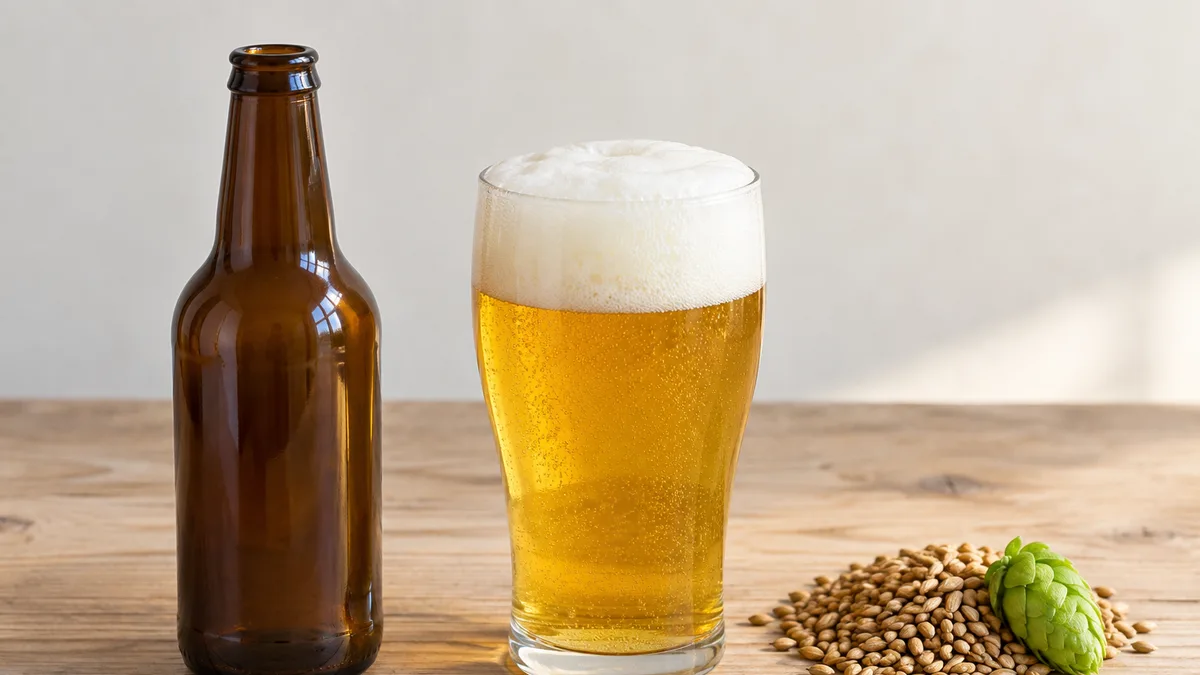
A beverage is called non-alcoholic not when the alcohol content is zero, but when it does not exceed 0.5% by volume. This figure is specified in both the law and the beer standard, whereas the label "0.0" is defined nowhere—and these are two different facts worth distinguishing.
The threshold is 0.5% ABV, and it's in two documents at once
In Russian law, the boundary is drawn through a definition: Law No. 171-FZ defines alcoholic products as food products with an ethyl alcohol content of more than 0.5% by volume of the finished product. Beer in the same law is defined as an alcoholic product with alcohol formed during the fermentation of beer wort.
From this, exactly what is written follows: a drink with 0.4% alcohol is not an alcoholic product, but one with 0.6% is. The threshold is not zero, and 'non-alcoholic' means 'below the threshold,' not 'alcohol-free.'
The current standard sets the same value. GOST 31711-2012 'Beer. General technical conditions' does not introduce a separate term 'non-alcoholic beer' — it is a column in the tables of physicochemical indicators, and in it, for the row of alcohol by volume, it states 'not more than 0.5'.
There is also a third document worth knowing about, so as not to confuse it with the current one. Technical Regulation of the EAEU 047/2018 on the safety of alcoholic products, adopted by Decision of the EEC Council No. 98 of December 5, 2018, sets the same threshold of 0.5% and excludes beer with an alcohol content of no more than 0.5% from its scope of application by a separate annex. Its entry into force has been repeatedly postponed by decisions of the EEC Council — six such decisions are listed on the regulation's page. This means the figure in it is the same, but it cannot be referred to as a current requirement today.
What the standard does not measure about non-alcoholic beer
In the notes to the tables of GOST 31711-2012, it is explicitly stated: the original wort extract content in non-alcoholic beer is not determined.
Extract content is the main indicator of regular beer, on which density, strength, and carbohydrates depend; for light beer, it is standardized in the range of 8 to 22%. For non-alcoholic beer, this line is completely absent. There is also no carbohydrate norm: where regular beer has 3.5 to 8.9 g per 100 g depending on the extract content, non-alcoholic beer has a dash, and the standard refers to the technological instructions for a specific variety to determine nutritional value.
What emerges from this is: non-alcoholic beer is almost not described by the standard in terms of its composition. The only numerical requirement for it is an alcohol content not exceeding 0.5%. Everything else is at the manufacturer's discretion, and therefore the spread between brands is greater than for regular beer.
What must be on the label, the standard still requires: alcohol by volume and alcohol content in 100 ml and in the container volume. This means the alcohol content is always written, and you should read that, not the large inscription on the front.
Why '0.0' is an inscription, not a norm
Neither Russian nor European regulations define '0.0'. There is also no distinction between 'non-alcoholic,' 'alcohol-free,' and '0.0': these are different words for the same status below the threshold.
In the European Union, alcohol content is mandatory only for drinks stronger than 1.2% ABV — this is how Regulation 1169/2011 on the provision of food information is structured. Below this limit, the number on the label is a voluntary statement by the manufacturer, not a regulated declaration. Regulation 1924/2006 on claims adds that there are no common rules for claims about the absence of alcohol in the EU, and national rules apply.
The WHO directly points to this gap. In its review of zero and low-alcohol beverages (2023), it states that the alcohol content in such beverages should be defined, harmonized, and clearly indicated on the labeling, and their promotion needs regulation to avoid misleading adolescents, pregnant women, and those trying to quit alcohol. The requirement is formulated as a future task — meaning it is not currently met.
The tolerance also adds uncertainty. In the same tables of GOST 31711-2012, there is a footnote for the alcohol by volume row: permissible deviations are ± 0.5%. The footnote is written for the 'not less than' norm, and the standard does not suggest applying it to the upper limit of non-alcoholic beer — but it also does not say the opposite.
Finally, measurements. In the USDA FoodData Central database, the entry for 'non-alcoholic beer' (number 174863) shows 0.3 g of ethanol per 100 g — which is approximately 0.38% ABV. Not zero, although a bottle of such a product may well be labeled '0.0'.
Hence, the honest answer to the question 'is there alcohol in it?': as a rule, yes, in an amount up to half a percent, and the '0.0' label does not refute this, because it promises nothing legally.
Fewer calories, more sugar
Here, a common perception is reversed. Non-alcoholic beer is considered more caloric due to unfermented sugars — according to the USDA database, it's the opposite:
| Per 100 g | Kcal | Carbohydrates, g | of which sugars, g | Ethanol, g |
|---|---|---|---|---|
| Non-alcoholic beer (174863) | 37 | 8.05 | 8.05 | 0.3 |
| Regular beer (168746) | 43 | 3.55 | 0 | 3.9 |
| Light beer (168749) | 29 | 1.64 | 0.09 | 3.1 |
The reason is that alcohol itself is caloric: about 7 kcal per gram, and 3.9 grams of ethanol in regular beer provide approximately 27 kcal out of its 43. Remove fermentation — and you remove these calories. Where calories in alcohol come from is a separate analysis.
However, for carbohydrates, the difference is real and in the opposite direction: 8.05 versus 3.55 grams — 2.3 times more, and in non-alcoholic beer, all of them are accounted for as sugars, whereas in regular beer, sugars are zero. This is precisely that unfermented sugar: yeast did not convert it into alcohol, and it remained in the bottle. Non-alcoholic beer accounts for about 32 kcal of carbohydrates out of 37 — meaning almost all of its caloric content.
Two caveats, without which the table will be misleading.
First. The entry in the database is called 'malt beverage, including non-alcoholic beer' — this category also includes sweetened malt beverages, so 8 g of sugar is likely higher than typical for beer. The data reliably show the direction of the difference, but not the magnitude.
Second. The standard, as mentioned above, does not regulate carbohydrates in non-alcoholic beer at all. This means the only source of a number for a specific bottle is its own nutritional value table, and comparing brands manually based on it.
For those counting calories, one figure is important: half a liter of non-alcoholic beer is about 185 kcal, and almost all of them are from carbohydrates. The order of magnitude is the same as for sweet soda, not water.
Who it is not suitable for
Pregnant women. The recommendation here is unequivocal and not about non-alcoholic beer, but about alcohol in general: the UK National Health Service advises against consuming alcohol during pregnancy and when planning it. Neither it nor other agencies have a separate position on beverages with an alcohol content up to 0.5% — this gap is also noted in scientific literature. That is, one cannot say 'half a percent is safe' because no one has checked it; the decision is made with a doctor. What else changes in nutrition during this period — in a separate text.
Those who abstain from alcohol. There is little evidence on both sides, and both sides exist. A review in the journal Addiction describes a mechanism by which non-alcoholic alternatives, against a background of complete abstinence, could extinguish craving as a conditioned reflex — and immediately warns that periodic consumption of real alcohol in this process can, on the contrary, restore the reflex and disrupt extinction. The authors explicitly state that empirical data for high-risk groups are insufficient. Practically, this means: the decision is individual and not universal, and someone in remission discusses it with their specialist, not with the label.
Those who consider it a 'healthy' substitute. The WHO reminds that no safe amount of alcohol exists, and ethanol is classified as a Group 1 carcinogen. Non-alcoholic beer is not excluded from this logic in its favor — it is simply below the threshold. And in the same WHO review, it is separately stated that there is currently little evidence of the benefits of such beverages.
Children and adolescents. Since, according to Law No. 171-FZ, a beverage with an alcohol content of no more than 0.5% is not classified as an alcoholic product, restrictions on its retail sale, including the prohibition of sales to minors, do not apply to it. This is a consequence of the definition, not a separate permission, and the WHO in the aforementioned review calls the marketing of such beverages among adolescents a reason for regulation.
What to look for on the bottle
- The alcohol by volume as a number, not the inscription on the front. GOST requires it to be indicated, and '0.0' is not equivalent to it.
- Carbohydrates in the table. The standard does not regulate them, so they vary freely between brands.
- Container volume. You should calculate not per 100 ml, but per bottle: half a liter is about 185 kcal.
- Is there a GOST. Without it, even the 'not more than 0.5%' norm does not apply — only what the manufacturer wrote in their technical specifications remains.
Frequently asked questions
- How much alcohol is in non-alcoholic beer?
- Up to 0.5% by volume. Law No. 171-FZ classifies beverages with an ethyl alcohol content of more than 0.5% of the finished product volume as alcoholic products, and GOST 31711-2012 for the column "non-alcoholic beer" sets a volume fraction of alcohol of no more than 0.5%. This does not mean zero: the entry for "non-alcoholic beer" in the USDA database lists 0.3 g of ethanol per 100 g, which is about 0.38% ABV.
- Does the label "0.0" mean there is no alcohol at all?
- No. Neither in Russian nor in European regulations does a definition for "0.0" exist, and legally it does not differ from "non-alcoholic". In the EU, alcohol strength is mandatory only for drinks stronger than 1.2% ABV, so below this threshold, the figure on the label is a voluntary manufacturer claim. The WHO in a 2023 review indicates that the alcohol content in such beverages still needs to be determined, standardized, and clearly labeled.
- Is non-alcoholic beer higher in calories than regular beer?
- No, it is lower in calories: according to the USDA database, 37 kcal per 100 g compared to 43 for regular beer, because alcohol provides about 7 kcal per gram. However, it contains 2.3 times more carbohydrates — 8.05 g versus 3.55 g, and in non-alcoholic beer, all of them are accounted for as sugars, compared to zero in regular beer. Half a liter is about 185 kcal, almost entirely from carbohydrates.
- Is non-alcoholic beer safe during pregnancy?
- Agencies do not have a separate position on beverages with an ABV of up to 0.5%: the UK National Health Service recommends avoiding alcohol during pregnancy and when planning to become pregnant, without discussing such drinks separately. Asserting that half a percent is safe and therefore acceptable has not been tested. The decision should be made with a doctor.
Read next
- Calories in alcohol: how many calories are in beer, wine, and spirits — Alcohol is the only category that almost everyone skips when counting calories.
- GOST and TU: what is actually behind these letters — GOST is often read as a mark of quality, while TU is seen as permission to do whatever one wants.
- What to look for in an ingredient list in ten seconds — Reading an entire ingredient list at the shelf is impossible: the print is small, and there is no time.
- Soda and its "zero": what changes when sugar is removed — The difference between regular soda and its "zero" version comes down to one line in the ingredients: a sweetener instead of sugar.
This article is for general information. It is not medical advice, a diagnosis, or a prescription for treatment or a diet, and it does not replace a consultation with your doctor. If you have a health condition, are pregnant, take medication, or follow a diet prescribed to you, decisions about food belong with your doctor.
Figures from regulations, guidelines and studies are given as they stood when this article was prepared and may since have changed; check them against the primary sources. This article is not advertising, an offer, or individual advice, and neither the author nor the site owner is responsible for decisions taken on the basis of it.