Vitamin B12: where it is in food and who should check their level
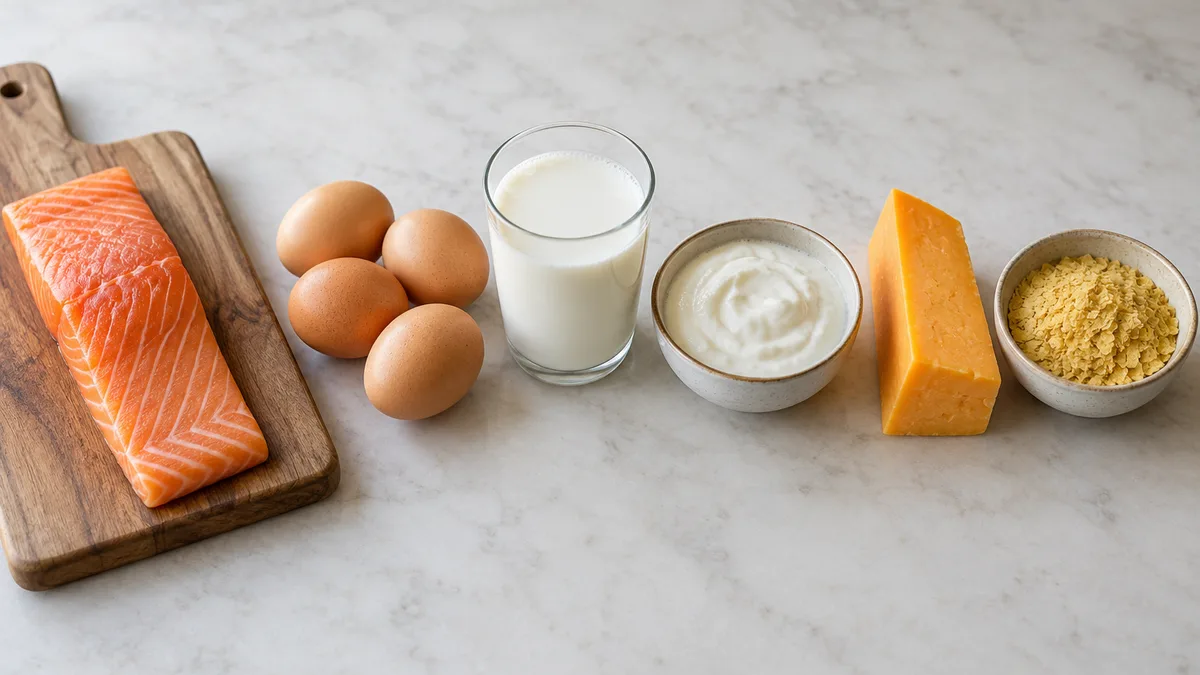
Vitamin B12 occurs naturally only in foods of animal origin; plant foods have it only when fortified. Adults need 2.4 to 4 mcg a day, depending on whose figure you take. A serving of beef liver gives 70.7 mcg, while a banana, beans and spinach give none.
How much B12 you need a day
Three sources, three numbers. The gap comes from method: each uses its own criterion for "enough".
| Source | Adults | What the number is |
|---|---|---|
| Rospotrebnadzor, MR 2.3.1.0253-21 | 3.0 mcg | Physiological requirement for people over 18 |
| EFSA, 2015 | 4 mcg | Adequate intake: the level at which blood markers stay in the normal range |
| NIH, US | 2.4 mcg | Recommended Dietary Allowance: the amount needed for normal blood status and serum B12 |
Sources: MR 2.3.1.0253-21 on the Rospotrebnadzor site, the EFSA opinion, the NIH Office of Dietary Supplements fact sheet. These are micrograms, millionths of a gram, so the unit on a label matters.
Where B12 is in food
Values come from the NIH fact sheet, per standard serving. Three ounces is about 85 g of the cooked food.
| Food and serving | B12, mcg |
|---|---|
| Beef liver, pan fried, 3 oz | 70.7 |
| Clams, cooked, 3 oz | 17 |
| Oysters, cooked, 3 oz | 14.9 |
| Nutritional yeast, fortified, about ¼ cup | 8.3 to 24 (depends on the brand) |
| Atlantic salmon, cooked, 3 oz | 2.6 |
| Light tuna, canned in water, 3 oz | 2.5 |
| Ground beef, 85 % lean, 3 oz | 2.4 |
| Milk, 2 %, 1 cup | 1.3 |
| Yogurt, plain, fat free, 6 oz container | 1.0 |
| Breakfast cereal fortified with 25 % of the daily value, 1 serving | 0.6 |
| Cheddar cheese, 1½ oz | 0.5 |
| Egg, 1 large, cooked | 0.5 |
| Turkey breast, roasted, 3 oz | 0.3 |
| Tempeh, ½ cup | 0.1 |
| Banana, boiled kidney beans, boiled spinach, whole wheat bread, strawberries | 0 |
Nutritional yeast brands differ almost threefold, from 8.3 to 24 mcg per quarter cup, so the exact B12 in a fortified product is read from its own package. More on the yeast itself in the article on nutritional yeast.
Why a big number in the table is not a big number in the body
NIH explains that absorption of B12 from food falls sharply once the capacity of the protein that helps absorb it is exceeded, which happens at 1 to 2 mcg at a time. So 70.7 mcg from liver does not become 70.7 mcg in the blood. For high-dose tablets the figures are starker: about 2 % at 500 mcg and 1.3 % at 1000 mcg.
The stores are large, though: the body holds 1,000 to 2,000 times more B12 than a person typically takes in a day. That is why a shortage shows up after years, not weeks.
Who should check their level
The question here is not how much B12 is on the plate but whether it reaches the blood. NIH names several groups where a shortage is more common.
- Vegetarians, especially vegans. The only natural sources of B12 are animal foods. The risk is higher for vegans than for vegetarians who eat dairy and eggs. Fortified foods and supplements lower the risk markedly; without them, a plant-based diet has no source of B12.
- People over 50, especially over 65. Many older people do not have enough stomach acid to release B12 from food. Autoimmune atrophic gastritis affects 2 % of the general population and 8 to 9 % of people over 65. NIH advises people over 50 to get most of their B12 from fortified foods or supplements, because in that form it is absorbed better than the protein-bound B12 in ordinary food.
- People with pernicious anemia. Without treatment it causes deficiency even on a full diet.
- Bowel diseases and operations on the stomach or intestine: celiac disease, Crohn's disease, gastric bypass.
- People taking drugs for heartburn and ulcers (omeprazole, lansoprazole and similar) or metformin. These medicines can reduce B12 absorption.
- Pregnant and breastfeeding women on a plant-based diet. NIH also lists infants of women who follow vegan diets as a risk group, so such a diet is worth discussing with a doctor in advance.
Do not stop any of these medicines on your own because of B12. If you take them, that is a reason to have a blood test and talk to your doctor, not a reason to change treatment.
A shortage is easy to miss
Because the body's stores last for years, symptoms appear late. They include tiredness and weakness, pale skin, numbness and tingling in the hands and feet, problems with balance and memory. According to NIH, deficiency can damage the nervous system even before anemia appears, which is why it should not be left untreated.
The same symptoms have dozens of other causes, so they are no basis for self-diagnosis. A blood test shows the B12 level, and whether a supplement is needed, in what form and how much, is for a doctor to decide from the result.
What B12 does not do
B12 is often advertised for energy and stamina. NIH says plainly that it gives these benefits to nobody who already gets enough from food. If tiredness does not go away, look for the cause with a doctor: B12, iron deficiency, poor sleep and many other things are possible. Iron has its own article on iron and ferritin.
If you eat plant-based and keep a diary, see the article on tracking a plant-based diet, and for supplements in general the one on multivitamins.
Frequently asked questions
- How much vitamin B12 do I need a day?
- Rospotrebnadzor (MR 2.3.1.0253-21) gives 3.0 mcg for adults, EFSA 4 mcg and NIH 2.4 mcg. The numbers differ because of the method used.
- Which foods have the most B12?
- According to NIH, per 3 oz serving (about 85 g): beef liver 70.7 mcg, clams 17 mcg, oysters 14.9 mcg, salmon 2.6 mcg, tuna 2.5 mcg, ground beef 2.4 mcg.
- Is there B12 in plant foods?
- Not naturally. NIH gives zero for bananas, kidney beans and spinach and 0.1 mcg for tempeh. Fortified products such as nutritional yeast and cereal have it added, and the amount is on the package.
- Who should check their B12 level?
- Vegans and vegetarians, people over 50, people with pernicious anemia or bowel disease, after stomach or intestinal surgery, and those taking metformin or heartburn drugs. A doctor orders the test.
- Does B12 give you energy?
- Not if you already have enough: NIH says there is no energy or endurance benefit for such people. Constant tiredness is worth discussing with a doctor.
Read next
- Vegetarian and vegan diets: what to prioritize in your tracking — Calories in a plant-based diet are calculated exactly the same way as in any other.
- Nutritional yeast: where its protein and vitamin B12 come from — Nutritional yeast is dried, inactive yeast: it adds a savoury flavour but cannot raise dough.
- Multivitamins: what large trials have shown — Multivitamins have been tested in randomized trials involving tens of thousands of people—a rare case in nutrition where we have experiments with placebos rather than just observations.
- Iron and ferritin: what the test shows and why you feel tired — Ferritin is tested more often than any other iron metabolism marker and is most frequently misinterpreted.
This article is for general information. It is not medical advice, a diagnosis, or a prescription for treatment or a diet, and it does not replace a consultation with your doctor. If you have a health condition, are pregnant, take medication, or follow a diet prescribed to you, decisions about food belong with your doctor.
Figures from regulations, guidelines and studies are given as they stood when this article was prepared and may since have changed; check them against the primary sources. This article is not advertising, an offer, or individual advice, and neither the author nor the site owner is responsible for decisions taken on the basis of it.