Nutritional yeast: where its protein and vitamin B12 come from
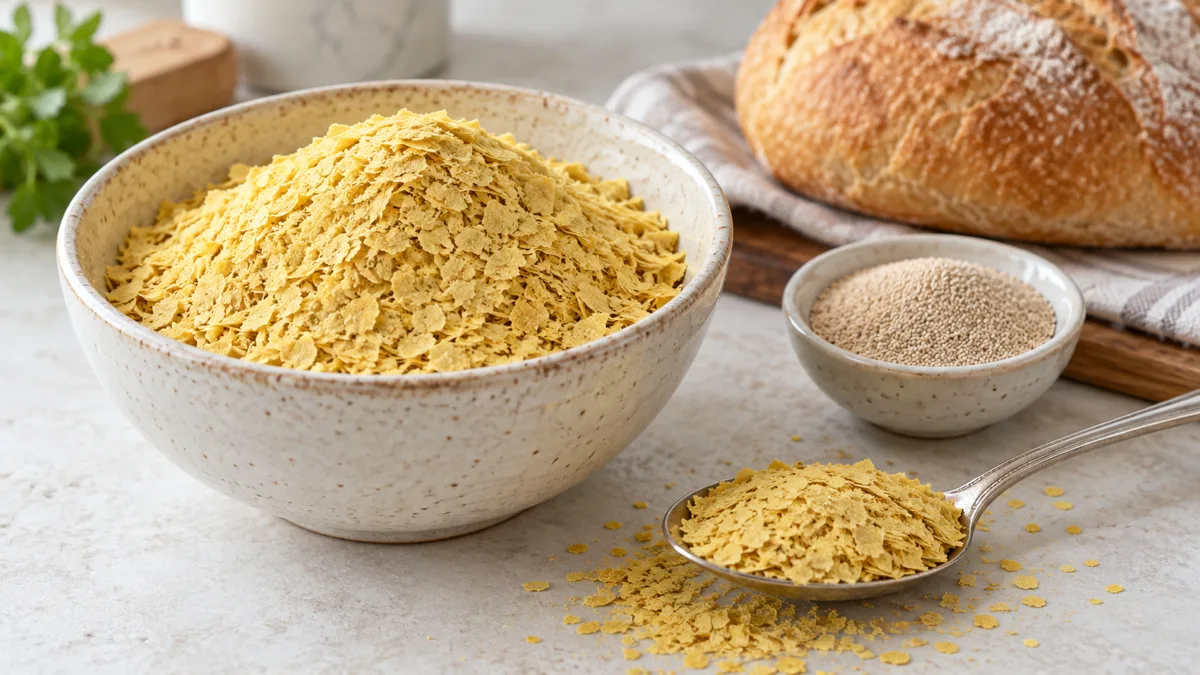
Nutritional yeast is dried, inactive yeast: it adds a savoury flavour but cannot raise dough. The protein belongs to the yeast cells, while vitamin B12 is generally added through fortification, so two similar-looking products can have very different labels.
Nutritional yeast cannot replace baker’s yeast
Both products are often made from Saccharomyces cerevisiae, but they do different jobs. A US Department of Agriculture technical report describes nutritional yeast as deactivated yeast eaten for flavour and nutritional content. Baker’s yeast remains active: as it uses sugars, it produces the carbon dioxide that leavens dough.
Deactivated nutritional yeast will not make dough rise. Baker’s yeast is not an exact substitute for flakes in a finished dish either: it is made for fermentation, not for use as a seasoning. Sharing a species does not make the two products interchangeable.
The protein is part of the yeast cells
Yeast is grown, the resulting biomass is collected, heat-inactivated and dried. Protein is part of that biomass; it is not a coating added to the flakes after production. The same USDA report describes nutritional yeast as an inactive product with a high protein profile, amino acids and B vitamins.
“Contains protein” does not reveal how much reaches a dish. A spoonful of flakes is light, and label values vary among products. For tracking, use the protein line on your package and the weight you actually added, rather than an average copied from somebody else’s food log.
Vitamin B12 is present only when the label confirms it
The word “yeast” does not guarantee vitamin B12. The US National Institutes of Health fact sheet treats nutritional yeast specifically as a fortified source of B12 and tells readers to check the label. In the data it cites, about a quarter cup of fortified nutritional yeast from several brands supplied 8.3–24 mcg of B12. That nearly threefold range shows why one product should not be logged from another product’s numbers.
Look for B12 in the Nutrition Facts panel and its source in the ingredients, where provided. It may appear as vitamin B12 or cyanocobalamin. If the label does not declare B12, do not count the product as a source. For diagnosed deficiency, flakes are not a substitute for testing and treatment agreed with a clinician.
Why the nutrition varies among products
| What to compare | Why it matters |
|---|---|
| B12 fortification | The product name alone does not establish its B12 content |
| Serving weight | The same “two tablespoons” of flakes and fine powder can weigh differently |
| Protein and calories | Use the panel on the product you have |
| Added ingredients | Salt, flavourings and other additions change the mixture |
“Nutritional” describes the product’s use, not a standard recipe. Compare packages per 100 g where that information is available, then track your own serving in grams. Our guide to nutrition labels covers the other limits of the panel.
How to log a spoonful of nutritional yeast
The FDA explains that a US serving size appears as a familiar household measure, such as tablespoons or cups, followed by its metric weight in grams. The listed nutrition belongs to that defined serving, not to every spoon in the kitchen.
- Weigh your usual spoonful once. Put a bowl on the scale, tare it and add the flakes as you normally would.
- Calculate from grams. If the panel gives values per 100 g, multiply each value by your serving weight and divide by 100.
- If the panel uses a serving, compare the weights. For example, a product with 5 g protein per 10 g would provide 2 g protein in a 4 g amount.
- Save your measure. You do not need to reweigh every spoonful until the product or the way you scoop it changes.
Volume transfers poorly between packages: large flakes settle more loosely than powder, and a packed tablespoon weighs more than a level one. For a rough diary entry, use the label serving. For a recipe split among several meals, weighing the total amount is simpler.
What the ingredient cannot promise
Inactive yeast is not a probiotic: its cells have been deactivated. Protein on the panel does not turn a light sprinkle into a full protein serving. B12 in a particular product does not mean that product treats deficiency.
Fortified foods can help people obtain B12 in their diet, as the NIH notes, but individual needs depend on age, diet and absorption. People who exclude animal foods should plan a dependable B12 source by its measured dose and discuss it with a clinician, rather than relying on the product name. Our article on plant protein covers the wider protein picture.
If you have a known yeast allergy, do not use a new product as a test. The complete ingredients matter too: flavoured versions may contain other ingredients, so check allergen statements on every new package. The FDA lists difficulty breathing and swelling of the face or throat among allergic-reaction symptoms that need urgent medical attention.
What to check before buying
- Name. Choose inactive nutritional yeast, not active baker’s yeast.
- B12. If this is why you want the product, find an amount per serving instead of relying on a front-label promise.
- Grams. Match the household measure to its serving weight.
- Full ingredients. Plain flakes and a prepared seasoning with salt and flavourings will not have the same nutrition.
Flake size and grind can be a matter of taste. Protein, calories and B12 require three lines from the package: serving weight, the nutrition panel and the ingredients.
Frequently asked questions
- Can nutritional yeast replace ordinary baker’s yeast?
- No. Nutritional yeast is deactivated and used as a seasoning; baker’s yeast remains active and is used for fermentation and dough rise. Sharing a yeast species does not make the products interchangeable.
- Does every nutritional yeast contain vitamin B12?
- No. B12 is associated with fortified products, and the amount varies substantially. If the Nutrition Facts panel does not list the vitamin, do not rely on the product as a B12 source.
- How much protein is in a tablespoon of nutritional yeast?
- It depends on the product and the tablespoon’s weight. Multiply the protein per 100 g on the label by your serving weight and divide by 100. If the label says 5 g protein per 10 g, a 4 g amount provides 2 g.
- Is nutritional yeast a probiotic?
- No. Nutritional yeast is deactivated, so it is not intended to supply live, active yeast cells. It is used for flavour and nutritional composition, not as a live culture.
Read next
- Calories and macros on the label: why the numbers don't match reality — The same buckwheat in three different apps gives three different calorie counts, and the package shows a fourth.
- "Sugar-free," "fitness," "eco": what these labels actually mean — The front of a package speaks in short words: "light," "fitness," "sugar-free," "eco.
- Plant protein: how it compares to animal protein and how to bridge the gap — The difference between plant and animal protein is not that one is "complete" and the other is "incomplete"—it comes down to two specific factors: amino acid profile and digestibility.
- Multivitamins: what large trials have shown — Multivitamins have been tested in randomized trials involving tens of thousands of people—a rare case in nutrition where we have experiments with placebos rather than just observations.
This article is for general information. It is not medical advice, a diagnosis, or a prescription for treatment or a diet, and it does not replace a consultation with your doctor. If you have a health condition, are pregnant, take medication, or follow a diet prescribed to you, decisions about food belong with your doctor.
Figures from regulations, guidelines and studies are given as they stood when this article was prepared and may since have changed; check them against the primary sources. This article is not advertising, an offer, or individual advice, and neither the author nor the site owner is responsible for decisions taken on the basis of it.