Marshmallows, pastila, and fruit jelly: light in appearance only
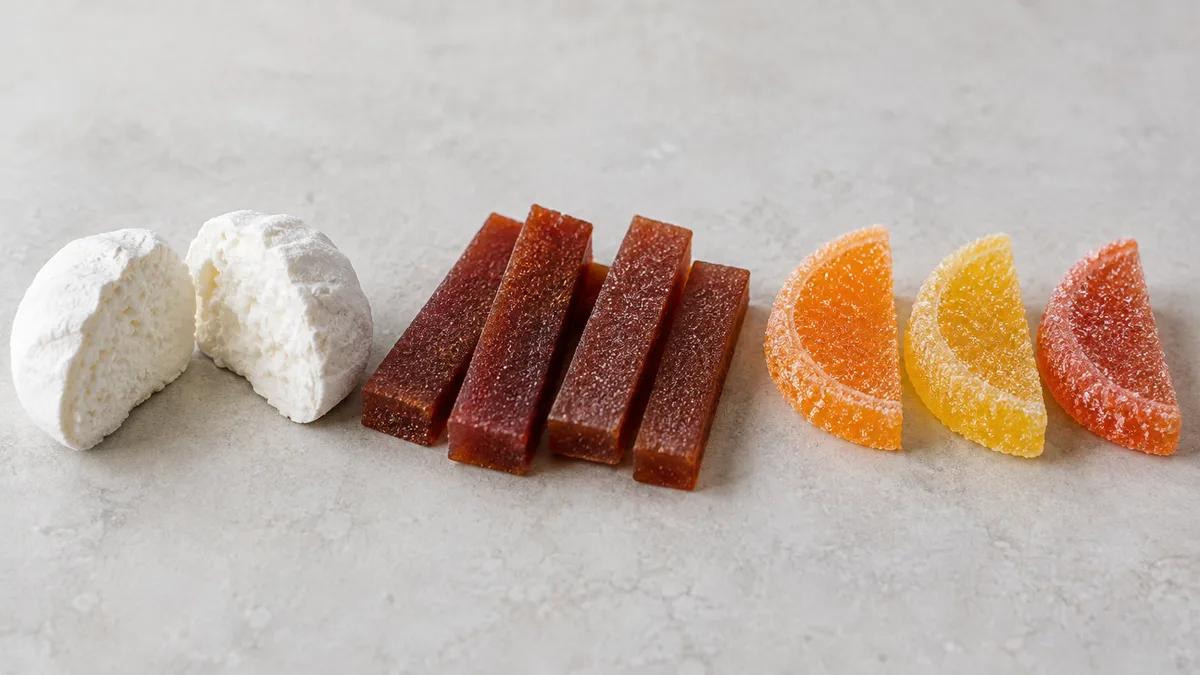
There is almost no fat in them, which gave them the reputation of being a "light" sweet. There is indeed no fat: marshmallows are whipped sugar syrup with apple puree, and they are light in only one parameter out of two.
these are two different standards and two different technologies
marshmallow and pastila are foamy confectionery products. GOST 6441-2014 defines them as sweet confectionery products with a foamy structure obtained from a whipped mass, with or without a structuring agent. The key word is "foamy": part of the volume there is occupied by air whipped together with egg white.
marmalade is a different standard and a different consistency. GOST 6442-2014 (in effect since January 1, 2016) describes it as a product of a jelly-like consistency of a given shape, obtained by boiling down gelling fruit or vegetable raw materials or a solution of a gelling agent with sugar, with or without molasses. Nothing is whipped — it is boiled down and allowed to set.
The practical consequence is simple. Air in foam makes marshmallows bulky, but does not make them less sweet: sugar is counted per gram, not per cubic centimeter.
pectin, agar, gelatin, starch
The gelling agent is responsible for how the product holds its shape and how it behaves in the mouth. It has little effect on taste, but a strong effect on two issues.
| gelling agent | origin | what it provides |
|---|---|---|
| pectin | apples, citrus fruits, beets | short, brittle gel, clean taste |
| agar | red algae | firm gel, holds at room temperature |
| gelatin | animal skin and bones | stretchy, chewy gel |
| starch | corn, potatoes | soft, slightly cloudy texture |
The first question this answers is who the product is suitable for. Pectin and agar are plant-based; gelatin is animal-based, and if its origin matters — during fasting, for vegetarianism, or for religious reasons — this is the exact line to read. What is written in the ingredient list instead of a direct indication of the raw material is discussed separately.
The second question is about fiber. Pectin is indeed soluble fiber, and this is often referenced on the packaging. But in the recipe, it works as a structure, not a filler: there is as much of it as needed for the mass to set. This does not move the daily fiber requirement — it is obtained from vegetables, grains, and legumes, not from dessert.
how much is that in calories — per piece, not per one hundred grams
One hundred grams is a useless unit where things are eaten by the piece. Therefore, it is worth counting this way; the values are typical, exact ones are always on the package.
| what | piece weight | kcal | sugars |
|---|---|---|---|
| marshmallow | 33 g | ≈ 108 | ≈ 23 g |
| molded marmalade | 10–12 g | ≈ 35 | ≈ 8 g |
| milk chocolate | 4 segments, 20 g | ≈ 107 | ≈ 10 g |
From this comes a comparison that usually surprises: one marshmallow is about four segments of milk chocolate in calories and twice as much in sugar. Chocolate is higher in calories per gram because it contains fat, but a segment weighs six times less than a marshmallow, and marshmallows are eaten whole.
This is not an argument against marshmallows and not an argument for chocolate. It is an argument against the word "light": it refers to fat, not to sugar and not to calories. The same mismatch between name and contents is found on half of the sweets shelf.
Marmalade wins in this company only by the size of the piece: per gram, it is comparable to marshmallows, but one candy weighs four times less. If you count what is eaten rather than weighing the package, this is a significant difference.
what "sugar-free" means on such packaging
Usually — maltitol or isomalt. These are polyols, and they differ from sugar in two things.
lower calorie content, but not zero. In European legislation, polyols are assigned an energy value of 2.4 kcal per gram for labeling purposes, compared to 4 for sugar; the exception is erythritol, which is assigned zero. That is, "sugar-free" means about 40% fewer calories in the sweet part, rather than an absence of calories.
intestinal response. Polyols are poorly absorbed, and in noticeable amounts cause bloating and a laxative effect. The threshold is individual and depends on the dose: one candy and half a pack are different stories. Detailed information about this is in the analysis of polyols, and about sweeteners in general — there as well.
A separate case is glazed products. Chocolate or confectionery glaze adds both fat and sugar, so glazed marshmallows are closer in the table to candy than to regular ones. How confectionery glaze differs from chocolate is in the text about cocoa butter substitutes.
what this looks like in the food diary
The practical part is short.
- log by pieces, not "some marshmallow". The weight of a single piece inside the pack is almost identical, and it is easy to obtain by dividing the net mass by the quantity — then a single marshmallow becomes a ready-made accounting unit.
- count before, not after. One hundred grams of marshmallows is three pieces, and seeing this in numbers is easier in advance than trying to reconstruct it from memory in the evening.
- do not replace with "diet" automatically. The maltitol version saves about 40% of the sweet part's calories and can cause an intestinal reaction; there is a gain, but it is smaller than it looks on the packaging.
And one more thing that has nothing to do with arithmetic. If you want sweets regularly and strongly, the question is usually not about choosing between marshmallows and chocolate — there is a separate text about the craving itself. Dessert in the diet is a normal part of it, and counting is necessary so that it fits there, not so that you have to give it up.
Frequently asked questions
- Which has more calories — marshmallow or chocolate?
- Per one hundred grams, chocolate: 535 kcal versus 326 for marshmallow. Per piece, it is the reverse: one marshmallow weighing 33 g has about 108 kcal, the same as four pieces of milk chocolate weighing 20 g. However, the marshmallow contains about twice as much sugar.
- Is pectin jelly a source of fiber?
- No. Pectin in jelly acts as a gelling agent: it is added in the amount needed for setting. This does not affect the daily fiber requirement — fiber is obtained from vegetables, grains, and legumes.
- What is the difference between marshmallow (zefir), pastila, and jelly (marmelad)?
- Marshmallow and pastila are whipped confectionery products according to GOST 6441-2014: sugary products with a foamy structure made from whipped mass. Jelly (marmelad) according to GOST 6442-2014 has a gel-like consistency; it is not whipped, but boiled down with sugar.
Read next
- Maltitol, xylitol, erythritol: polyol sweeteners — Polyols sit between sugar and intense sweeteners: they are less sweet, contain calories, yet the packaging still says "sugar-free.
- Artificial sweeteners: are they harmful, and do they help you lose weight? — Arguments about sweeteners are conducted as though the choice were between them and plain water.
- Gelatin, pork, and alcohol on labels: how to check in another language — Pork is rarely called pork in an ingredients list.
- Sugar cravings: where they come from and what to do about them — Cravings for sweets rarely have a single cause, which is why the universal advice to "just don't eat them" doesn't work.
This article is for general information. It is not medical advice, a diagnosis, or a prescription for treatment or a diet, and it does not replace a consultation with your doctor. If you have a health condition, are pregnant, take medication, or follow a diet prescribed to you, decisions about food belong with your doctor.
Figures from regulations, guidelines and studies are given as they stood when this article was prepared and may since have changed; check them against the primary sources. This article is not advertising, an offer, or individual advice, and neither the author nor the site owner is responsible for decisions taken on the basis of it.