Potassium bromate: a flour improver that is no longer permitted
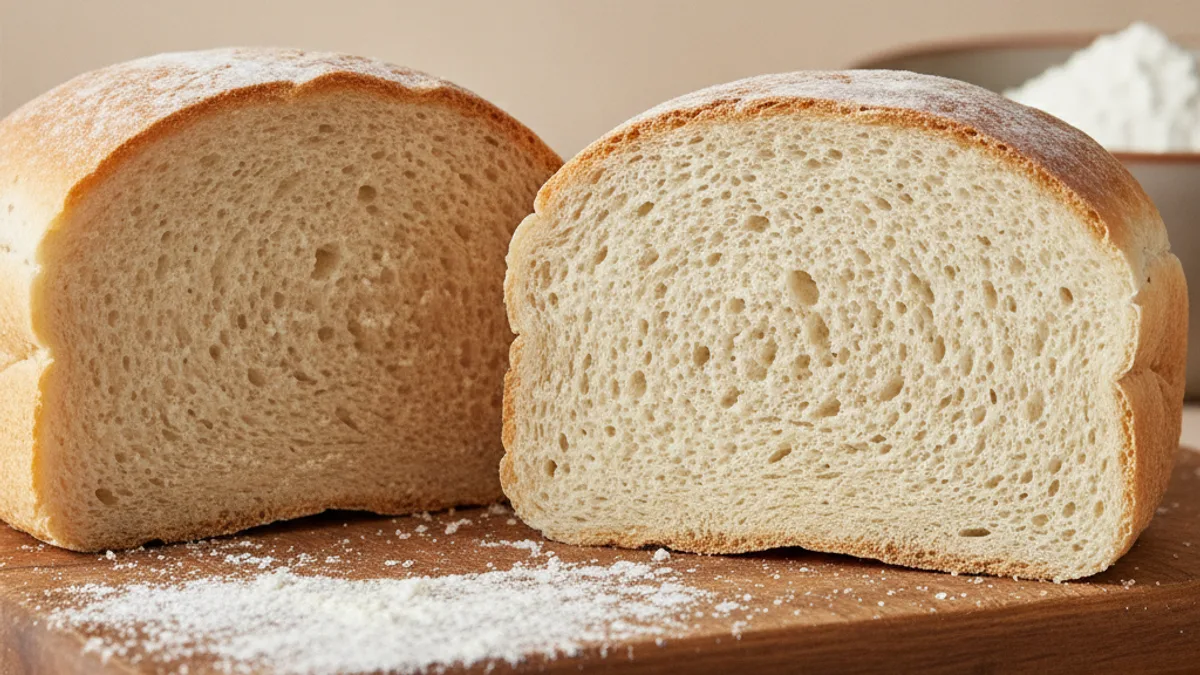
Potassium bromate was used for decades as a flour improver: it made dough more elastic and bread more voluminous with an even crumb. It was assumed that during baking, it would completely convert into harmless bromide. It turned out that this is not always the case—and it was these residual amounts, rather than the intake itself, that changed its fate.
What it did in flour
Bromate is an oxidizing agent. In dough, it acts on gluten proteins, strengthening their network: the dough retains gas better, rises higher, and the crumb becomes more uniform.
Its advantage over other improvers was its delayed action: bromate did not work immediately, but rather during proofing and at the beginning of baking, which is convenient for industrial production.
The calculation was based on the fact that during the baking process, it would completely reduce to potassium bromide—a substance without such an effect.
What went wrong
Two circumstances.
The reaction is not complete. With insufficient temperature, short baking times, or excessive dosage, some bromate remains in the finished product.
The substance itself is classified as potentially carcinogenic. IARC classified potassium bromate as Group 2B—possibly carcinogenic to humans. The basis for this was data on tumor development in laboratory animals.
The combination of these two points determined the outcome: if a substance is capable of remaining in a product and a safe level cannot be established, the only solution is to discontinue its use.
Where it stands now
In the European Union, potassium bromate is not permitted as a food additive. It is also not permitted in a number of other jurisdictions, including Russia, where the list of permitted additives is set by technical regulations.
At the same time, there are still countries in the world where it is used or was used until recently. This is the same story of divergent regulatory decisions that is analyzed in the article on standards in different countries.
What it was replaced with
The task of improving flour has not gone away, and it is being addressed by other means:
- Ascorbic acid. It provides the same oxidizing effect in dough, while being a well-known and permitted substance; for its secondary role, see the article on antioxidants.
- Enzyme preparations. Amylases and other enzymes work in a targeted manner and are destroyed during baking.
- Emulsifiers. They improve crumb structure and slow down staling—the mechanism is in the article on emulsifiers.
Practically, this means that the abandonment of bromate has not affected the consumer: bread is baked with the same result using other means.
Key takeaways
- The key issue is residual amounts. A substance that is supposed to disappear during the process is evaluated by what remains, not by the original intent.
- The absence of a safe threshold changes the logic of the decision. For genotoxic and potentially carcinogenic substances, it is impossible to set a safe intake level, and therefore their use is discontinued.
- "It worked for decades" is not an argument. Re-evaluation upon the emergence of new data is a normal part of the system's operation, the same case as with titanium dioxide E171.
- A replacement is usually found. A technological function can almost always be covered in another way; the question is one of cost.
Other cases of revoked and revised permits can be found in the articles on "Sudan" dyes, cyclamate and saccharin, and brominated vegetable oil.
Frequently asked questions
- What is potassium bromate and why was it needed?
- An oxidizing agent that was used as a flour improver: it strengthened the dough's protein network, which made the bread more voluminous and the crumb more even. It worked with a delay, which was convenient for industrial baking.
- Why was it no longer permitted?
- It was assumed that during baking it would completely convert into harmless bromide, but with insufficient temperature or excessive dosage, some remains in the product. The substance itself was classified by IARC as Group 2B—possibly carcinogenic to humans.
- Is potassium bromate permitted in Russia?
- No. The list of permitted food additives is defined by technical regulations, and potassium bromate is not included. It is also not permitted in the European Union, although it was used for longer in some other countries.
- What has it been replaced with in bread making?
- Ascorbic acid, which provides a similar oxidative effect in dough, as well as enzyme preparations and emulsifiers. The move away from bromate has not affected the result for the consumer.
- Why couldn't the dosage just be limited?
- For substances classified as potentially carcinogenic, a safe level of consumption cannot be established: no threshold is assumed for such an effect. Therefore, the solution is not to limit, but to discontinue its use.
Read next
- Titanium dioxide E171: an additive allowed for decades and then banned — Titanium dioxide has been used as a food coloring for decades and was considered one of the most inert additives: it does not dissolve, is not absorbed to any significant degree, and is chemically extremely stable.
- Antioxidants: what they do to fat and why it spoils without them — There are two different ways for food to spoil.
- Food standards in different countries: why the same product varies — The same brand in two countries may have a different composition, and this is not always about cost-cutting.
This article is for general information. It is not medical advice, a diagnosis, or a prescription for treatment or a diet, and it does not replace a consultation with your doctor. If you have a health condition, are pregnant, take medication, or follow a diet prescribed to you, decisions about food belong with your doctor.
Figures from regulations, guidelines and studies are given as they stood when this article was prepared and may since have changed; check them against the primary sources. This article is not advertising, an offer, or individual advice, and neither the author nor the site owner is responsible for decisions taken on the basis of it.