Instant noodles: what is in the package and how much salt they contain
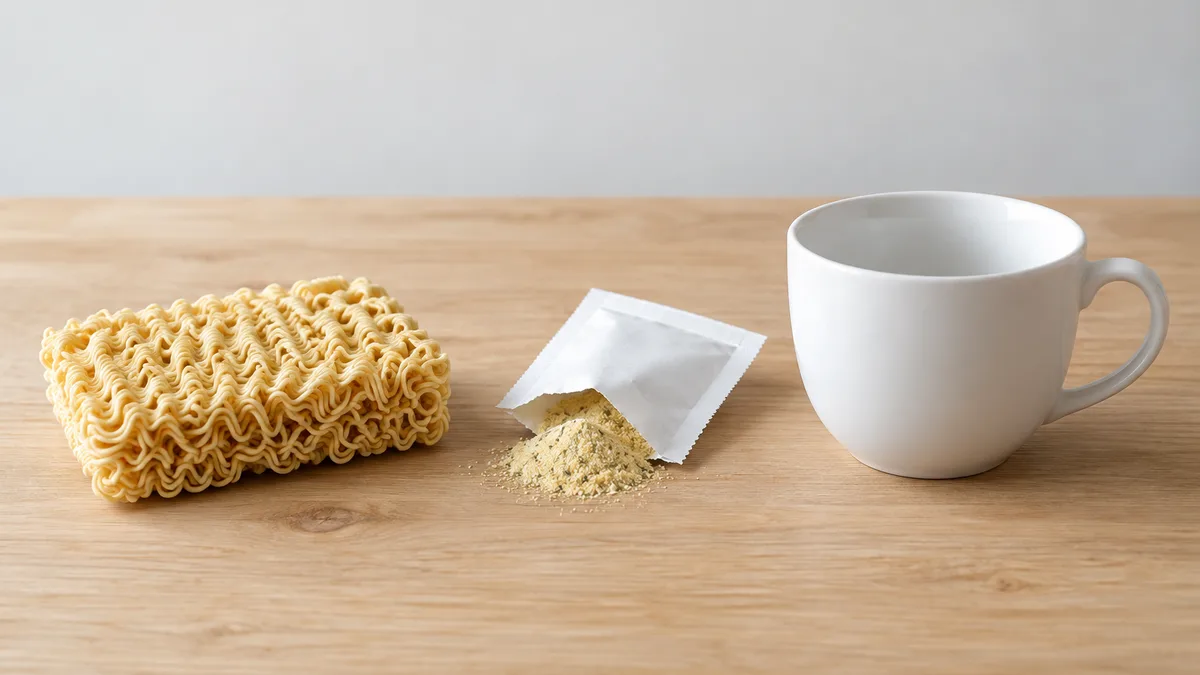
The standard for instant noodles has a fat content limit and not a single line about salt. This is the main thing worth knowing about the package: what it is criticized for is regulated, but what truly sets it apart from other food is not.
"Instant" means "oil-dried"
GOST 31749-2012 "Instant pasta products" has been in effect since July 1, 2013, and frying is explicitly stated in its scope of application: the standard applies to products made from wheat flour and water, oil-dried. This is not a manufacturer's discretion or a simplification of technology — it is a defining characteristic of the product.
The purpose of frying is technological. The briquette emerges from it with a moisture content of no more than 5%, and then hot water rehydrates it within a time frame that the standard also regulates: ready in no more than 5 minutes. The product must retain its corrugated noodle shape for another ten minutes after that — meaning after fifteen minutes in the cup, it should not turn into mush.
The oils for drying are named in the standard: palm, refined deodorized sunflower, and refined deodorized soybean. Palm oil is listed first and explicitly permitted, with a reference to its own separate standard.
From this, it immediately follows what not to expect from such a package. These are not dried pasta with seasoning: regular pasta has about one gram of fat per hundred, because it is air-dried. Here, it is fifteen to twenty times more, and the difference lies entirely in the drying method.
Twenty-five percent fat is the permitted limit
The standard sets six regulated indicators for the products, and the fat limit is: no more than 25%. Also regulated are moisture content (up to 5%), acidity (up to 4 degrees), acid-insoluble ash (up to 0.2%), metallomagnetic impurities (up to 3 mg/kg), and cooking time.
A separate table monitors the quality of the fat itself in the finished product — acid value and peroxide value. For palm oil, the acid value is permitted up to 0.6 mg KOH/g, and the peroxide value up to 10 meq/kg. These lines exist to ensure that the fried briquette does not sit in storage until it becomes rancid: it is not the quantity of fat that is checked, but its condition.
Actual labels stay below the permitted limit — usually 17–20 g of fat per hundred grams. But approximately half of this fat is saturated, and here palm oil is visible in the nutrition facts table without any ingredient list: an air-dried product does not have such a proportion. What is generally known about this oil is discussed separately.
There is not a single line about salt in the standard
Salt is mentioned once in GOST 31749-2012 — in the list of additional raw materials, next to onions, garlic, and dried herbs. Neither the mass fraction of salt nor the sodium content is among the regulated indicators. There is a fat limit, but no salt limit.
For comparison: the WHO recommends for adults less than 2000 mg of sodium per day — which is less than 5 g of salt, slightly less than a teaspoon. One value is present in the dietary recommendation and absent in the product standard.
What this means in practice is visible on the labels. In Open Food Facts — an open database of ingredients — for instant noodles sold in Russia and neighboring countries, the following numbers are recorded (checked September 22, 2026):
| Barcode | Salt, g/100 g | Sodium, mg/100 g | Kcal/100 g | Fat / saturated, g |
|---|---|---|---|---|
| 4820179250060 | 5.5 | 2200 | 450 | 19.7 / 8.6 |
| 4605496007494 | 5.4 | 2160 | 451 | 19.7 / 8.6 |
| 4607065580070 | 5.33 | 2132 | 400 | 17 / 9.5 |
| 4820179250077 | 5.3 | 2120 | 413 | 19 / 8.3 |
| 4820179251777 | 5.1 | 2040 | 403 | 18.7 / 8.7 |
| 4820179254761 | 4.3 | 1720 | 396 | 16.6 / 7.8 |
The last two columns should not be read as two independent values: salt and sodium are the same figure written two ways, one obtained from the other by multiplying by roughly 2.5. A label states one or the other; they must never be added together.
For five out of six entries, one hundred grams of the product provide more than the entire daily maximum of salt. Not 'a lot of salt,' not 'above average': 5.33 g versus the recommended less than 5 g. Sodium crosses its limit at the same point — 2132 mg versus less than 2000 mg.
It's easy to make a mistake in your favor with further arithmetic. A package usually weighs less than one hundred grams, and the number in the nutrition facts table does not directly apply to the package. For entry 4820179251777, the database indicates a weight of 85 g — at 5.1 g of salt per hundred, this is 4.3 g per package, or 86% of the daily maximum. For entry 4820179254761, weighing 62 g and with 4.3 g per hundred, the result is 2.7 g — more than half. None of these numbers can be read directly from the label without multiplication.
And another mistake in the same direction: to consider these grams as the only salt intake for the day. It comes from places where it's not sought — bread, sausages, and sauces contribute more than the salt shaker.
Why the number on the package refers to the briquette along with the seasoning
Here, a rule from TR CU 022/2011 on labeling applies: the nutritional value indicators of products prepared by the consumer are stated without considering their further preparation. That is, the table describes the contents of the package as sold — everything inside, including the sachet.
The standard limits the weight of this sachet from another perspective. GOST 31749-2012 requires products to be packaged in containers with a net weight of up to 100 g, and the proportion of the pasta products themselves to be no less than 80% of the contents. From this, it follows that the spice sachet in a product conforming to this GOST is no more than twenty grams, and almost all the salt in the package is concentrated in these twenty grams.
These two norms together provide something that can be managed: the amount of salt in your bowl is regulated not by the manufacturer, but by how much powder from the sachet you pour into it. This is the only quantity in the package that can be managed — and half a sachet reduces the salt by approximately half, without changing either the fat or the calorie content.
"Flavoring additive" — a word not from the technical regulation
This expression appears on packages and looks like an official term. In TR CU 029/2012 on the safety of food additives, it is not present: the regulation defines 'flavoring,' 'flavoring substance,' 'flavoring preparation' — and separately 'flavor enhancer' as an additive intended to enhance or modify natural taste and aroma. This is the functional class to which E620–E635, including monosodium glutamate, belong.
Where did the word on the package come from then? From GOST 31749-2012 itself: in the list of additional raw materials, 'flavoring additives (natural or nature-identical)' are listed — alongside food additives, among which flavor and aroma enhancers are named. That is, the wording relies on the product standard, and in terms of the additive regulation, it means a flavoring.
There is one difference here, and it's not about safety. 'Flavoring additive' in the ingredient list does not indicate whether a flavor enhancer is present in the product: these are different functional classes, and an enhancer must be indicated by its name or code. You should look for E621 and neighboring numbers, not this word. What is known about glutamate itself is analyzed separately, and the general rule for reading ingredient lists also.
Palm oil: the real question is not about the oil itself
The claim against frying is usually formulated as 'palm oil is harmful,' and in this form, it is not verifiable. EFSA's verifiable question is different — it concerns substances formed during high-temperature refining of oils: 3-MCPD, its esters, and glycidyl esters.
The agency's position on them is as follows. In a 2016 review, EFSA indicated that the highest amounts of glycidyl esters, as well as 3-MCPD and 2-MCPD, were found specifically in palm oils and fats, and that no safe level has been established for glycidyl esters: glycidol is recognized as genotoxic and carcinogenic. For 3-MCPD and its esters, a value exists — in a 2018 re-evaluation, a group acceptable daily intake of 2 µg per kilogram of body weight per day was established.
It is important what is not in these documents. EFSA evaluated oils and products based on them in general, not noodle briquettes, and did not establish content limits for specific product categories. The connection 'palm oil is permitted for drying' and 'palm oils contain the most of these substances' are two separate facts from two different sources, not a conclusion of a single study on noodles. The exact dose in a specific package cannot be determined from open data.
What is visible even without EFSA: a fried briquette is an example of a highly processed product, and questions about such food begin earlier than questions about a specific substance within it.
If the package does not have GOST
A significant portion of noodles is produced according to the manufacturer's technical specifications. Then everything described above does not apply to it: neither the 25% fat limit, nor the 80% rule, nor the packaging limit of one hundred grams, nor the requirement to hold its shape for fifteen minutes.
This does not make the product worse — TU (technical specifications) mean 'the manufacturer wrote the recipe'. But comparing packages by their labels becomes impossible, and what always works remains: the ingredient list by descending weight and the nutrition facts table, multiplied by the package weight.
What to look for on the package in ten seconds
- Salt in the table, multiplied by the package weight. Not the number per 100 g, but grams per package. Daily maximum — less than 5 g.
- Saturated fat. About half of the total means the briquette was dried in palm oil.
- E numbers in the ingredients. A flavor enhancer is indicated by code E620–E635, not by the words 'flavoring additive'.
- How many sachets inside. The powder and seasoning oil are the only things you can choose not to add completely.
Frequently asked questions
- Is instant noodles really fried in oil?
- Yes, and this is specified in the scope of GOST 31749-2012: the standard applies to instant pasta dried in oil. Palm oil, refined deodorized sunflower oil, and refined deodorized soybean oil are permitted for drying. The standard limits the fat content in the products to no more than 25%.
- How much salt is in a single pack of instant noodles?
- GOST 31749-2012 does not regulate salt at all, so the answer is only on the label. According to Open Food Facts records for September 22, 2026, brands sold in Russia contain 4.3–5.5 g of salt per 100 g, meaning 100 g of the product is the entire WHO recommended daily maximum (less than 5 g). An 85 g pack contains about 4.3 g, and a 62 g pack contains about 2.7 g.
- What does "flavor and aroma additive" mean in the ingredients?
- This is a wording from the list of additional raw materials in GOST 31749-2012, not a technical regulation term. TR CU 029/2012 does not have such a concept: it contains "flavoring" and separately "flavor (aroma) enhancer"—the class that includes E620–E635. The presence of a flavor enhancer cannot be determined by this inscription; it is indicated by its code.
- Does the nutrition information on the packaging refer to the dry block or the entire pack?
- To the entire contents of the package as sold. According to TR CU 022/2011, nutritional value indicators of products prepared by the consumer are indicated without taking further preparation into account. At the same time, GOST 31749-2012 requires that the pasta itself constitutes at least 80% of the package contents with a net mass of up to 100 g.
Read next
- Salt in processed food: where it is most abundant and why the salt shaker is not the culprit — The WHO recommendation is less than five grams of salt per day, but the actual intake is about twice that.
- Palm oil: is it actually harmful? — Palm oil has become the universal explanation for everything bad in food.
- What to look for in an ingredient list in ten seconds — Reading an entire ingredient list at the shelf is impossible: the print is small, and there is no time.
- GOST and TU: what is actually behind these letters — GOST is often read as a mark of quality, while TU is seen as permission to do whatever one wants.
This article is for general information. It is not medical advice, a diagnosis, or a prescription for treatment or a diet, and it does not replace a consultation with your doctor. If you have a health condition, are pregnant, take medication, or follow a diet prescribed to you, decisions about food belong with your doctor.
Figures from regulations, guidelines and studies are given as they stood when this article was prepared and may since have changed; check them against the primary sources. This article is not advertising, an offer, or individual advice, and neither the author nor the site owner is responsible for decisions taken on the basis of it.