How to calculate calories and macros for a dish using your own recipe
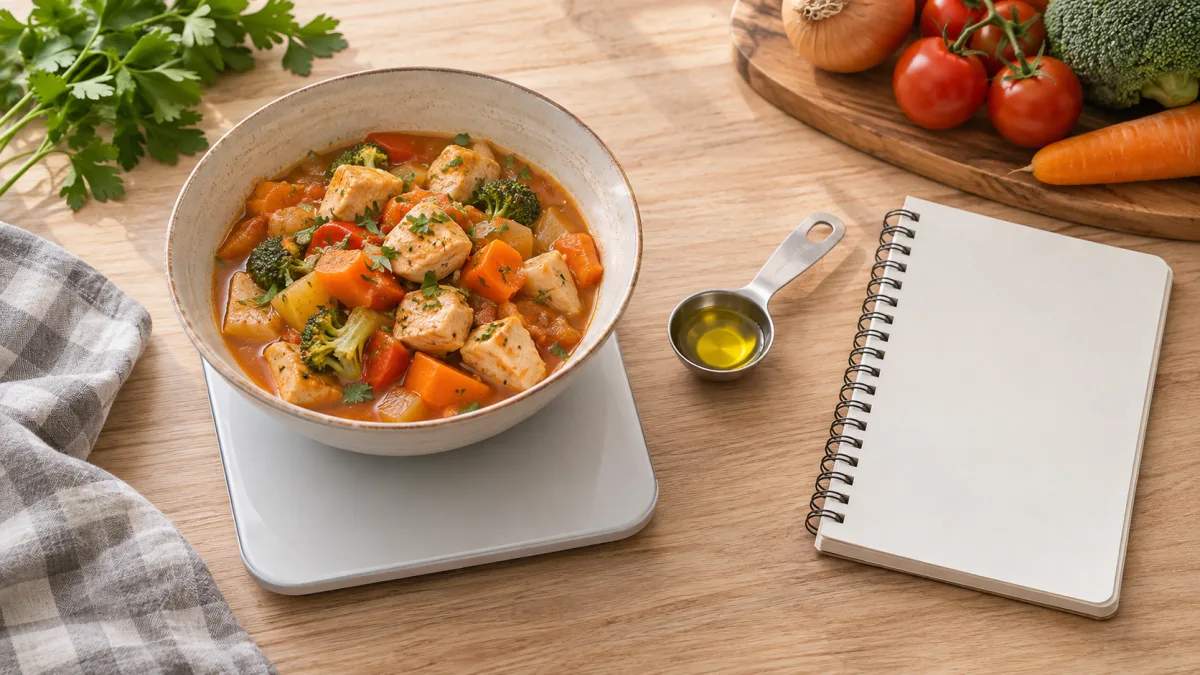
The calories and macros of a homemade dish should be calculated based on your specific ingredients rather than a generic title like "stew" or "cottage cheese pancakes". Add up the data for all ingredients, weigh the finished dish, and decide whether you want to log 100 grams or a single portion.
First, choose the recording unit
A single dish can have two convenient formats. If you serve yourself varying portions, calculate per 100 g. If you always eat a prepped meal container or half of a casserole, you can log a portion. Both figures are correct, but they cannot be mixed.
| What to log | When convenient | What to weigh |
|---|---|---|
| Per 100 g | Soup, side dish, stew, multi-day meals | The entire finished pot or baking dish |
| Per portion | A single plate, lunchbox, divided casserole | The portion or number of identical servings |
Add up ingredients, not finished volumes
- Record the mass of each ingredient before cooking.
- Get its calories, protein, fat, and carbohydrate values from the label or a reference book.
- Multiply the values by the mass used and add up all rows.
- Add oil, sauce, sugar, breading, and anything else that remains in the dish.
Water, salt, and spices with no significant nutritional value change the taste and mass, but hardly change the final calories and macros. Oil changes both: it is easy to overlook, although a spoonful often provides more energy to the dish than vegetables.
Example: vegetable stew with chicken
| Ingredient | Mass | What it contributes to the calculation |
|---|---|---|
| Chicken fillet | 500 g | Protein and part of the fat |
| Zucchini and tomatoes | 900 g | Mass, carbohydrates, and fiber |
| Cooking oil | 15 g | Almost exclusively fat and calories |
There is no need to search for "chicken stew" in an app and hope they used the same products. First, the three ingredient rows are calculated. Then the finished dish is weighed without cookware. If 1,415 g of raw ingredients yielded 1,180 g of stew, the total calories and macros do not change from the evaporated water; only the value per 100 g changes.
How to get a single portion and 100 grams
For 100 g, divide the total of each metric by the mass of the finished dish and multiply by 100. For a portion, multiply the value per 100 g by the mass of the plate and divide by 100.
For example, the finished stew weighs 1,180 g. A 320 g portion is not a "quarter of a pot" by eye, but 320/1,180 of it. The same principle works for proteins, fats, and carbohydrates: the portion share is the same for all four indicators.
If cutlets, cottage cheese pancakes, or muffins turned out identical, you can divide the total calculation by their number. If some cutlets are larger than others, it is more accurate to weigh each one or log the dish per 100 g.
Four mistakes that skew the result the most
- Counting grain twice. Dry grain and cooked porridge are the same food with different amounts of water. Choose the state for which you have data and do not add a second entry.
- Forgetting oil and sauce. They rarely increase volume, but they often change the per-portion result.
- Including inedible parts. Bones, peel, and discarded fat should not end up in the portion.
- Dividing by the raw mass. For a portion from a finished pot, divide by the weight of the finished dish.
The difference between raw and cooked weight is discussed in more detail in the home cooking guide. If the recipe changes every time, the exact number per 100 g will not remain constant: it must be recalculated for the new batch of ingredients.
When an estimate is enough
You do not have to turn every dinner into accounting. An exact recipe is useful for dishes you cook regularly and eat over several days. One-off meals can be estimated by photo, keeping in mind that dressings, hidden oils, and portion weight will remain sources of error. If tracking causes anxiety or guilt, it is best to discuss this with a specialist.
Frequently asked questions
- How to calculate calories and macros for a dish per 100 grams?
- Add up the calories and macros of all ingredients, weigh the entire finished dish without cookware, and divide each total by the mass of the finished dish. Then multiply by 100.
- Do I need to account for water when calculating a recipe?
- Water adds almost no calories or macronutrients, but it changes the weight of the finished dish. Therefore, it is factored into weighing the pot, but not as a separate source of calories.
- How to calculate calories and macronutrients for a single cutlet or cottage cheese pancake?
- If the items are identical, divide the total calculation by their number. If the sizes differ, weigh each one or use the value per 100 g of the finished dish.
- Do I need to account for oil after frying?
- Account for the oil that remains in the food being eaten. If some of the oil or fat was intentionally drained and not eaten, do not log it as part of the portion.
Read next
- How to count calories in homemade food — Processed foods are counted by the label, and restaurant meals by a reference guide.
- What is KBZHU — KBZHU represents four numbers that describe food: caloric content and the three macronutrients that make it up.
- How to determine portion size without a scale — Portion weight is the most inaccurate variable in any calculation, including analysis by photo.
- How many calories does frying add — The cooking method adds more calories to a dish than any choice between "healthy" and "unhealthy" foods.
This article is for general information. It is not medical advice, a diagnosis, or a prescription for treatment or a diet, and it does not replace a consultation with your doctor. If you have a health condition, are pregnant, take medication, or follow a diet prescribed to you, decisions about food belong with your doctor.
Figures from regulations, guidelines and studies are given as they stood when this article was prepared and may since have changed; check them against the primary sources. This article is not advertising, an offer, or individual advice, and neither the author nor the site owner is responsible for decisions taken on the basis of it.