Why product calories change after cooking
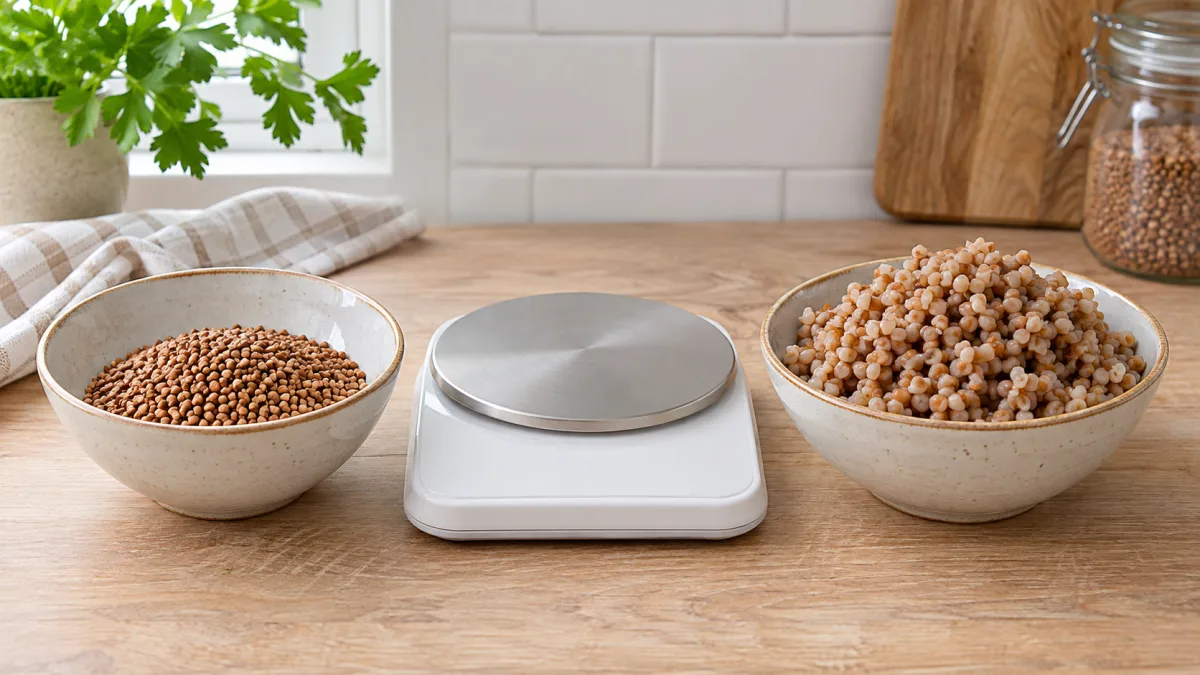
There are no fewer calories in a pot after boiling, but per 100 grams there may be three times less. Grains absorb water, meat loses it, and oil adds energy that was not present in the original product.
The number per 100 g is always tied to the product's state
“Buckwheat — 330 kcal” usually means 100 g of dry grain. In 100 g of cooked buckwheat, most of the weight is water, so the calorie count is lower. Both figures are correct, but they refer to different products on the scale.
Because of this, a calorie table only makes sense after clarification: are you weighing the dry, raw, cooked, or packaged product? If dry pasta is entered as cooked, the error will be large even before you start counting the sauce.
What cooking does to weight and calories
| Scenario | What happens to weight | What happens to total energy |
|---|---|---|
| Grains or pasta are boiled in water | Weight increases | Almost unchanged |
| Vegetables or meat are baked | Weight usually decreases | Unchanged in itself |
| Fat or broth is drained from meat | Weight decreases | Some energy may leave along with the drained part |
| Oil, sugar, cream, sauce are added | Weight and composition change | Energy increases |
There is no need to look for a single "cooking coefficient" for all cases. For porridge, the yield depends on the amount of water; for meat, on fat content, the cut, and the degree of doneness. For a regular dish, it is more accurate to weigh your result once.
Dry and cooked: choose one path
If you weighed 80 g of dry rice, count it as dry rice. After boiling, you can divide the cooked rice into portions by weight, but do not record the same 80 g again as a cooked product.
If the rice is already on your plate and the dry weight is unknown, use the entry for cooked rice. This is precisely the case handled by the raw and cooked weight calculator: it does not guess your recipe, but provides a reference point for converting one state to another.
Why frying is a separate case
Water evaporates, so 100 g of cooked breast can be higher in calories than 100 g of raw breast, even if you did not add calories overall. However, frying often adds oil, while some of the product's fat remains in the pan. Therefore, the question of "how many calories there are now" cannot be solved by a reduction in weight alone.
The practical procedure is simple: count the original product, add the oil that you actually eat, and do not include drained fat or inedible parts. A detailed breakdown can be found in the article on calories from frying.
How not to make a mistake in the calorie table
- Check what state the value is given for: dry, raw, boiled, baked, skinless, boneless.
- Match it against what was on the scale.
- For a mixture of ingredients, count all components used and divide by the cooked weight.
- For packaged products, take the values from the specific label rather than an average line from a reference book.
Calories per 100 g are convenient for comparison, but do not tell you how much you actually ate. A 250 g portion multiplies any table row by 2.5. If you do not have a scale, tableware and hand-based reference guides are collected in the article on portion weight.
When the figure will still be approximate
Homemade borsch, pilaf, or casserole do not have a single calorie count: it is altered by the oil, meat fat content, and proportions. The table is needed as a reference point, and for a repeating recipe, it is better to calculate your own pot. This is faster than choosing from a dozen similar entries in an app each time.
Frequently asked questions
- Why does cooked buckwheat have fewer calories per 100 g than dry buckwheat?
- During boiling, buckwheat absorbs water. The total energy of the grain remains almost unchanged, but it is distributed over a larger weight, so 100 g of cooked porridge has fewer calories.
- How to count pasta: dry or cooked?
- Count it the way you weigh it. If you weighed it dry before boiling, use the dry entry. If only the weight on the plate is known, use the entry for cooked pasta.
- Does meat become higher in calories after frying?
- Per 100 g — often yes, because meat loses water. The total energy changes only if fat, oil, sauce, or another part of the dish was added or removed.
- Why shouldn't you use a single calorie count for any borscht?
- Recipes differ in meat, oil, sour cream, and the amount of vegetables. An average figure is useful as a guideline, but for a homemade dish, it is more accurate to sum up your ingredients and divide by the cooked weight.
Read next
- The FoodGPT raw vs cooked weight calculator: how it works and where it goes wrong — The calculator converts the weight of raw food into cooked weight and back, and counts calories from the raw food: cooking changes the weight, not the calories.
- How to count calories in homemade food — Processed foods are counted by the label, and restaurant meals by a reference guide.
- How many calories does frying add — The cooking method adds more calories to a dish than any choice between "healthy" and "unhealthy" foods.
- How to determine portion size without a scale — Portion weight is the most inaccurate variable in any calculation, including analysis by photo.
This article is for general information. It is not medical advice, a diagnosis, or a prescription for treatment or a diet, and it does not replace a consultation with your doctor. If you have a health condition, are pregnant, take medication, or follow a diet prescribed to you, decisions about food belong with your doctor.
Figures from regulations, guidelines and studies are given as they stood when this article was prepared and may since have changed; check them against the primary sources. This article is not advertising, an offer, or individual advice, and neither the author nor the site owner is responsible for decisions taken on the basis of it.