Raf coffee calories in 200, 300 and 400 ml cups
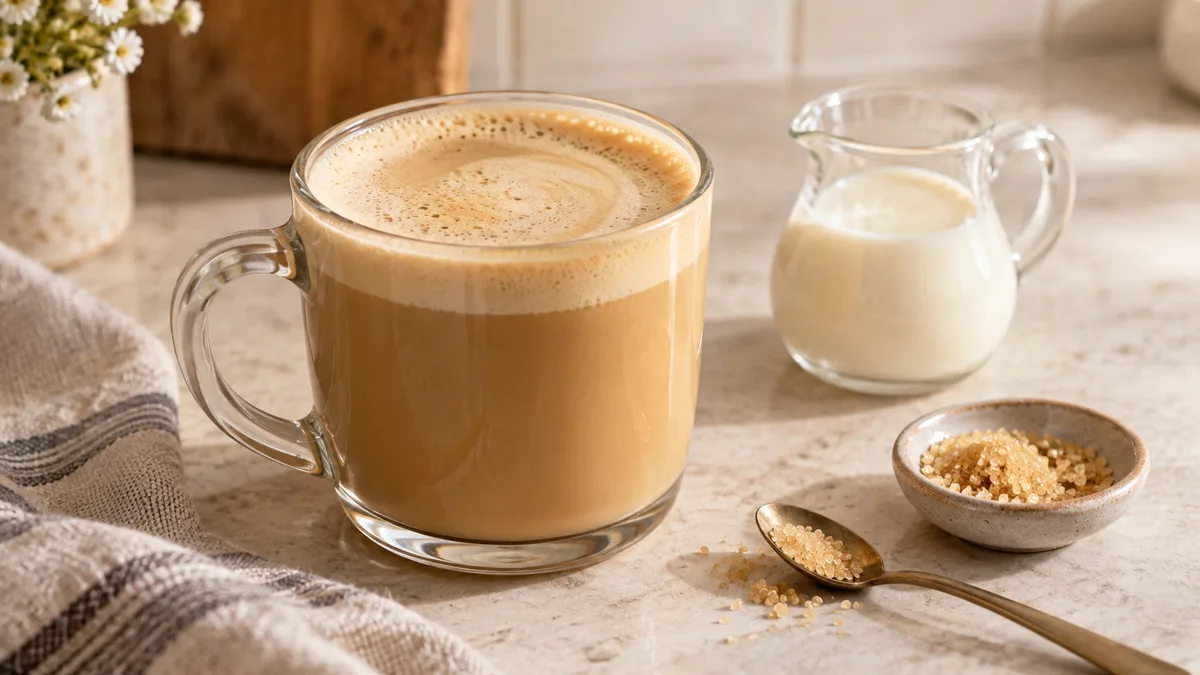
A 300 ml raf has no single calorie value: the café recipe determines it. In our illustrative example, 150 g of 10% cream and 15 g of sugar provide 237 kcal before coffee. Replacing some cream with milk changes that number even with the same cup.
Start with the recipe, then the cup size
To calculate a particular raf, you need the weight and fat content of cream plus the amounts of milk, sugar or syrup. A 300 ml menu description gives the drink or cup size, not those quantities. It does not mean 300 g of cream: coffee and foam occupy space, and the recipe may contain milk or water.
If the café publishes calories per serving, use the figure for the right size and recipe. If it lists values per 100 ml of drink, multiply by the actual serving volume. A per-100-g table combined with a volume in milliliters requires the serving's weight; these are different units.
Without published nutrition, ask: "How many grams of cream and sugar are used in my size?" Knowing that the cream contains 10% fat supplies only one part of the calculation. Without its weight, the result remains approximate. Other drinks are covered in our coffee shop calorie guide.
Verified ingredient values
We will use three specific products for the examples. On October 9, 2026, their manufacturers listed the values below. These are inputs for the calculation; your café may use different products.
| Ingredient | Kcal per 100 g | Kcal per gram |
|---|---|---|
| Domik v derevne 10% cream, 480 g | 118 | 1.18 |
| Domik v derevne 3.2% milk, 1400 ml | 60 | 0.60 |
| Chaikofsky white sugar, 500 g | 400 | 4 |
For these products, base calories = 1.18 × cream grams + 0.60 × milk grams + 4 × sugar grams. Add the calories in the coffee and any other ingredients. Use a syrup's own label: 15 g of syrup is not equivalent to 15 g of sugar.
Examples for 200, 300 and 400 ml cups
The table sets out three illustrative ingredient quantities for different cup sizes. These are neither a raf standard nor a chain's published recipes. The weights are chosen for the example, and the volume after steaming has not been measured. The table calculates cream and sugar separately from coffee.
| Cup | 10% cream | Sugar | Base calculation |
|---|---|---|---|
| 200 ml | 100 g | 10 g | 118 + 40 = 158 kcal |
| 300 ml | 150 g | 15 g | 177 + 60 = 237 kcal |
| 400 ml | 200 g | 20 g | 236 + 80 = 316 kcal |
Coffee also contributes. As a reference, Nespresso lists less than 2 kcal per serving from a non-flavored capsule. Preparing each example with one such serving gives less than 160, 239 and 318 kcal respectively. That reference should not automatically be applied to every café espresso shot.
A larger serving may use a different ingredient ratio, an extra shot or a different syrup dose. Doubling a small raf's calories works only if all ingredients double proportionally. Matching drink color and foam height do not establish that.
Replacing some cream with milk
For the 300 ml cup example, replace 75 g of cream with 75 g of the listed milk. This leaves 75 g of cream and 15 g of sugar. The base gives 88.5 + 45 + 60 = 193.5 kcal, or less than 195.5 kcal with the reference coffee serving. Compared with the all-cream base, the difference is 43.5 kcal.
This compares two defined recipes. Your raf with milk may have different calories, and a barista may use another ratio. Ask for the proportions and product names. For cream with another fat percentage, substitute its label value.
Calculate plant milk using the label on the chosen drink too. "Oat" or "coconut" alone cannot tell you the mixture's calories. See our article on plant milk for composition and product differences.
Raf without added sugar still contains cream calories
Removing 15 g of sugar from the 300 ml example removes 60 kcal, leaving 177 kcal from cream plus coffee. The milk-and-cream version without sugar contains 133.5 kcal plus coffee. Both results apply to the two recipes above.
Ask what the café removes when you request no sugar. If flavor comes from a premixed sweet base, syrup or honey, omitting a separate spoonful of sugar does not describe the whole recipe. Calculate honey and syrup using their calorie values and actual quantities. See the comparison of sugar, honey and syrups.
If the recipe is unavailable, record an approximate estimate and your order details. Picking the first "raf 300 ml" database value can apply another café's recipe to your drink.
What to check before logging
- The size and actual recipe of your raf, including flavored versions.
- The cream weight, fat percentage and whether milk is added.
- The quantity of sugar, syrup, honey and extra toppings.
- Whether published calories refer to the whole serving, 100 g or 100 ml.
Photograph the menu and provide your size in FoodGPT's menu mode. Compare the estimate with café nutrition data when available. A menu photograph helps read the ingredients but cannot reveal an unlisted cream quantity. For orders without published calories, see our separate guide.
Frequently asked questions
- How many calories are in a 300 ml raf?
- You need the café recipe. In an illustrative example, 150 g of 10% cream at 118 kcal per 100 g and 15 g of sugar provide a 237 kcal base plus coffee. This illustrates the calculation, not a universal value for that drink size.
- How many calories are in 200 and 400 ml raf cups?
- Our illustrative quantities give a 158 kcal base from 100 g of cream and 10 g of sugar for a 200 ml cup. For a 400 ml cup, 200 g of cream and 20 g of sugar give 316 kcal. Add coffee calories. Actual café quantities may differ.
- How many calories are in raf without added sugar?
- Cream and milk still contribute calories. In the example with 150 g of 10% cream, removing 15 g of sugar removes 60 kcal, leaving 177 kcal plus coffee. Check for sweet premixes, honey or syrup in the recipe.
- Can I count a 300 ml raf as 300 g of cream?
- No. Cup size does not equal cream weight. Coffee and other ingredients occupy space, and steaming creates foam. Use ingredient weights or published nutrition for the specific serving.
- How do I count raf with syrup?
- Multiply syrup calories per 100 g by the grams added and divide by 100, then add the other ingredients. If the label uses 100 ml, calculate in milliliters. Do not equate syrup weight with sugar weight.
Read next
- Calorie content of coffee shop drinks: where the difference hides — In a coffee shop, calories are often hidden in the cup rather than in the food next to it.
- How to determine the calorie content of a dish if it is not listed on the menu — Menus often list only the name and price.
- Sugar, honey, and syrups: how they actually differ — Honey, maple syrup, and agave syrup are marketed as sugar substitutes.
- Plant-based milk: how it differs from cow's milk — Plant-based beverages replace cow's milk in taste and in coffee, but not in composition.
This article is for general information. It is not medical advice, a diagnosis, or a prescription for treatment or a diet, and it does not replace a consultation with your doctor. If you have a health condition, are pregnant, take medication, or follow a diet prescribed to you, decisions about food belong with your doctor.
Figures from regulations, guidelines and studies are given as they stood when this article was prepared and may since have changed; check them against the primary sources. This article is not advertising, an offer, or individual advice, and neither the author nor the site owner is responsible for decisions taken on the basis of it.