Salmon, chicken or shrimp poke: how to count the whole bowl
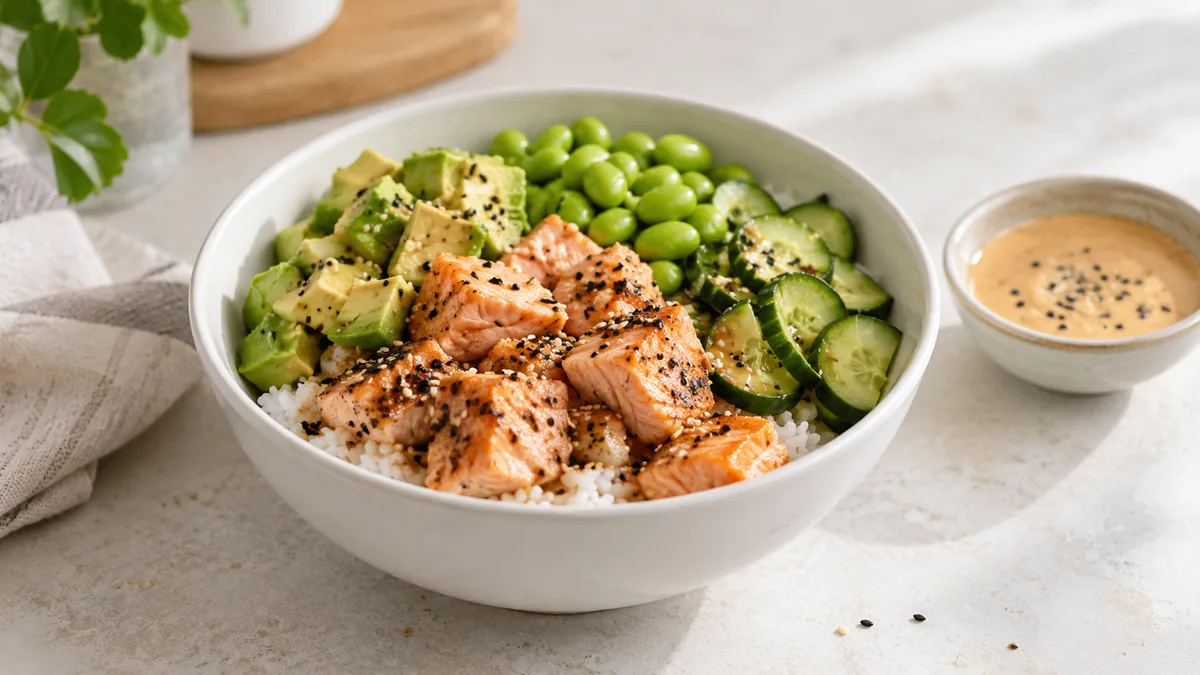
Count poke by adding the ingredients in the whole bowl: the base, fish or meat, vegetables, toppings and sauce. A database entry for “salmon poke, 100 g” only describes its own recipe. At home, build a recipe from your ingredients; at a café, start with the serving weight and the menu information.
Record the ingredients before mixing
Put the bowl on a scale, tare it and add ingredients one at a time. Record rice, the protein component, avocado, vegetables, sauce and toppings separately. This avoids trying to reconstruct their proportions after the bowl is mixed.
For rice, use either dry weight and your actual cooked yield, or cooked weight and a matching database entry. For fish and chicken, specify whether they are raw, cooked or breaded. Add any cooking oil that reached the bowl as a separate ingredient. The guide to counting homemade food explains recipe yields.
Convert dry rice into your cooked portion
The manufacturer lists 351 kcal per 100 g of dry Tilda Pure Basmati. For a worked example, take 100 g of that rice and assume cooking without oil produces 300 g. That yield is an assumption for the example, not a guarantee for every saucepan.
The batch retains the calculated energy of its starting rice: 351 kcal. If your bowl contains 150 g of the 300 g batch, its rice contribution is 351 × 150 ÷ 300 = 175.5 kcal. At home, substitute your measured yield and your own package information.
If you season the batch, add the dressing ingredients before dividing it into portions. Sweetened or oiled rice needs those additions in the recipe. For packaged cooked rice, use its own label rather than the value for dry grain.
Salmon, chicken and shrimp change one line
To compare versions, keep the rice, vegetables and dressing constant. Change the protein ingredient and its weight. Baked chicken, breaded fried chicken and chicken coated in sauce need different entries. Weigh shrimp without the shells when the database entry describes the edible portion.
USDA FoodData Central lists 206 kcal per 100 g for cooked farmed Atlantic salmon. Its roasted skinless chicken breast entry has 165, and cooked shrimp has 99. At 90 g each, those contributions are 185.4, 148.5 and 89.1 kcal respectively. These are specific database entries; they do not automatically include your cooking oil or other additions.
Replacing 90 g of fish with 120 g of chicken changes both the ingredient and the amount. That comparison may describe your order, but it cannot establish that every chicken poke is lighter or heavier than every salmon poke.
Measure the sauce in its stated unit
The checked manufacturer page for Kikkoman Teriyaki Marinade & Sauce lists 20 kcal per 15 ml. One such serving contributes 20 kcal and two contribute 40. This label uses volume: do not automatically treat 15 ml as 15 g.
A mayonnaise dressing needs another calculation. The Kraft Real Mayo label lists 90 kcal per 13 g, so 26 g of that product contributes 180 kcal. These products demonstrate the arithmetic; another recipe or regional package requires its own numbers.
A mix of mayo, water and seasoning does not have the same value as pure mayo. At home, enter the blend as a recipe. At a café, ask for the sauce name or nutrition information. If neither is available, mark the result as an estimate. The sauce calorie guide explains spoonfuls and units.
Add the bowl and check the leftovers
Add 50 g of avocado and 100 g of cucumber, without toppings. The selected USDA entries list 160 kcal per 100 g for avocado and 15 for cucumber with its peel. The selected amounts contribute 80 and 15 kcal.
A bowl with 150 g of the calculated rice, 90 g of salmon, avocado, cucumber and 15 ml of teriyaki totals 175.5 + 185.4 + 80 + 15 + 20 = 475.9 kcal, rounded to 476. With the same amount of chicken it totals 439 kcal; with shrimp, about 380. Using 26 g of mayo instead of teriyaki puts the salmon version at about 636 kcal. The weights are selected for this example; reference values and real labels do not make the total universal for café bowls.
If some food remains, its composition matters. A reasonably even mixture can be divided by weight, but leftover avocado slices do not have the same composition as leftover rice. For an unmixed bowl, estimate the amount eaten from each component separately.
Use the menu at a café; consider raw fish separately
If the café publishes information for the whole serving, use it for an unchanged order. Extra sauce, a larger base or a different topping requires an adjustment. A photo can preserve the visible ingredients and support a rough portion estimate, but cannot reveal hidden oil or the exact rice weight.
Cooked fish or shrimp works for a homemade bowl. FDA guidance explains that freezing does not kill all harmful microorganisms and that cooking is the safer choice. It recommends avoiding raw or undercooked seafood for pregnant people, children and people with weakened immune systems. Lemon dressing alone does not establish that a raw product is safe.
Frequently asked questions
- How many calories are in salmon poke?
- You need the recipe and weight of the actual serving. Add rice, salmon, vegetables, avocado, sauce and toppings; a single number cannot describe every bowl.
- How should I log poke rice?
- Use cooked weight with a matching entry, or calculate from dry rice and the actual cooked yield. Include any rice dressing.
- Can I replace salmon with chicken without recalculating?
- Change the ingredient line to the weight and nutrition of the chicken as served, including any breading and cooking oil.
- How can I count poke without scales?
- Start with the café’s information for a whole serving. Otherwise save a photo, list the ingredients and mark the result as approximate, particularly the base and sauce.
Read next
- How to count calories in homemade food — Processed foods are counted by the label, and restaurant meals by a reference guide.
- Sauce calories: mayo, ketchup, cheese, garlic, and teriyaki by the spoonful — A tablespoon of sauce can add 20 kcal or 90 kcal to a meal.
- How to determine portion size without a scale — Portion weight is the most inaccurate variable in any calculation, including analysis by photo.
- Sushi and roll calories: what is in a set and which rolls are lighter — A piece of a roll or nigiri weighs 20–35 g.
This article is for general information. It is not medical advice, a diagnosis, or a prescription for treatment or a diet, and it does not replace a consultation with your doctor. If you have a health condition, are pregnant, take medication, or follow a diet prescribed to you, decisions about food belong with your doctor.
Figures from regulations, guidelines and studies are given as they stood when this article was prepared and may since have changed; check them against the primary sources. This article is not advertising, an offer, or individual advice, and neither the author nor the site owner is responsible for decisions taken on the basis of it.