Pasta and sauce: why the calories vary so much
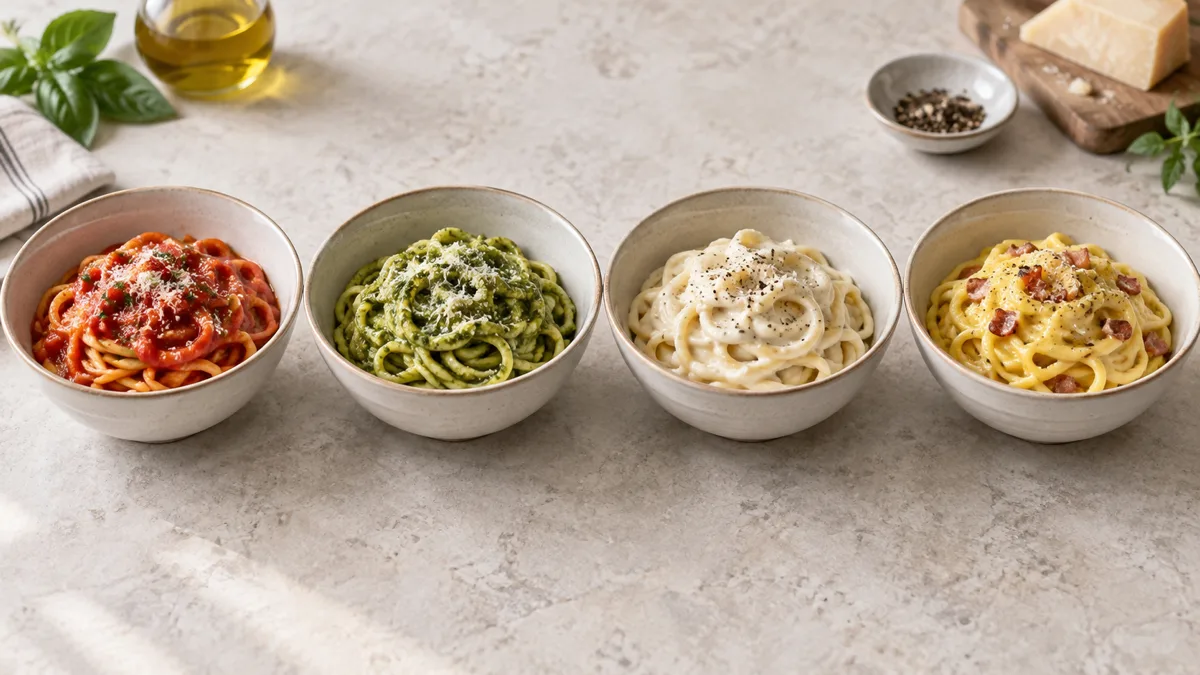
Two plates containing the same amount of pasta can have different calorie totals: tomatoes contribute mostly water, while oil, cream, cheese, and fatty pork provide more energy per gram. The sauce name still does not give you a number. You need the state of the pasta, the actual sauce portion, and the ingredients in that particular recipe.
First establish whether the pasta weight is dry or cooked
A major error can happen before the sauce is counted. In USDA FoodData Central, dry unenriched pasta provides 371 kcal and contains 9.9 g of water per 100 g. The entry for cooked pasta without added salt gives 158 kcal and 62.1 g of water per 100 g.
Cooking did not destroy the calories. Pasta absorbed water, so 100 g of the cooked food contains less dry matter. Do not weigh 100 g of dry pasta, cook it, and log it as 100 g cooked. Use either the dry amount or the cooked amount with the matching database entry. Our guide to raw and cooked weights explains this distinction in detail.
For example, 200 g of cooked pasta using the USDA entry is 158 × 200 / 100 = 316 kcal. That is the base of the plate before oil, sauce, cheese, or other additions.
A sauce name suggests ingredients, not a portion
| Sauce | What changes the calculation most | What you need to know |
|---|---|---|
| Tomato | Oil, cheese, sugar, and how far it was reduced | Sauce weight and the oil used in the recipe |
| Cream sauce | The cream's fat content and amount, butter, and cheese | The specific products and their label values |
| Pesto | Oil, nuts or seeds, and cheese | The serving weight instead of a spoon count |
| Carbonara | Cheese, egg, fatty pork, and rendered fat | The full recipe and the number of servings |
These are not four fixed calorie categories. A tomato sauce made with a generous amount of oil can exceed a small serving of cream sauce. Two jars of pesto, cream sauces with different fat levels, and two restaurant carbonaras need not match either. The name identifies ingredients worth checking; the number must come from the recipe, label, or that restaurant's data.
Count a packaged sauce from its nutrition declaration and the actual serving weight. Our guide to sauce calories includes examples of converting labelled spoonfuls into grams.
Fat changes the total quickly, but you cannot see its amount
Under Annex XIV of Regulation (EU) No 1169/2011, fat contributes 9 kcal per gram. Thus 5 g of oil adds 45 kcal, 15 g adds 135 kcal, and 30 g adds 270 kcal. This explains why the amounts of oil, cheese, and cream matter; it does not let you measure them from a photograph.
For a transparent example, take the same 200 g of cooked pasta. FoodData Central lists canned crushed tomatoes at 32 kcal per 100 g. Add 150 g of these tomatoes and 5 g of oil:
- pasta: 158 × 200 / 100 = 316 kcal;
- tomatoes: 32 × 150 / 100 = 48 kcal;
- oil: 5 × 9 = 45 kcal;
- whole plate: 316 + 48 + 45 = 409 kcal.
This is a calculation for stated ingredients, not an average for “pasta with tomato sauce.” Another 10 g of oil would raise the total by 90 kcal; cheese, meat, and sugar belong on separate lines.
Count the whole recipe at home
- Weigh the dry pasta. Use the nutrition declaration on its package. Cooking water adds no calories.
- Record every sauce ingredient. Count oil, cream, cheese, nuts, eggs, meat, and tomatoes in the amounts actually used.
- Add the ingredient calories. If some rendered fat or sauce remains in the pan, do not invent a deduction unless you measure it.
- Weigh the finished dish. Calories per 100 g equal the recipe total divided by finished weight and multiplied by 100.
- Weigh your portion. Multiply the per-100-g value by serving weight and divide by 100.
Suppose the package values and ingredient weights put the full recipe at 1,355 kcal and it weighs 900 g after mixing. It then contains 1,355 / 900 × 100 = 150.6 kcal per 100 g, and a 300 g serving contains 451.7 kcal. The full method appears in our guide to calories in homemade food.
Keep the uncertainty visible in a restaurant
For restaurant pasta, you usually do not know the dry pasta amount, grams of oil, sauce formula, or weight of the cheese added at the pass. A universal carbonara or pesto figure creates false precision. Start with the restaurant's nutrition information when it publishes one, then check that it applies to your serving and includes cheese and extras.
When no data are available, record the plate size, sauce style, visible cheese, and fraction eaten. A photograph preserves those details but cannot reveal oil inside an emulsion. Use a range or choose a comparable dish with similar ingredients and weight. The limits are covered in our guides to restaurant calories and delivery food calories.
A short rule for your food log
Treat pasta and sauce as two parts of one entry. Record whether the pasta weight is dry or cooked; for the sauce, enter its actual weight or a share of the calculated recipe. Do not hide oil, cheese, or garnish inside the dish name. Tomato, cream, pesto, and carbonara will then differ according to what reached the plate, rather than an average borrowed from somebody else's recipe.
Frequently asked questions
- Should I count pasta dry or cooked?
- Either works if the weight matches the database entry. For a homemade recipe, it is usually easiest to weigh the dry pasta and use its package values; a cooked serving can be logged with a cooked-pasta entry.
- Which pasta sauce has the fewest calories?
- The name alone cannot answer that. A tomato base contains plenty of water, but oil, cheese, and serving size can change the result. Compare specific recipes or labels at the same weight.
- How many calories does oil add to a sauce?
- Fat contributes 9 kcal per gram: 5 g of oil adds 45 kcal, 10 g adds 90 kcal, and 15 g adds 135 kcal to the plate or recipe receiving that amount.
- How do I count pasta with sauce at a restaurant?
- Look first for the restaurant's data for that serving. If none exist, save the photo and ingredients, estimate pasta and sauce separately, and retain a range because hidden oil and the precise recipe cannot be measured by sight.
Read next
- Raw or cooked weight: how to count grains, pasta, and meat — "100 g of buckwheat" can mean 346 kcal or 92, depending on the state of the grain.
- How to count calories in homemade food — Processed foods are counted by the label, and restaurant meals by a reference guide.
- How to count calories in a restaurant and with food delivery when there is no recipe — A home-cooked meal can be calculated by its ingredients, and packaged food can be checked on the label.
- Sauce calories: mayo, ketchup, cheese, garlic, and teriyaki by the spoonful — A tablespoon of sauce can add 20 kcal or 90 kcal to a meal.
This article is for general information. It is not medical advice, a diagnosis, or a prescription for treatment or a diet, and it does not replace a consultation with your doctor. If you have a health condition, are pregnant, take medication, or follow a diet prescribed to you, decisions about food belong with your doctor.
Figures from regulations, guidelines and studies are given as they stood when this article was prepared and may since have changed; check them against the primary sources. This article is not advertising, an offer, or individual advice, and neither the author nor the site owner is responsible for decisions taken on the basis of it.