Mashed potato calories: what milk, butter and cream add
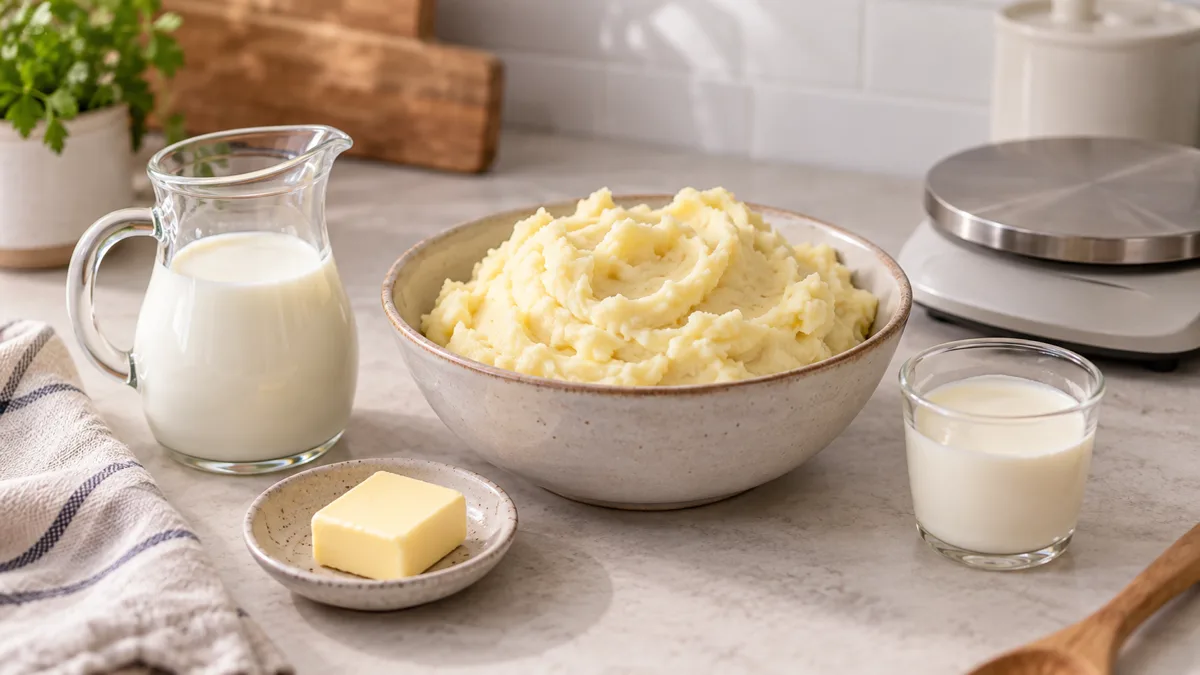
Mashed potatoes do not have one calorie value. A reference estimate of 110 kcal per 100 g can suit a typical batch made with milk and butter, but your recipe depends on the grams of each ingredient and the final weight of the mash. As a guide, 10 g of butter adds about 72 kcal, 100 g of whole milk adds 61 kcal, and 100 g of heavy cream adds 340 kcal to the batch.
A reference value is an estimate; the recipe gives the answer
The FoodGPT calorie table lists mashed potatoes at 110 kcal per 100 g for a version made with milk and butter. This is a midpoint for estimating someone else's serving, not a standard home recipe.
Two bowls can look alike while one was mashed with water and the other contains cream and a large piece of butter. For food you make yourself, add the calories in the ingredients and divide them by the cooked batch weight.
How many calories each ingredient adds
The examples below use reference entries from USDA FoodData Central: boiled potato flesh without skin or salt (FDC 170440), 3.25% whole milk (FDC 171265), butter (FDC 173430), and heavy whipping cream (FDC 170859). Values on a carton or wrapper can differ, so use the product label when calculating your own batch.
| Ingredient | Reference per 100 g | Calories in the stated amount |
|---|---|---|
| Boiled potatoes | 86 kcal | 800 g = 688 kcal |
| Water | 0 kcal | 120 g = 0 kcal |
| Whole milk, 3.25% | 61 kcal | 120 g ≈ 73 kcal |
| Butter | 717 kcal | 30 g ≈ 215 kcal |
| Heavy cream | 340 kcal | 120 g = 408 kcal |
Milk and cream join the potatoes in the total batch weight. Water increases the weight too, even though it adds no calories. This is why simply adding butter to a reference value of 110 kcal does not work: calculate the whole batch first.
An exact example with milk and butter
Suppose the mash contains 800 g of boiled potatoes, 120 g of whole milk, and 30 g of butter. Using the values above:
- potatoes: 800 × 86 ÷ 100 = 688 kcal;
- milk: 120 × 61 ÷ 100 = 73 kcal;
- butter: 30 × 717 ÷ 100 = 215 kcal.
The batch contains 976 kcal. After mixing, it weighs 920 g without the pan. Its calories per 100 g are:
976 ÷ 920 × 100 = 106 kcal.
A 200 g serving contains 212 kcal in this example. If your cooked batch does not weigh 920 g, replace that number with the weight from your scales.
What water, milk, butter and cream change
To isolate the additions, keep the same 800 g of potato and assume each finished version weighs 920 g. These rows demonstrate the arithmetic; they are not four universal recipes.
| Additions | Calories per batch | Calories per 100 g | Calories per 200 g |
|---|---|---|---|
| 120 g water, no butter | 688 | 75 | 150 |
| 120 g water + 30 g butter | 903 | 98 | 196 |
| 120 g milk + 30 g butter | 976 | 106 | 212 |
| 120 g cream + 30 g butter | 1,311 | 143 | 285 |
The comparison shows how the ingredients affect calories when the finished weights are equal. In a kitchen, those weights may differ: some water evaporates, and a looser mash contains more moisture. Do not copy 75, 106, or 143 kcal to a different recipe without recalculating it.
Why the final weight matters
The calories in potatoes, milk, and butter add together. Water may evaporate or remain in the mash. That does not change the total calories in the batch, but it does change the figure per 100 g.
For example, the same 976 kcal works out to 115 kcal per 100 g when the batch weighs 850 g, and 98 kcal per 100 g when it weighs 1,000 g. The difference comes from the amount of water in each 100 g, not from calories disappearing.
The guide to raw and cooked food weights explains this in more detail.
How to calculate your mashed potatoes
- Weigh the potatoes after boiling and draining. Use a database entry for boiled potatoes or the entry you selected in your food log.
- Weigh milk, butter, cream, and other additions. A spoonful or a piece of butter can vary too much; use grams.
- Add the calories in every ingredient. Salt and water add no calories, but water affects the finished weight.
- Weigh the finished mash without the pan. Divide the batch calories by this weight and multiply by 100.
- Weigh your serving. Multiply the per-100-g value by the serving weight, then divide by 100.
The general method is covered in the guide to counting calories in homemade food. If someone else made the mash and you do not know the recipe, use 110 kcal per 100 g as an estimate rather than presenting it as an exact measurement.
Frequently asked questions
- How many calories are in 100 g of mashed potatoes?
- FoodGPT uses 110 kcal per 100 g as a reference for mashed potatoes made with milk and butter. A homemade batch depends on the amounts of milk, butter, or cream and on its final weight, so calculate the whole recipe for a closer figure.
- How many calories does butter add to mashed potatoes?
- At the reference value of 717 kcal per 100 g, each 10 g of butter adds about 72 kcal to the batch, and 30 g adds about 215 kcal. The increase per 100 g of mash depends on the finished batch weight.
- Which has more calories in mashed potatoes, milk or cream?
- The cited FoodData Central entries list whole milk at 61 kcal and heavy cream at 340 kcal per 100 g. Use the value on your product label and the weight you actually added.
- Does water add calories to mashed potatoes?
- No, but it increases the weight. If the water remains in the mash, there are fewer calories per 100 g; if it evaporates, there are more calories per 100 g. The total calories from the ingredients do not change.
Read next
- How to count calories in homemade food — Processed foods are counted by the label, and restaurant meals by a reference guide.
- Raw or cooked weight: how to count grains, pasta, and meat — "100 g of buckwheat" can mean 346 kcal or 92, depending on the state of the grain.
- How to determine portion size without a scale — Portion weight is the most inaccurate variable in any calculation, including analysis by photo.
- How many calories does frying add — The cooking method adds more calories to a dish than any choice between "healthy" and "unhealthy" foods.
This article is for general information. It is not medical advice, a diagnosis, or a prescription for treatment or a diet, and it does not replace a consultation with your doctor. If you have a health condition, are pregnant, take medication, or follow a diet prescribed to you, decisions about food belong with your doctor.
Figures from regulations, guidelines and studies are given as they stood when this article was prepared and may since have changed; check them against the primary sources. This article is not advertising, an offer, or individual advice, and neither the author nor the site owner is responsible for decisions taken on the basis of it.