How many calories are in varenye: classic, five-minute and lower-sugar
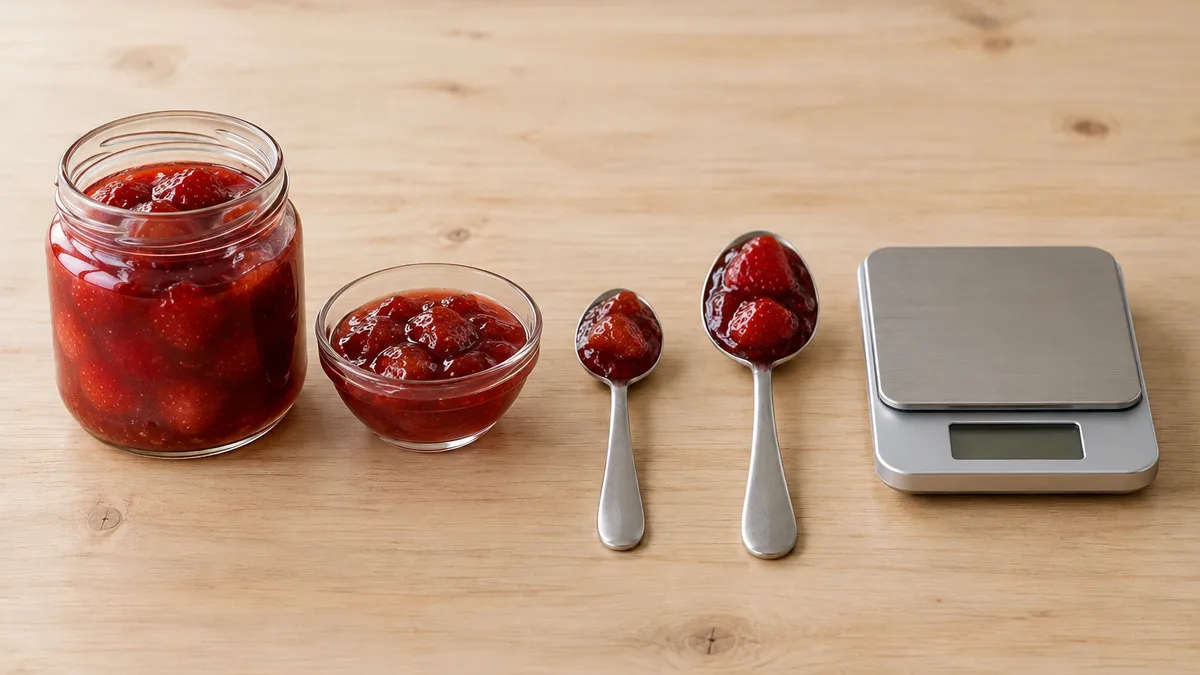
The FoodGPT reference card lists varenye, the Russian whole-fruit preserve, at 271 kcal and 65 g of sugar per 100 g. A teaspoon weighs about 12 g and has 33 kcal; a heaped tablespoon about 35 g and 95 kcal. A home batch can differ noticeably: the figure depends on how much sugar went in and how much water boiled off.
When a reference value is enough
The FoodGPT reference card for varenye lists 271 kcal per 100 g. It is a guide for the classic preserve made from equal weights of fruit and sugar, and for when the recipe is unknown: varenye at a friend's place, from a market, in a jar with no label.
In USDA FoodData Central the entry for jams and preserves (FDC 169641) is close: 278 kcal and 68.9 g of carbohydrate per 100 g. A shop-bought jar has its exact calories printed on the label, and the label matters more than any reference.
Where the calories in varenye come from
Almost all of them come from sugar. Take the classic recipe: a kilogram of strawberries and a kilogram of sugar. The values are from FoodData Central: granulated sugar (FDC 169655) has 387 kcal per 100 g, strawberries (FDC 167762) have 32 kcal and 4.9 g of sugars.
- sugar: 1,000 × 387 ÷ 100 = 3,870 kcal;
- strawberries: 1,000 × 32 ÷ 100 = 320 kcal.
The pot holds 4,190 kcal, and 92% of it came from sugar. The berries add flavour, colour and a little sugar of their own, about 49 g per kilogram.
Boiling neither adds nor removes calories: only water evaporates. What changes is the weight of the finished preserve, and with it the calories in every 100 g. If the batch in this example boils down to 1,550 g:
4,190 ÷ 1,550 × 100 = 270 kcal per 100 g, with about 68 g of sugar.
That is the reference figure: the classic ratio of a kilogram of fruit to a kilogram of sugar gives about 270 kcal, and two thirds of the weight is sugar.
Classic, five-minute, half the sugar
Keep the same kilogram of strawberries and change only the sugar and the cooking time. The finished weight here is an example: yours will differ depending on the fruit, the pot and the heat.
| Version | Finished weight | Kcal per 100 g | Sugar per 100 g | Kcal in a 35 g tablespoon |
|---|---|---|---|---|
| 1 kg sugar, long boil | 1,550 g | 270 | 68 g | 95 |
| 1 kg sugar, five-minute | 1,850 g | 226 | 57 g | 79 |
| 500 g sugar, five-minute | 1,350 g | 167 | 41 g | 58 |
The five-minute batch with the same sugar is lighter per 100 g only because more water stays in it. The pot holds exactly as many calories, they are just diluted: eat the whole batch and you get the same 4,190 kcal.
Only the amount of sugar changes the figure noticeably. Half the sugar of the classic ratio removes 1,935 kcal from the pot, almost half.
What a spoon and a small dish weigh
According to the FoodGPT weights and measures card for varenye, a teaspoon holds about 12 g and a slightly heaped tablespoon about 35 g. The USDA entry gives a tablespoon as 20 g. The two differ almost twofold: spoons come in different sizes, and everyone heaps varenye differently.
| Measure | Weight | Kcal at 271 per 100 g | Sugar |
|---|---|---|---|
| Teaspoon | 12 g | 33 | 8 g |
| Tablespoon, USDA | 20 g | 54 | 13 g |
| Heaped tablespoon | 35 g | 95 | 23 g |
The small glass dishes varenye is served in have no standard size: a small one holds a couple of spoonfuls, a large one five or six. It is more reliable to put your own dish on the scales once, tare it and add varenye the way you usually do.
The WHO advises keeping free sugars below 10% of energy intake, which is about 50 g on a 2,000 kcal day. Sugar added to varenye counts as free sugar. A heaped tablespoon provides about 23 g, a teaspoon about 8 g.
Varenye, jam and confiture: the difference
Each of the three has its own interstate standard in Russia and neighbouring countries, and they differ in texture and in the minimum share of soluble solids. In these products the soluble solids are mostly sugars, so the threshold shows how sweet the product is at the least.
| Product | What it looks like | Soluble solids, at least |
|---|---|---|
| Varenye | Whole or cut fruit in a thick syrup that is not jellied | 63% when sterilised; 55% is the recommended figure for the "homemade" style |
| Jam | A spreadable jellied mass with pieces of fruit | 60%, and 68% for cherry, plum, blackcurrant and a few others |
| Confiture | A spreadable jellied mass with fruit distributed through it | 50% |
The sources are the texts of the standards: GOST 34113-2017 "Varenye", GOST 31712-2012 "Jams" and GOST 34447-2018 "Confitures".
Under its standard, confiture can be noticeably less sweet than varenye, but it does not have to be: 50% is a lower limit, not an average. The calories of a particular jar are still read from its label.
If you want varenye with less sugar
The most direct way is to use less sugar: in the example above, half the sugar lowers the value from 270 to 167 kcal per 100 g. Sugar in varenye also makes it thick and keeps it, so for a lower-sugar batch use a tested recipe that says how to store it.
The second way is a smaller serving with the same recipe. A teaspoon with your tea instead of a heaped tablespoon is 33 kcal instead of 95.
The third is varenye made with sweeteners. What these substances are and how they differ is covered in the article on sweeteners. Jars labelled "no sugar" are worth turning over to read the ingredients: fruit juice concentrate is sugar too, under another name. How such names look on a label is collected in the article on hidden sugar.
How to count your own varenye
- Weigh the fruit and the sugar before cooking. The calories of the whole pot are the sugar plus the fruit; nothing else counts.
- Weigh the empty jars, then the filled ones. The difference is the finished weight.
- Divide the calories by the finished weight and multiply by 100. That is your varenye's calories per 100 g.
- Weigh your spoon or dish once. From then on that figure is enough.
The general method for any dish is in the article on counting calories in home cooking, and how the sugar in varenye compares with honey and syrups is covered in the article on sugar, honey and syrups.
Frequently asked questions
- How many calories are in a spoonful of varenye?
- A teaspoon weighs about 12 g and has about 33 kcal; a heaped tablespoon about 35 g and 95 kcal. That is at the reference 271 kcal per 100 g; varenye with less sugar comes out lower.
- How much sugar is in varenye?
- With the classic ratio of a kilogram of fruit to a kilogram of sugar, about 65–68 g per 100 g, or two thirds of the weight. The exact figure depends on how much sugar went in and how much water boiled off.
- Is five-minute varenye lower in calories than regular?
- Per 100 g, yes, if it cooked for less time and kept more water: in the article's example 226 kcal against 270 with the same sugar. But the whole pot holds the same calories, just diluted. Only using less sugar lowers the value noticeably.
- How is varenye different from jam and confiture?
- In texture and in the minimum share of soluble solids set by their standards. In varenye whole or cut fruit sits in a thick syrup, while jam and confiture are spreadable jellied masses. The threshold is 63% for sterilised varenye, 60% for most jams and 50% for confiture.
- Can I eat varenye if I have diabetes?
- That is for you and your doctor to decide: a heaped tablespoon has about 23 g of sugar, and how such a serving fits your meal plan depends on your treatment. The article helps count the serving but does not replace that conversation.
Read next
- How to count calories in homemade food — Processed foods are counted by the label, and restaurant meals by a reference guide.
- Sugar, honey, and syrups: how they actually differ — Honey, maple syrup, and agave syrup are marketed as sugar substitutes.
- Hidden sugar: under what names it appears in ingredients — The word "sugar" appears in ingredients less often than sugar itself does in a product: it has a dozen legal names, and the manufacturer has every right to use any of them.
- Artificial sweeteners: are they harmful, and do they help you lose weight? — Arguments about sweeteners are conducted as though the choice were between them and plain water.
This article is for general information. It is not medical advice, a diagnosis, or a prescription for treatment or a diet, and it does not replace a consultation with your doctor. If you have a health condition, are pregnant, take medication, or follow a diet prescribed to you, decisions about food belong with your doctor.
Figures from regulations, guidelines and studies are given as they stood when this article was prepared and may since have changed; check them against the primary sources. This article is not advertising, an offer, or individual advice, and neither the author nor the site owner is responsible for decisions taken on the basis of it.